Earth’s Rotation Day 2026 : A look at climate change
|


Dr Naorem Munal
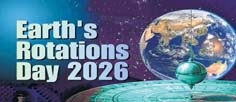
January 8th was Earth’s Rotation Day. This day commemorates the anniversary of French physicist Leon Foucault’s 1851 public demonstration that the Earth rotates on its axis using a pendulum.
This day serves to appreciate the fundamental scientific principles that govern our planet’s movement and its impact on the environment. The day also reminds us of the fundamental force behind day and night, shaping life’s rhythms and the pivotal role in our existence.
Earth’s rotation and climate change are interconnected: melting ice sheets and sea-level rise from global warming redistribute mass, affecting Earth’s spin via conservation of angular momentum.
Conversely, shifts in atmospheric and oceanic patterns like El Nino Southern Oscillation linked to climate change can also alter Earth’s rotation, creating feedback loops, with length of day variations serving as climate indicators, potentially predicting extreme weather events, though CO2 impacts remain dominant. These continued warming along with astronomical tidal forces, post glacial rebound processes and anthropogenic climate change influenced the Earth’s rotational rate.
Earth is oblate, meaning the surface at the equator is 21.5 km farther from the centre of the planet than the surface at the poles. As climate change melts the polar ice caps, meltwater moves from the poles to the equator via the ocean, slowing Earth’s rotation, lengthening the day and causing polar wander. Rising sea levels mean water is farther from the surface and just like the ballerina moving their arms back out, it aids Earth’s rotation slowdown. Redistribution of Earth’s mass changes our rotation in similar ways, including by earthquakes.
Climate-driven changes in atmospheric circulation e.g., Hadley Cells can exchange momentum with the solid Earth, altering rotation and potentially causing equatorial super-rotation with increased warming. Climate change also influences Earth’s rotation by depleted groundwater.
The tidal force of the Moon on the Earth can slow down the Earth’s rotation, forming a ‘locked’ synchronization phenomenon, resulting in an increase in the length of the day and a decrease in the number of days in the year.
Two fluid structures, the oceans and atmosphere envelope the solid Earth. A rotating fluid generates inertial waves that flow inside the fluid, not on the surface. The Earth’s rotation has a dominant role in climate dynamics because it causes the inertial waves. Every ten years or so, the Earth’s rotation rate increases or decreases significantly by between three and five milliseconds.
When, on a decadal basis, the Earth’s rotation rate increases, the Earth warms globally; when the rate decreases, the Earth cools.
The earth’s rotation causes the important environmental consequences. It causes the tides- twice daily rise and fall of sea level. Tides are complicated because they are the result of both the gravity of the moon and the sun. The Coriolis force also increases atmospheric angular momentum that can alter the fundamental circulation of the Earth’s rotation with reducing surface torques.
Winds in Earth’s atmosphere are also the biggest influencer on the length of each day as a result of their collisions with the land surface, particularly when they hit mountain ranges. Incredible as it may sound, wind actually slows the spin of the Earth this way. The Earth’s rotation is responsible for the Coriolis Effect, which is the defection of air currents. Air gets deflected to the right (clockwise) in the Northern hemisphere and to the left (anticlockwise) in the Southern hemisphere causing the Trade winds.
The rotation of the Earth is a charismatic phenomenon which influences climate patterns and provides the basis for the day-to-day calendar. Earth revolves at around 1,525 feet per second, which creates the average 24-hour rotation cycle that distinguishes day from night.
Earth’s Rotation Day is a way to appreciate the beauty and complexity of our planet’s mechanism shaping our day-to-day life. Let Earth’s Rotation Day be a reminder to cherish our planet and strive to preserve its delicate balance for the generations to come.
The writer is an environmentalist, presently working as DFO/Chandel, email- [email protected]