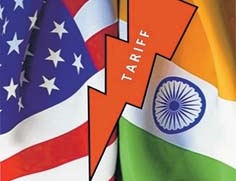
Can the Elephant withstand Trump’s tariff and other Tsunami ?
|


Brigadier (Retired) L Ibotombi Singh
(The 30 percent tariff on US pulses imposed by India since 01 Nov last year is a welcome step, due to which a ripple effect was felt recently in Washington, whereby two republican Senators have urged US president Donald trump to intervene on the ground of ‘unfair’ and harmful to US farmers).
In 2024, bilateral trade between India and the US stood at approximately $212bn, with a trade gap of about $46bn in India’s favour. After assuming as President of the United States for the second term, India-US trade ties seemed to be heading in a positive direction with Trump and Modi agreeing to increase bilateral trade to $500 billion by 2030 during their meeting in February 2025. However, it all started during operation ‘Sindoor,’ India’s precision missile attacks on nine terror infra- structure and terror launch pads in Pakistan. The pro-active response by India against Pakistan, led to four days short standoff air warfare during which over 110 fighter jets of both the countries were involved, one of the biggest air battles in decades. As per Washington, India was inches away from sparking a nuclear showdown with Pakistan, but Trump stepped in not because he cared about peace, but because he wanted to take credit for preventing a world crisis, as Trump ran his whole election campaign on being the only US President in decades who never started a war. He boosted Wall Street, kept investors happy and bragged about peace.
So, when the Indo-Pak tension boiled over, he saw a chance to shine. Trump tried to position himself as the global peacemaker, the guy who stopped millions from being caught in nuclear destruction. Pakistan actually praised him, even nominated him for a Nobel Prize. India’s refusal to accept Trump’s claim that he “solved” the conflict and avoided a nuclear war seems to have provided the real trigger for the spike in Trump’s economic tsunami.
Beginning of Trump’s Economic Tsunami against India
As per Trump, should India and Pakistan not agree to a ceasefire, he threatened with a brutal sanction with high tariff, which resulted in an abrupt ceasefire on May 10 last year. However, India’s stand is that it was a bilateral agreement leading to ceasefire post telephone call by the Director General of Military Operations of Pakistan to his counterpart in New Delhi. This led to Indian journalists running anti Trump stories.
Donald trump has repeatedly claimed that Indian fighter jets were shot down, figures varying from five to eight, implying Pakistan was behind it. France's Air Chief, General Jerome Bellanger says three jets were downed, which was confirmed by India's CDS, but no clear numbers were given. This explosive claim has sparked outrage in India's political circles. However, New Delhi officially remained completely silent about the losses of jets and did not give credit to Trump for stopping the conflict. Now, it is a foreign policy minefield for India with no easy exit and looks cornered. It is a “Catch 22” situation for India, if New Delhi admits Trump's claim as true, it could spark National outrage and force internal investigations. And if India calls Trump a liar, it risks a full-blown diplomatic conflict with the US either way, it's a political nightmare.
Either side with the US and risk upsetting Russia and China or stand firm and face US sanctions and pressure. Since then, the diplomatic war between Trump and India began, which blew up at the G7 summit as Trump wanted to meet India’s Prime Minister, but Modi refused and that was the final straw. But this incident runs deeper than personal ego leading to economic tsunami. Trump started hitting India where it hurts. First, he told Elon Musk not to invest in India. India's stock market tanked, billions lost in weeks. Under the garb of India’s policies as overly protectionist, Trump imposed 25 per cent tariffs on Indian goods on August 01 last year. Then came targeting the Indians by openly dictating major companies based in the US not to hire Indians, any American company hiring foreign workers on H1B visa will have to pay $100,000 (88 lakh rupees) every year to the US Government in the form of a fee, not one time, but every single year.
In a major strategic shift, the Trump administration has pursued a rapprochment with Pakistan, hosting its leadership and exploring crypto and mineral deals, which India views as a pressure tactic against its own security interests. Trump has authorized the deportation of Indian Nationals who entered the US illegally, with some being returned via military transport aircraft in early 2025. Then came the oil war in which Trump told India, stop buying oil from Russia, and India refused. His decision to double the Indian tariff, 50 percent, effective from August 27th last year due to its purchase of Russian oil is, however, hard to explain. By that logic, his administration should have imposed higher tariffs on several other countries, starting with China, which is by far the biggest buyer of Russian crude. Yet it has not done, and the Trump administration seems fairly confident that it can secure a trade deal with Beijing.
A key reason for the draconian tariff hike, though, according to a New York Times report, was Trump’s anger at Delhi dismissing his claims of brokering peace in the fierce four-day May 2025 conflict between arch-foes India and Pakistan.
What Next ?
The final nail in the coffin came up in August last year, when Donald Trump called Modi four times and he flat out refused to take the calls. This came out in a German newspaper Frankfurter Allegmeine, which Trump took as a humiliation and has not taken lightly. He's preparing retaliation. Washington is not issuing threats, but now executing threats in high stakes new version of global diplomacy wherein Trump will eventually run out of options. But in the short term it will impact New Delhi, which are: -(a) He has given clearance to a Lindsay Graham US Senator pushed Bill which is called the Russian sanctions Bill which will increase sanctions to at least 500% relative to the value of such goods and services on trade partners of Russia that deal in petroleum and uranium. As per US Media, the Senate could vote on this at the earliest, though this sounds unlikely, but under Trump, it's not impossible. And at 500%, Indian exports to the US become almost impossible. Pharma, IT services, textiles, steel, auto parts, all at risk. This signals a shift to economic Nationalism. As markets hate uncertainty, actual impact is the Nifty50 index going down by almost 2.73% in the last few days and value of dollar pegged at Rs 91.71 and is expected to trade at Rs 98.93 by end of this quarter, according to trading Economics Global macro models and analysts’ expectations.
(b) On 12 January 2026 Trump said he will slap 25 percent tariff on any country doing business with Iran, leading to New Delhi’s strategic withdrawal from Iran’s Chabahar port thereby $120 million of Indian taxpayers’ money had ‘gone up in smoke.’
(c) Trump’s recent warnings to Apple CEO Tim Cook against expanding manufacturing operations in India also suggest that he will not respond favorably to any efforts by US firms to shift manufacturing to India.
(d) Out of sheer frustrations, reports suggest Trump might even raise the Kashmir issue. He could declare that Kashmir must be freed or say America won't recognize India's control. That alone could shake Delhi to its core.
(e) Another area which Trump may prop up is to accuse India for poor human rights records in the field of freedom of expression and media, religious freedom, civil society restrictions, Govt accounta- bility, regional conflicts etc.
(f) To support claim about Indian fighter jets have been destroyed, Trump may spill every secret, every classified piece of intelligence gathered by his agencies about what went down ie all data, pilot names, hospital records, images etc. thereby, drop a bombshell revelation. Meanwhile, Russia keeps warning that a political shakeup might be on the horizon for India. And if that's true, then this story is just beginning. America could ban Indian leaders, block Indian businesses, shut down visas, cut remittances, and even push Europe to sanction India.
Dragon-Elephant Tango
Despite India having deep-seated military and security concerns over its border dispute with China, Trump’s tough stance has pushed India to mend ties with rival Beijing, the world’s second-largest economy and New Delhi’s second largest trading partners with a bilateral trade of around $136bn. Increased trade with China could help stabilize India’s economy amid tariff threats from Washington, especially if it can increase its raw materials exports to China. India’s re-engagement with China started when Modi and Xi met briefly on the sidelines of the BRICS summit held in Kazan, Russia, in October 2024, followed by Defense Minister Rajnath Singh’s visit to Shanghai in June 2025.
On August 30th last year, India’s Prime Minister paid his first visit to China in seven years, meeting President Xi Jinping on the sidelines of the Shanghai Cooperation Organisation (SCO) summit in Tianjin in what seemed to signal a thaw in relations between the two Asian giants. The meeting was cordial, with both heads of State expressing the wish that their countries become partners rather than rivals.
By attending the SCO summit, Modi also raised the chances that Beijing will support India’s presidency of BRICS, which now has been officially fructified from January 01st this year. Further, Chinese Foreign Minister Wang Yi visited New Delhi in August 2025, during which he attended the 24th round of the Special Representatives Dia- logue on the boundary question.
Despite recent developing bonhomie, New Delhi’s deep-rooted concerns about the challenges Beijing poses to India’s economic and national security means that cooperation will remain limited. This is proven by the fact that on January 12 Chinese Foreign Ministry reaffirmed its territorial claims over the Shaksgam valley, an area of 5180 sq km illegally ceded to China by Pakistan in 1963, in the backdrop of Indias objection, stressing that the Chinese infrastructure projects in the area are beyond reproach, the same day a Chinese communist party delegation met with senior BJP leaders at its party office in New Delhi.
In 2024-25, India ran a massive $99.21 billion trade deficit with China, which includes imports in a variety of sectors that are critical to the Indian economy. Further, too much economic cooperation with China could very well result in the Indian market being flooded with Chinese imports. Additionally, China may not seek to cooperate with India given its ambitions to play a greater role in manufacturing and supply chains, in which China currently dominates. Whether China will play ball with India depends on decisions made in Beijing, which are highly strategic and often only made in their own best interest.
Way Ahead to Deflect Trump’s Tsunami
India has shown significant economic resilience and a strong commitment to its strategic autonomy, making it unlikely to simply "bend to pressure" from potential US tariffs. While tariffs do impact key export sectors, India should actively implement counter measures like market diversification and more domestic reforms, besides free trade agreement and favourable trade negotiations with the UK, the EU, New Zealand, Peru, and Oman, and deepen existing trade agreements with Chile, Australia and ASEAN. India must also strengthen ties with other members of the BRICS bloc, boost bilateral trade with Brazil and resume talks with South Africa and other African Nations. Considering the fact that about 18 percent of India’s exports go to the US and about 15 percent of India’s imports come from China, above efforts may marginally reduce dependence on the two great powers.
Simultaneously New Delhi must use personal diplomacy to protect from Washington’s protectionist impulses. Ultimately, while the tariffs create economic challenges for specific industries, India's proactive and independent approach indicates a strategic resolve to protect its National interests rather than simply bowing to external pressure. The 30 percent tariff on US pulses imposed by India since 01 Nov last year is a welcome step due to which a ripple effect was felt recently in Washington, whereby two Republican Senators have urged US president Donald trump to intervene on the ground of ‘unfair’ and harmful to US farmers.