A century-old coin : The British halfpenny of 1925
|


S Balakrishnan
A hundred-year-old coin is not a big deal in numismatic world because I myself have a 1000-year-old coin of a Chola king from Tamil Nadu. But when I found this ½ penny British coin issued exactly a hundred years ago in 1925, I felt like delving deep into its history, of course by diving deeper with the help of AI. Besides knowing about this coin itself it is more interesting to know about the person whose image it carries, that of King George V; but first the facts about the ½ penny coin and then the interesting titbits about the person himself.
The halfpenny coin is a round coin issued between 1925 and 1927 during the reign of King George V (1910 to 1936). This “standard circulation coin” of ½ penny (abbreviated as ½d), was worth 1/480 of the then prevailing Pound Sterling of the pre-decimalization system. Struck in bronze (95.5% copper, 3% tin, 1.5% zinc), it weighs 5.67 grams, has a diameter of 25.5mm and thickness of 1.4mm. The edge of the coin is smooth plain; the Royal Mint, London, minted 1,22,16,123 halfpenny coins. The 1925 die had two varieties with two different portraits of the king. Hence they are coded as KM#809 (1st portrait of the king) and KM#824 (2nd modified/re-cut portrait). But the differences are so minute that it is for the professional numismatists to break their head about. Though these large size halfpenny coins were associated with good luck traditions, they found themselves demonetized on 31 July 1969 as a step towards decimalization that was introduced on 15 February 1971-Decimal Day; the new decimal halfpenny that was introduced in 1971 after decimalization was also withdrawn in 1984. In British India, half pice (paisa) coin was issued in 1925 with the image of Emperor George V on the obverse and a wreath of foliage on the back.
The obverse (front) of the coin has the portrait of King George V without the crown, facing left. His effigy is surrounded by the abridged Latin letterings “GEORGIVS V DEI GRA:BRITT:OMN:REX FID:DEF:IND:IMP:”. The expanded form of the letterings is “Georgius V Dei Gratia Britanniarum Omnium Rex Fidei Defensor Indiae Imperator” which translates to “George the Fifth, by the Grace of God, King of all the Britains, Defender of the Faith, Emperor of India”. The engraver who designed the obverse side of the ½ penny coin was Sir Edgar Bertram MacKennal. Though it is stated that the initials of the engraver “BM” is found below, on the neck truncation in small letters, alas, I am unable to trace it in my coin. A problem was caused by the high relief portrait; by causing displacement of metal while striking, "ghosting" of the king’s image showed through on the reverse side as an incuse outline of the head. This was rectified to some extent by changing the bronze alloy and re-cutting of the king’s portrait. Both the sides have a beaded border all around.
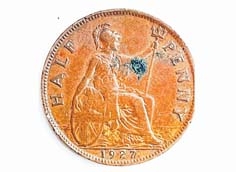
The reverse of the coin was designed by engraver Leonard Charles Wyon with an image of the female warrior Britannia. She is seated and facing right, holding a trident in left hand and resting her right hand on a shield bearing the Union flag, with the sea in the background. The letterings “Half Penny” flank her image and the year is shown at the bottom. The trident symbolizes naval power. The Latin word Britannia means the British Isles, the island of Great Britain, and the Roman province of Britain in the time of the Roman Empire.
The symbol of Britannia came to feature on British coins as a figure of strength and resilience.
(To be contd)