Radio licence!
|


S Balakrishnan
While the radio set in its original form is a rare thing these days – now that radio has shrunk into the cell phone – a licence for owning and listening to the radio could be shocking information. But that was one way of sustaining the funding for All India Radio – A.I.R. - (Akashvani) which monopolised broadcasting in India in those days. Of course, radio broadcasting is still popular because of its FM avatar, RJs and community radio stations.
The best thing is that one can listen to the radio while doing other activities also which is not possible with the Idiot Box.
The system of Broadcast Receiver’s License (BRL) for radio got implemented in 1928; the mandatory license system for radios was officially abolished in 1984 and it was finally abolished in 1991 for all types of users. However, HAM radio operators (amateur radio) do require a licence even now for security reasons; this is regulated under the WPC(Wireless Planning and Coordination).Later, the BRL covered television sets also when TV telecast started in India.
Wireless Inspectors were authorised to conduct door-to-door checks and those who did not have a valid license were slapped with a fine or had their device confiscated. The requirement of BRL was gradually phased out along with the phasing out of the “Licence-Permit Raj” and technological developments that spread fast & wide. The BRL was largely abolished in 1984 under the Rajiv Gandhi government (1984-1989).
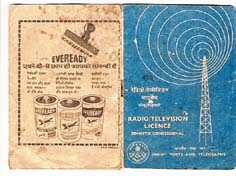
The BRL book usually had a dull blue cover with about 18 pages cover-to-cover. The first page had space for entering details of the owner of the radio set (name, address, registration no., etc.,) and the following pages hadrows for yearly renewal entries.
Besides domestic licence for domestic/private use, commercial licences were also issued for business use with varying annual licence fee.
To promote radio usage in rural areas, single-band (Medium Wave - MW) transistor sets were exempt from the fee, initially. The last few pages listed out the terms & conditions for the BRL and also guidance. The BRL had to be obtained from the nearest Post Offices of the Posts & Telegraphs Department (P&T Dept.).
The annual licence fee for a radio was 10 rupees in the 1960s (and until 1976? when it was raised to 15 rupees till abolishment). Special BRL Fee stamps of that value were affixed on the BRL booklet and cancelled with the postal date stamp mark.
The following were some of the conditions listed in the BRL booklet – The radio set should be used only for private and domestic use and not for public or commercial listening! The licence and the set were subject to inspection by the P&T Dept. Change in address to be entered. However, temporary relocation of the set for three months was permissible by informing the authorities.
The annual license ended on 31st December every year and had to be renewed before 31st January of the next year. If the licensed apparatus became inoperative or irreparable, this should be informed and the license got cancelled.
But no refund, mind you! On death of the owner, the license can be renewed in the name of the person in possession of the set. (Hope the authorities did not insist on a death certificate, Will, Legal Heirship Certificate, Notary Certificate, etc., etc.!) In case of transfer of ownership by sale or otherwise, it had to be informed to the relevant Post Office within seven days of such a transaction.
The Guidance warns to ensure license for sets received as gift or as prize won in some contest or other.
Though it is said that the BRL was abolished for radios in 1984, I did operate and listen to a made-in Japan 2-in-1 radio-cum-tape recorder set from 1980 onwards but without a BRL.
Either I was not aware of the BRL license raj then or it was not implemented that strictly. Hope I won’t be put behind bars now for this offence. Well, I would not mind a short jail term, say just for a day, as long as they permit me a radio in the cell.
It would be a lifetime experience, I hope. Long Live Radio without License! And Long Live Guglielmo Giovanni Maria Marconi, or simply Marconi!
The writer can be reached at [email protected]