Trace fossils and palaeo-environment of depositional basin of Laisong rocks and its significances
|


Professor RK Hemanta Singh
What are Trace Fossils?
Trace Fossils, also known as Ichnofossils are structures developed in se-diments (sedimentary rocks) by activities of organisms which lived in the past. They provide direct/indirect evidences of life in the geological past - ~4.54 billion years ago to the present.
However, during the geological past the oldest to the youngest trace fossil age ranges between 3.7 billion years to the last ~10,000 years. Trace fossils are the tracks, trails, burrows, borings, coprolites, etc., produced by both invertebrate and vertebrate animals.
Burrows are excavations made into unhardened earth materials; Tracks are marks on sediments due to walking/crawling by animals with legs; Trails are imprints on sediments by a legless animal when it drags its body across the sediment surface; Borings are excavations made into hardened rocks including woods; Coprolites are fossilized faeces (poops), and are considered valuable clues to the palaeodiet ‘Caveman Diet’ or ‘Stone Age Diet’ of extinct organisms and provide additional information to paleontologists, who study the branch of science concerned with fossil animals and plants, in reconstructing ecosystem relationships of fossil plants and animals. Eggs and nests are indirect evidence of reproductive behaviour. Aside from invertebrate and vertebrate animals, fungi, bacteria and plant roots also contribute to the formation of trace fossils.
Importance of Trace Fossils
1. Evaluating palaeo-environmental conditions during the geological past; reconstructing past habitats, climates, and ecosystems, including water depth, salinity, and climate.
2. Analyzing deposi-tional sequences of sedi- mentary rocks – such as interpreting which sedimen- tary rock layers are younger and which ones are older.
3. To assess potential petroleum bearing source rocks.
4. To evaluate hydro-geological parameters such as porosity and permeability related with groundwater exploration, etc.
Trace Fossils of Rocks of Laisong Formation, Manipur
The first report on trace fossil from Manipur dated back in 1982 when Satsangi and Tripathi reported Ophiomorpha isp. in the Geological Society of India survey report. More detailed accounts on three ichnotaxa of trace fossils namely Chondrites ichnospecies (isp.), Ophiomorpha isp. and Thalassinoides isp. were reported from the sandstones of the lower Laisong Formation rock exposures located along the Thongjaorok Stream (Turel) in Bishnupur (2005). In the Laisong rocks, trace fossils are found in shales, silty-shales, siltstones and sandstones.
Prior to discussing trace fossils of Laisong Formation, let us first have an idea on where the Laisong Formation rocks exposures are? The Laisong Formation is the lower division of Barail Group of rocks. The name Laisong Formation was given to the rock sequences in the type section (the representative rock sequence) located near Laisong Village along the Jenam River in the North Cachar Hills by P. Evans in 1932. Whereas the Barail Group of rocks denoted the Tertiary Period rock successions, especially represented by the Barail Range in North East India which is situated between Brahmaputra and Barak Basins stretching from Nagaland and Manipur to the east and Assam and Meghalaya to the west. Highest Peak of Barail Range is Mount Japfü (3,048 m) in Nagaland; and Mount Iso (2,994 m) is the highest peak of the Barail Range in Manipur. The middle and upper divisions of Barail Group are called the Jenam and the Renji.
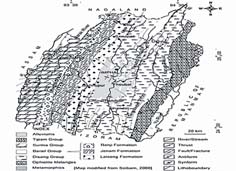
Figure 1 can be referred for the locations of these rock formations. The lithological transition between the Disang Group and the Barail Group is not sharp, but gradual. Therefore, it is commonly described as Disang-Barail Transition. The rocks of the Disang Group are shalier/laminated mudstone, where-as the rocks of the Barail Group are sandier/fine-to medium- grained sand-stones. The Disang-Barail Transition rocks are approximately Late Eocene to Early Oligocene in age, which is approximately 38–33.9 Ma (Ma - million age) to approximately 33.9–28 Ma. The time period also marked the transition of a major shift from a warm ‘greenhouse’ to a cold ‘icehouse’ climate; onset of significant Antarctic glaciation, sea-level drops, and global cooling, driven by falling CO2 gas.
The exact age of the lowermost part of the Barail Group, that is the basal part of Laisong Formation is not yet dated properly. However, observation of foraminifera (microfossil), Chilogumbelina cubensis from the fine-grained sandstone of lower part of Laisong Formation, from the nearby area of Shadu Chiru waterfall suggested approximately 34Ma; which is only a relative age.
Trace Fossil Assemblages Observed
Important forms of trace fossils observed in the Laisong Formation rocks can be classified broadly into continental and marine assemblages. Marine trace fossils are the dominant forms. More than 70 ichnospecies (formally named type of trace fossil) have been identified; all of which have characteristic signatures as far as their development conditions are concerned. Therefore, they represent typical palaeo-environmental conditions such as depth of water under which they were formed, salinity and oxygen content of sea water in which the trace forming organisms dwelled, food availability in the surrounding, and the substrate conditions - nature of sediments like sandy, silty or muddy.
The so far identified trace fossils from the above-mentioned rock formations can be categorised mainly into six (6) ichnofacies (groups) as Teredolites, Skolithos, , Glossifungites, Cruziana, Zoophycos and Nereites.
Teredolites ichnofacies is a distinct group of trace fossils comprising club-shaped borings such as Teredolites and Gastrochaenolites. It is indicative of marine to marginal- marine condition with brackish water (a mixture of seawater and freshwater, with salinity levels between 500 to 30,000 mg/L of total dissolved solids, TDS), in high-energy shallow water coastal environments.
Skolithos ichnofacies consists of typical ichnospecies such as Bergaueria hemispherica, Ophiomorpha nodosa, Skolithos linearis, Thala-ssinoides paradoxicus, Tere- dolites longissimus, etc., in association with sedimentary structures, such as ripple marks, produced under shallow water marine depositional setting with high-energy condition in the foreshore and shoreface zones.
Presence of perissodactyle footprints (3-toed vertebrate animal like tapir) and crocodylian tracks (footprints of crocodiles) namely Indosuchipes igen. nov. from the lower Laisong rocks further strengthened the shallow water or marginal marine condition of depostional environment.
Cruziana ichnofacies comprise of characteristic trace fossils, namely An-corichnus ancorichnus, Cur- volithus simplex, Paleo-phycus isp., Phycodes palmatus, Protovirgularia rugosa, Rhizocorallium jenense, Scolicia isp., Sko-lithos linearis, Sponge- liomorpha isp., Taenidium satanassi, Teichichnus isp., Thalassinoides isp., Trepti-chnus pedum, etc., formed under moderate-energy, shallow marine setting.
Glossifungites ichno-facies comprise of Thala- ssinoides isp., Sponge-liomorpha isp., Rhizo- corallium jenense, Skolithos linearis, etc. The ichnofacies represents fall in sea level. Zoophycos ichnofacies is represented by the presence of Zoophycos isp., Helmin-thoidichnites isp., Gordia marina, Gyrophyllites kwa-ssizensis, Teichichnus isp., etc., and represents regions like the outer continental shelf, slope, and deep-sea fans.
Nereites ichnofacies consists of Chondrites targionii, Desmograpton alternatum, Gyrophyllites kwassizensis, Halimedides annulata, Helminthoidichnites isp., Helminthorhaphe flexuosa, Nereites missouriensis, Palaeodictyon isp., etc., and are typical of deep-sea environments.
Trace Fossils and Palaeo-depositional Conditions of the Laisong Formation Bathymetry (depth) and Energy Conditions
Based on the six ichnofacies identified, it can be ascertained that deposition of the Laisong Formation rocks in Manipur have taken place mainly under marine conditions extending from regions with dominantly high hydrodynamic energy conditions like coastal, foreshore, shoreface and offshore to bathyal and abyssal areas with low to very low hydrodynamic energy conditions.
Salinity
The ichnofacies examined indicated deposition in fresh water condition in the terrestrial areas like river and lake environment with salinity less than 500mg/L, to brackish environment (salinity levels 500mg/L to 30,000mg/L), to the more dominantly marine condition with salinity 30,000mg/L and above.
Oxygenation
Well oxygenated environmental conditions in general are indicated by the trace fossils. However, fluctuating to poorly oxygenated, and even dysoxic conditions are also shown by some other specimen of trace fossils.
Trace fossils and hydrocarbon source rocks are both integral components of petroleum systems, often occurring together in fine-grained, low-energy sedimentary environments.
Trace fossils provide critical evidence of paleo-environmental conditions such as oxygen levels, sedimentation rates, and substrate consistency that control whether organic matter (the precursor to hydrocarbons) is preserved or destroyed.
Anoxic conditions of accumulated sediments may represent high source potential rock.
Low-oxygen environments restrict benthic life, leading to the near absence of trace fossils, or, the presence of very specific, low-diversity, tiny, thin-walled burrows such as Chondrites isp. and Zoophycos isp. This lack of oxygen prevents the destruction of organic matters, thus enriching accumulation and change into hydrocarbon deposits. On the contrary, high oxygen content in the bottom water sediments may leads to high bioturbation intensity, which mixes and aerates the sediment, oxidizing and destroying organic matter, and a lesser chance of hydrocarbon development.
However, presence of well bioturbated sedimentary rocks act as conduits that collect and transmit hydrocarbons and fluids through impermeable rocks such as shales, acting as injection points for the development of oil-bearing horizons. Sedimentary rock beds deformed by activities of trace fossils can control fluid migration pathways and improving the reservoir quality. Therefore, research on trace fossils could highlight whether the sedimentary rocks occurring in the presently described rock formations have potential source rocks of hydrocarbons or not!
Role of Trace Fossils in Groundwater Exploration
Trace fossils are extremely effective tools in groundwater exploration. They could provide crucial data on sediment porosity, permeability, and paleo-hydrology that are often missed by traditional core analysis. Burrows like Ophiomorpha nodosa and Thalassinoides isp. (Sko-lithos Ichnofacies) often behave as conduits, increasing the connectivity between pores in sandy sediments, which significantly enhances the permeability of rocks, viz. sandstones. Such rocks can act as groundwater aquifer with moderate to high potential. On the other hand, Cruziana Ichnofacies suggests lower-energy, mixed sand/mud environments that may have moderate to low groundwater potential. Hence, study of trace fossils is again very important from groundwater exploration point of view.
Observations
Some of the most significant points that have been observed from the study of trace fossils present in the Laisong Formation rocks of Manipur are:
1. The depositional environments (about 20-30 million years ago) in which the Laisong rocks have been deposited are found to have conducive life supporting conditions, which fact is clearly supported by the presence of moderately diverse trace fossils in these rocks.
2. The wide occurrence of Skolithos and Cruziana ichnofacies suggested that the water depth of the Laisong Basin ranges from littoral (10-20m) to sub-littoral zone (200- 300m).
3. Trace fossils play very crucial roles in the exploration of hydrocarbon and underground water bearing rocks. Research in this field will be very helpful for the state. The writer is from United College, Lambung, Chandel