As climate gets warmer, Napier thrives in State
|


Yaiphaba Meitei Kharibam
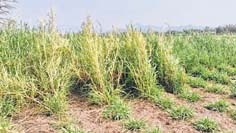
IMPHAL, Mar 28: Napier grass, a drought-tolerant tropical forage that thrives in hot climate, is witnessing a boom in Manipur.
Inexpensive and easy to grow, the napier grass has attracted the attention of farmers, seeing its potential to cut import of livestock feed and boost productivity.
Fish and livestock farmers are increasingly adop- ting the napier as a viable natural feed, cutting costs of buying expensive standard feeds.
Dr R Joseph Koireng, Senior Scientist at Central Agricultural University (CAU), Imphal, said there are many varieties of the napier grass, and farmers are increasingly growing them as feed for fish, poultry and cattle.
India's Napier CO4 and CO5 are being grown widely in Manipur.
Super napier, which originates from Thailand and red napier, which originates from South Africa are also able to thrive in Mani-pur, he said.
While standard feeds are expensive, the napier grass, once planted, will thrive for over 4-5 years, helping farmers cut the cost of importing/buying expensive feeds, he added.
Livestock and fish farmers are increasingly adopting the napier. Many of the napier species are thriving and Manipur is witnessing a boom.
But, what has brought this napier boom?
The napier thrives in hot and humid climates (25°C–40°C), and Manipur's rising temperature in the last several decades has made it suitable for such types of grasses, Dr Joseph said.
"It is all thanks to climate change that Manipur has become suitable for the napier, a highly valuable forage," Dr Joseph said.
Climate change has both negative and positive impacts. The climatic condition of Manipur becoming suitable for the napier may be seen as a boon. Adopting it widely and successfully may help cut import of feeds from outside States, he added.
Rising temperature
The Directorate of Environment and Climate Change's data from 1970 to 2024 shows an increasing trend in the maximum temperature.
According to the data, the maximum temperature from March to November ranges above 30 degree Celsius.
Data published in the State Action Plan on Climate shows an increase of 1.7 degree C in the minimum temperature and an increase of 1.5 degree C in the maximum temperature in the last 100 years.
The amount of rainfall has also increased in the last 60 years from 956.5 mm to 2268.9 mm.
By 2030, Manipur is projected to experience a rise in temperature by 1.7 degree C and a 15-19 % increase in rainfall.
Highest temperature recorded by year
2015: Chandel recorded a maximum temperature of 39.98 degree C in April
2016: Chandel recorded 39.86 degree C in May
2017: Chandel recorded a maximum temperature of 39.97 degree C in June
2018: Tamenglong recorded 39.92 degree C in August
2019: Chandel recorded 39.99 degree C in August 2019.
2020: Noney recorded 39.83 degree C in June
2021: Tengnoupal recorded 39.97 degree C in April 2022: Tengnoupal recorded 39.99 degree C in April
2023: Tengnoupal recorded 40 degree C in April
2024: Noney district recorded 40 degree C in May and a record 42.19 degree C in September
2025: Noney recorded 40 degree C in May and September; and Imphal West recorded 41.91 degree C in June
Farmers' experience with napier
Sapam Milan, a livestock farmer from Khongjom Chingtham Maning Leikai, said he has grown five napier species, and is trying another species this year.
Initially he imported the napier from Rajasthan and Gujarat, Milan said.
After adopting the napier, Milan said he no longer depends on feeds from the market.
Milan said he is able to earn income by selling the napier.
Climate change threatens the survival of many species and agriculture, but the key to survival lies in the ability to adapt. Farmers must learn to adapt to the changes, Milan said.
(This article is written under State Directorate of Environment and Climate Change's 6th Media Fellowship)