Tronglaobi rocket attack : Keeping separation issue alive
|


Brigadier (Retired) L Ibotombi Singh
The unfortunate incident in Moirang’s Tronglaobi village, Bishnupur district, resulting in the killing of a 5-year-old boy and a 6-month-old girl and injuring their mother, is nothing but sheer act of terrorism by suspected Kuki-Zo terrorists. The incident occurred around 1 am on April 7, 2026 when the family members were deep asleep. Tronglaobi is a low-lying area situated near the sensitive hill-valley boundary bordering the Kuki-dominated Churachandpur and Bishnupur districts. This geographic proximity has made it a frequent site of sporadic cross-border firing and ethnic clashes since 2023. Therefore, the terrorists selected this beleaguered village to terrorize the people and keep their issues alive by killing innocent people including children. For the act, this time they used a flat trajectory area weapon, possibly a rocket propelled grenade (RPG). Based on recorded materials found at the incident site and damages caused to the targeted house, the weapon used was a flat trajectory and not a mortar, as mortar munitions follow very high trajectory.
Apparently, the terrorists came upto the periphery of Tronglaobi village and fired one high explosive (fragmentation) round from RPG 7-V, having a maximum range of 700-900 meters (effective 500 meters), randomly at the nearest house from a distance less than 500 meters.
This extrapolation is proven by the fact that the villagers spotted an abandoned RPG-7V fitted with a rocket bomb, near the same locality. The Kuki-Zo terrorists must have abandoned the RPG after having misfired and escaped alongwith the crews who fired from the first weapon which killed the two children. For this act of terrorism the group must have employed minimum 6-8 terrorists, as crew required for RPG 7V would be two personnel per weapon making to four terrorists and balance as scouts cum lookout and covering party.
Whenever there is some semblance of normalcy, as there was no major violence except the Litan incident after return of a popular Government in Manipur, headed by Yumnam Khemchand Singh on February 4, 2026, the invisible hands incite violence and are continually attempting to destabilise Manipur. This has been proven by IED blasts on 05 January this year in Saiton-Nganukon area under Phougakchao police station, cold-blooded murder (shot dead at point blank range with an assault rifle) of M Rishikanta Singh by suspected Kuki terrorists believed to be part of the United Kuki National Army on the night of January 21-22, torching of 50 plus houses belonging to Kuki and Naga by the two warring communities in February this year, now Tronglaobi incident. Thus, by using acts of terrorism militant groups continue to compete for territorial control and resource allocation, often targeting peripheral villages to maintain separation between hill and valley, which is the ulterior motive.
The pattern is all similar with mob violence by the public, destructions of public property and the Government reacting with shutting down data services and imposition of curfew. This vicious cycle has been continuing since unfortunate incident of May 03rd 2023 and the invisible hands inciting violence, keeping Manipur boiling under the right temperature, are having the last laugh, with the primary aim to show state of lawlessness in Manipur. an attempt to ‘derail hard-earned peace’ and sabotage stability during a period of fragile political transition. The ultimate sufferers are the public and the State in terms of economy, presently in shambles. The students who are preparing for career examinations like NEET, JEE, UGCNET, Civil Services interview etc. are the most affected by virtue of shutting down data services.
This question is how the terrorists are freely moving with high caliber area weapons upto the periphery of the Meitei dominated villages bordering Chura- chandpur district. The area has large presence of security forces in terms of Army, Assam Rifles, Border Security Force CRPF and State Police, which shows lack of coordination in area domination and hard intelligence based punitive operations. Now all the Kuki SOO insurgent groups under United People’s Front (UPF) and Kuki National Organisation (KNO) and Civil Society Organisations (CSOs) like Indigenous Tribal Leaders Forum (ITLF), and and Kuki Inpi Manipur (KIM) will deny or have denied their involvement in the Tronglaobi incident. Their denial is obvious as the random symbolic target at Tronglaobi which were aimed to coerce the Government or societies through panic and create fear psychosis. However now the severity of damages by killing two innocent children, including a toddler has been condemned by all sections of society.
Apprehension by the Indian Army
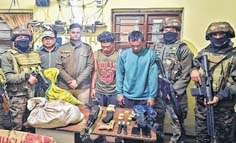
The apprehension of a non-SoO cadre, Jampao Kuki, the Information secretary of UKNA along with two more cadres during follow up joint operations of Tronglaobi incident by the Indian Army and the State police is a welcome step and will gain confidence of the public. One AK-47 and a pistol alongwith ammunition and other warlike ma- terials were recovered from the apprehended militants.
Despite on ground presence of more than one lakh boots, it appears that no significant effort has been made to douse the flame so far. Both the State and the Centre appear to have left both the warring groups to their fates, waiting for conflict theory’s “hurting stalemate situation,” leaving the warring groups to fight to the extent that the conflict automatically de-escalates when both parties are completely exhausted and unable to intensify the fight as nothing is left to fight for any further. The sporadic recurrence of violent attacks has led to the civilian population doubting the capability of SFs to protect them from armed attacks, instead are cursing the forced withdrawal of village defence volunteers from vulnerable villages.
This mindset needs to be changed. The security forces’ success in preventing the recurrence of violent incidents is critical to reversing the situation. Citizens are confused about who is responsible for law and order : the State Government, the Central Government, or the citizens themselves. Equally is the responsibility of lack of political will by the State Govt in bringing everlasting peace in the State. There is no accountability of the Unified Command, whose head happens to be Security Advisor to the State Government. The public is apprehending that installation of a popular Govt in February 2026 is because of upcoming State Assembly elections due early next year, as all important decisions and strings are presently pulled by New Delhi. Unless peaceful resolution is brought, uniting the hill and the valley, and if the present sporadic violence continues; there are high possibility of balkanistion of Manipur as fait accompli post State Assembly elections.
While examining the role of security forces under the Unified Command and the Political Will towards conflict resolution of the ongoing conflict, both have failed to bring conflict resolution in the State. The onus of failure, at present, is slightly titled towards the security forces, considering presence of more than one lakh boots in the State. The primary role of the security forces is to shape the environment free from violence to facilitate political dialogue between the warring communities. Efficacy of the present Unified Command is under cloud considering the knee-jerk reactive responses towards violence, recent example being Tronglaobi incident. Equally is lack of political will towards resolution of conflict in Manipur. It is important to remember that conflict resolution is an art, which requires a strong political will, combined with shaping a conducive environment by the ssecurity forces. Under the present arrangement of governance in Manipur, no significant roles have been given to the Chief Minister for effective and optimal use of the security forces as he is not at the helm in exercising Unified Command. The Centre needs to have confidence towards Chief Minister of a State, as he/she is elected as per Article 164 of the Constitution. Sidelining the Chief Minister under the existing Unified Command approach is a slap on the face of 38 lakh people (current estimation). The Centre must not see which person is the Chief Minister of Manipur, whether he/she is a Meitei or Naga or Zo-Kuki or Meitei Pangal; instead see it as an institution as he/she represents entire population of Manipur, elected as per the Constitution.
A Strategic Command headed by the Chief Minister will facilitate application of synergised security forces and other agencies in conflict management and initiation of political dialogue to resolve the present impasse. Also. a Unified Commander at operational level will be de facto Security Advisor to the Chairperson of the Unified Command at strategic level. The most important mandate of the Unified Command will be creation of conducive atmosphere for initiation of political dialogues which involves disarmament, stringent enforcement of cease fire ground rules, preventing flow of weapons and warlike stores from Myanmar into Manipur, thereby bring the level of violence down. Thus, clear cut mandate is a pre-requisite, which will include rules of engagement for the security forces. This arrangement can be made for six months and reviewed accordingly.
In conclusion a stable Manipur will depend on steady public safety, fair justice, and a serious effort to repair relationships across communities. Progress may be slow, yet consistent protection of rights and equal treatment under the law by optimum and synergised utilization of mammoth size security forces present in Manipur, can create the basic conditions needed for peace to hold. Restoration of rule of law to ensure the safety, security, and rights of all citizens, is a must. Lastly, leverage Manipur’s legacy of coexistence as a political resource for unity. Make the public aware that Manipur State itself is “Unity in Diversity”, a home to 34 communities. Reject the artificial barriers/division between hill and valley regions.