Existing schemes not enough for displaced women, children : Panel
|


New Delhi, Jun 17
A Parliamentary panel has renewed its call for targeted support for internally displaced women and children in Manipur, warning that existing welfare schemes may be inadequate to address a crisis of an “extraordinary and humanitarian nature”.
In a report on the action taken by the Government on recommendations contained in the demands for grants 2025–26 of the Ministry of Women and Child Development (MoWCD), tabled in Parliament on Tuesday, the department-related Parliamentary Standing Committee on Education, Women, Children, Youth and Sports, headed by Congress lawmaker Digvijaya Singh, said the immediate needs of displaced families living in relief camps require focused intervention and additional resources.
The committee had, in its March 2026 report, recommended that the Ministry provide nutritious food, breakfast, adequate accommodation facilities and allocate additional funds to support women and children staying in relief camps “till the situation becomes normal”.
In its reply, the Ministry said support was already being extended through Mission Vatsalya, Mission Shakti and Mission Poshan 2.0, and argued that there was “no requirement to establish a dedicated special committee with a targeted and separate programme/policy/scheme” for internally displaced women and children.
It said Mission Vatsalya provides institutional and non-institutional care to children in difficult circumstances, with Rs 4,000 per child available under non-institutional care, and that 78 child care institutions have been approved in Manipur.
The Ministry also cited the role of child welfare committees and the National and State Commissions for the Protection of Child Rights in monitoring care and protection mechanisms.
However, in its report submitted on June 16, the panel said that while it acknowledged the framework of existing schemes and institutional arrangements, the situation in Manipur involved “large numbers of internally displaced women and children residing in relief camps for an extended period”.
“The Committee is of the view that reliance solely on existing schemes may not be adequate to address the immediate and specific needs, particularly with regard to provision of nutritious food, breakfast, safe accommodation, health care and psycho-social support,” the report said.
The panel added that the issue of additional funding for relief camps “has to be taken care of” and reiterated that “temporary and targeted financial support, even within the ambit of existing schemes, is essential” to ensure that women and children in relief camps are not deprived of basic facilities.
It recommended that the Ministry undertake a “focused assessment” of conditions in relief camps and consider “earmarking additional funds or flexibilities under existing schemes” to meet emergent needs. The panel also called for close monitoring of service delivery to ensure adequate nutrition, shelter and care.
In addition, it asked the Ministry to coordinate with other Ministries to evaluate measures that could help alleviate the difficulties faced by women and children in Manipur.
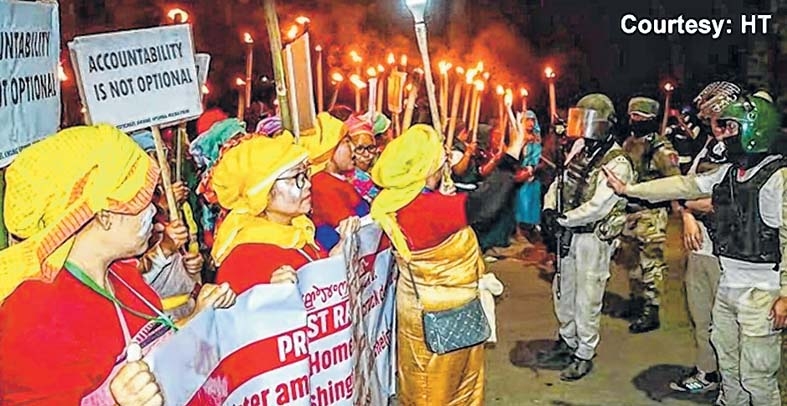
The ethnic clashes in Manipur first began between the Meitei and Kuki communities before involving almost every community. The State’s Meitei and Kuki-Zo communities have remained largely segregated in the areas they dominate since the ethnic clashes began in May 2023, leaving at least 260 people dead and displacing around 60,000.
The Meiteis, who are mostly Hindu, live largely in the Imphal Valley. The Kukis, who are predominantly Christian, reside in the hills. The state government has maintained that there are no buffer zones dividing communities in the state, though it has identified certain sensitive areas.
A new Government was formed in February, nearly a year after the imposition of President’s Rule. It includes representatives from all three major communities as part of an attempt to maintain ethnic balance.
Hindustan Times