Thoughts shared on responsible journalism at times of conflict
|


By Our Staff Reporter
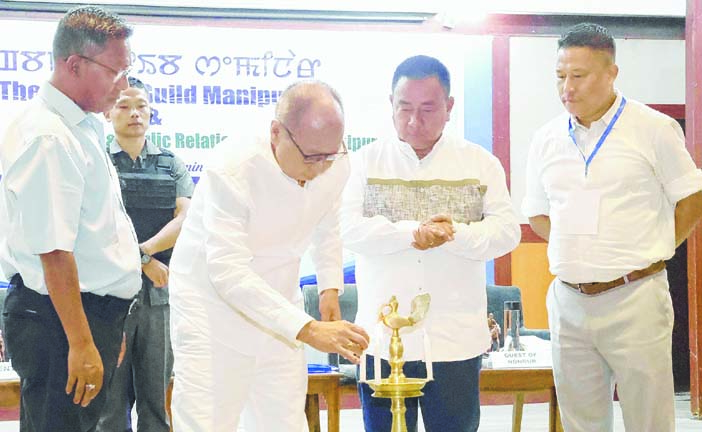
IMPHAL, Jun 8 : A one-day seminar on “Media for Communal Harmony and Responsible Journalism”, organised jointly by the Editors's Guild Manipur (EGM) and the Directorate of Information and Public Relations (DIPR), was held at Hotel Imphal today.
The seminar was inaugurated by Chief Minister Yumnam Khemchand Singh.
Stressing the need to strengthen the State’s media institutions, Oinam Sunil Singh, Media Advisor to the Chief Minister underscored the importance of reinforcing the role of media and the Directorate of Information and Public Relations in promoting balanced and responsible journalism.
Highlighting the significance of local narratives, Sunil Singh stated that National media should not be allowed to solely shape perceptions regarding Manipur.
He urged journalists and media organisations to collectively deliberate on these issues and work towards strengthening the credibility and effectiveness of the State’s media.
Dr Mayengbam Veto, Joint Secretary, Home Department, delivered a presentation on “Decoding Media Advisory by Manipur Government Home Department”.
Dr M Veto underscored the importance of ethical reporting, and asserted that the Government's media advisory is meant to ensure media houses' adherence to journalistic rules and norms as established by the Government.
The advisory is in no way a tool of intimidation. Rather it aims to put reasonable restrictions in the freedom expression to ensure responsible and ethical reporting of news and information, Veto said. Dr S Ibomcha, Commanding Officer, 6th IRB and SP (Special Commando), spoke on “Combating misinformation, rumours and hate speech in the digital era”.
Dr S Ibomcha underscored the importance of verifying information before publishing them.
Publication of misinformation, rumours and hate speech risks creating and escalating tension, he said, urging media organisations to verify the facts of any sensitive information they receive with trusted sources and authorities concerned before publishing them.
Natasha Elangbam, Associate Professor, Department of Mass Communication, Manipur University, delivered a lecture on “Journalism for Peace: Lessons, Challenges and Best Practices from Conflict Regions”.
The Associate Professor emphasised that media can play important roles in efforts to bring about reconciliation in any conflict environment.
Media is never truly neutral, and how it reports a conflict can help shape the outcome, she said.
While focusing on war, winners and losers, and demonising a group promotes hate and risks escalating tension, a positive reporting that seeks truth, cause of conflict and solutions can contribute to peace-building efforts, Natasha said.
Amid the prevailing crises in Manipur, positive reporting that discourages violence is highly needed, she added.
Speaking at the seminar, EGM president Khogendra Khomdram expressed concern about rampant publication of sensitive information, unfiltered and unverified reports on social media platforms, and stressed the need for monitoring and regulating such posts.
He commented on the Editors' Guild of India's "so-called" fact finding report on the Manipur conflict, and asserted that the report published by the body includes erroneous and baseless information.
The EGI team met with representatives of AMWJU, EGM and MHJU during their visit to Manipur. But none of the information, inputs provided by the bodies (AMWJU, EGM and MHJU) were included in the report, he said.
Dr Th Charanjeet Singh, Director, DIPR, Ashem Bhakta, president, AMWJU, and Peter Adani, president, MHJU, senior journalists, officials of DIPR, students and teachers of Mass Comm Dept, MU attended the seminar.