Thank you, Cristiano Ronaldo
|


Ringo Pebam
As Indians, we still dream of seeing our tricolour at the FIFA World Cup someday. Until then, every four years, many of us adopt teams from around the world and celebrate the game we love. The days following the FIFA World Cup are often gloomy and sad because of the heartbreak of seeing your team lose. If you are not emotionally invested in a team, you do not feel the pain as deeply. But the deeper your emotional investment, the deeper the heartbreak when your team finally falls.
It is like the aches and hangover after five days of Yaoshang sports in your locality. Then comes the return to school, when everything suddenly feels dull. You miss your friends and the sports ground where all the excitement had been.
Like many Argentina supporters, I was devastated when Lionel Messi's Argentina lost the 2014 World Cup final to Germany through Mario Gotze's late goal. I hardly felt like spea-king to anyone for days.
Having seen life and experienced its ups and downs, I now feel that glory should sometimes go to those who have not yet had their share. Since Argentina won the last World Cup, I quietly hoped Cristiano Ronaldo and Portugal would lift the trophy this time. But football can be heartbreakingly cruel. Portugal's campaign ended with a narrow 1–0 Round of 16 defeat to Spain, ending Ronaldo's final World Cup dream. Like millions around the world, I too have carried a quiet sadness ever since.
This is not an article about comparing players or debating who is the greatest. It is my way of saying thank you to a footballer who has inspired millions, including me. Although Ronaldo may still have more football ahead of him, his World Cup journey is now complete. It felt like the right moment to write this tribute.
Cristiano Ronaldo was born into a humble family on the Portuguese island of Madeira on February 5, 1985. At just 12 years old, he left home to join Sporting CP's academy in Lisbon, where he battled homesickness and ridicule over his Madeiran accent, but channelled those hardships into relentless training.
His extraordinary talent earned him a move to Manchester United under Sir Alex Ferguson in 2003. Over the next two decades, he won league titles in England, Spain and Italy, five UEFA Champions League titles, five Ballon d'Or awards, became Real Madrid's all-time leading scorer, and continued breaking records at Al-Nassr.
Beyond club football, Ronaldo helped transform Portugal from international underachievers into one of Europe's most successful teams. During his career, Portugal won UEFA Euro 2016 and two UEFA Nations League titles, while Ronaldo became the all-time leading goalscorer in men's international football.
His remarkable longevity was perhaps best reflected at the FIFA World Cup. Ronaldo became the first male player to play in and score at six different World Cup tournaments. He gave everything he had for the Portuguese badge, but football can be cruel. It broke millions of hearts to see his final World Cup dream end in tears after Portugal's narrow defeat to Spain. Yet by the time the final whistle blew on his World Cup career, Ronaldo had already secured his place among football's immortals.
My admiration for Cris-tiano Ronaldo has always gone far beyond his foot-balling brilliance. It is rooted in his discipline, work ethic, resilience in the face of rejection, unwavering focus, winning mentality, leadership, longevity, relentless desire to improve, and unshakeable self-belief. These are qualities that transcend football. Whatever your profession or stage of life, there is something in Ronaldo's journey that anyone can relate to and learn from.
There were moments in my life when things did not go as I had hoped and the future seemed uncertain. During those years, watching Cristiano Ronaldo rise after every setback reminded me that success belongs not only to the gifted, but to those who refuse to stop believing. His greatest lesson to me was not how to score goals, but how to keep getting up after every fall.
Long before he became one of the greatest footballers of all time, Ronaldo understood what it meant to struggle. During his early days at Sporting CP, there were evenings when he and his teammates waited outside a nearby McDonald's after training, hoping the staff would give them leftover burgers. Years later, after becoming one of the world's greatest athletes, he publicly searched for the women who had shown kindness to him and his teammates so he could thank them personally. To me, that story says as much about Ronaldo as any trophy ever could.
Another incident that reflected those convictions came during the UEFA Euro 2020 press conference, when he quietly moved aside two Coca-Cola bottles, held up a bottle of water and simply said, "Agua" ("Water"). Whether one agreed with the gesture or not, Ronaldo has consistently tried to live according to the values he promotes.
Perhaps that is why those who know him best speak so highly of him.
Sir Alex Ferguson once said, "We've had some great players at this club in my 20 years, but Cristiano Ronal-do's up with the best."
Zinedine Zidane described him simply as "the best" and added that "in his heart he's a good person."
Former teammate Toni Kroos perhaps summed up Ronaldo's work ethic best: "Cristiano was always there when I arrived at training and still there when I left."
Recently, India's football icon Bhaichung Bhutia said he encourages his own son to follow Ronaldo, not merely for his footballing ability, but for his discipline, focus, commitment and sacrifice.
Ronaldo's influence extends far beyond football. At this year's Wimbledon Championships, Italy's Flavio Cobolli celebrated a victory with Ronaldo's famous "Siuuu", prompting the crowd to join in. Afterwards, he said, "I love his celebration. I love him."
That scene reminded me of something much closer to home. Since this year's World Cup began, I had a poster of Ronaldo displayed at the gate of my house. Almost every day, little children, boys and girls alike, walking along my leirak (street), would stop, look at Ronaldo's poster, perform a joyful "Siuuu!", and continue on their way with a smile. They may not yet know his records, but they already know the joy he brings. That, to me, is the mark of a true sporting icon.
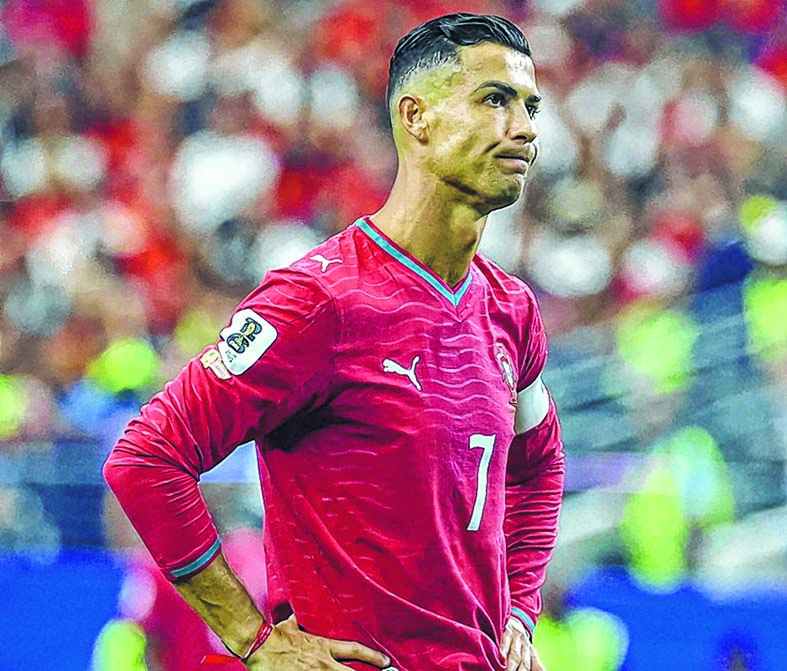
When the final whistle blew in Portugal's Round of 16 defeat to Spain, the cameras captured a sight that broke millions of hearts: Cristiano Ronaldo walking off the pitch in tears. For a man who had conquered almost everything football had to offer, the one dream that eluded him was lifting the FIFA World Cup. Later, he confirmed it had been his final World Cup, saying, "I gave it my all. I gave my best. And I leave with a clear conscience." Football has a strange way of measuring greatness. Sometimes it reduces extraordinary careers to a single trophy. But if winning a World Cup alone defined greatness, then George Best, Johan Cruyff, Eusebio, Paolo Maldini and Alfredo Di Stefano would somehow be considered incomplete. They are not. Neither is Cristiano Ronaldo.
Thank you, Cristiano Ronaldo, for teaching millions that talent is only the beginning; that discipline matters; that rejection can become fuel; that hard work can carry a boy from a small island to the summit of world football; and that even in defeat, dignity is possible.
The World Cup slipped away, but no final whistle can erase Cristiano Ronaldo's legacy. Long after the trophies have gathered dust and today's records are broken, generations will still remember the little boy from Madeira who taught the world to dream bigger, work harder, and never stop believing.
For that—and for so much more—thank you, Cristiano Ronaldo.
The writer can be reached at [email protected]