World Population Day observed Estimated population of Manipur put at 33 lakh
|


By Our Staff Reporter
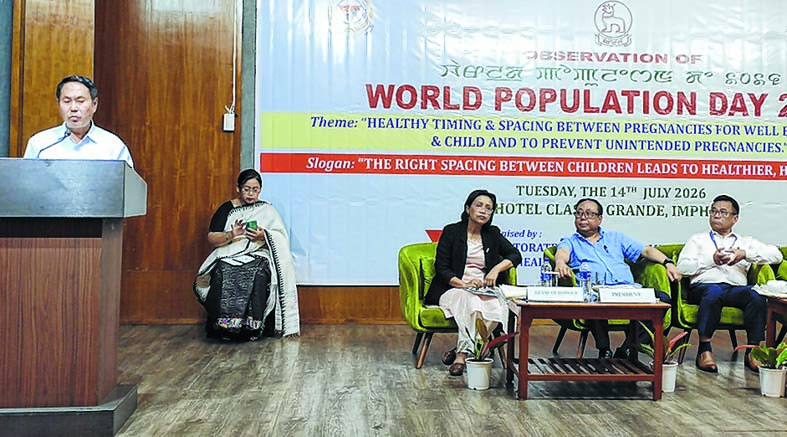
IMPHAL, Jul 14 : Manipur's estimated population in 2026 is over 33.06 lakh, an increase of around 15.78 percent from 2011, said Family Welfare Services Director Dr N Bino on the World Population Day 2026, observed at Hotel Classic Grande, Chingmeirong today.
According to Census 2011, Manipur's population is 28.56 lakh comprising 14.39 lakh males and 14.17 females. The estimated population for Manipur in 2026 is 33.06 lakh, an increase of around 15.78 percent, Dr Bino said.
Organised by the Directorate of Health & Family Welfare Services, Manipur and State Health Society, NHM, Manipur, the observance laid emphasis on healthy timing and spacing of pregnancies (HTSP) for preventing unintended pregnancies and ensuring the well-being of both mother and child.
NHM Manipur State Mission Director N Dinesh, RIMS' Head of Department of Obs & Gynaecology Dr M Rameswar and JNIMS' Head of Department of Obs and Gynaecology Dr Helen Kamei attended the event.
Speaking on the occasion, Dr N Bino said the global population is currently growing at a rate of approximately 0.84% per year which translates to an annual increase of over 69 million people.
The global population four decades ago was 3 billion, and it has now risen to over 8 billion. The global population is projected to reach approximately 9 billion in the year 2037, Dr Bino said.
India's current population is approximately 1.47 billion which is about 17.78 percent of the total global population. For a country like India, controlling population growth is highly necessary, Dr Bino hinted.
The Family Welfare Services Director said the objective of observing World Population Day is to raise awareness about demographic challenges and advocate for universal access to reproductive healthcare, family planning, and gender equality.
The aim is to bring about a healthy society with enhanced living standards, improved maternal and child health and gender equality through proper family planning, Dr Bino said.
Sexual education, healthy timing and spacing of pregnancies (HTSP), use of contraceptive methods, condoms, curbing child marriage and avoiding adolescent pregnancy are highly important for building a robust and healthy society, Dr Bino added.