Tobacco products demand in Manipur: A silent epidemic ignored
|


Dr Salam Himika Devi
On May 31, the world observes World No Tobacco Day, a solemn reminder of the millions of lives lost to tobacco each year. This year’s theme, “Unmasking the Appeal: Countering Nicotine and Tobacco Addiction”, exposes the manipulative tactics of the tobacco industry.
Yet, while the globe rallies against tobacco, Manipur seems to be marching in the opposite direction — towards more tobacco, more addiction, and more preventable deaths.
Globally, tobacco kills over 7 million people annually, including 1.6 million nonsmokers exposed to secondhand smoke. It is the only consumer product that kills half of its users. But in Manipur, tobacco use is not just widespread — it is alarmingly normalized.
According to the Global Adult Tobacco Survey (GATS2), more than 55% of Manipuri adults consume tobacco in some form, nearly double the national average. Smokeless tobacco, particularly betel quid with tobacco (kwa zarda), dominates usage, with Manipur ranking second in India for smokeless consumption. Women, once thought to be less vulnerable, now form a significant share of users, with cultural acceptance masking the health catastrophe.
The consequences are devastating. Oral cancer, largely driven by tobacco, accounts for 40% of all cancers in India. In Manipur alone, nearly 950 new cancer cases are reported annually, of which 390 are tobaccorelated. Tragically, many patients present with oral cancer at a much younger age compared to Western populations, robbing families of breadwinners and communities of leaders.
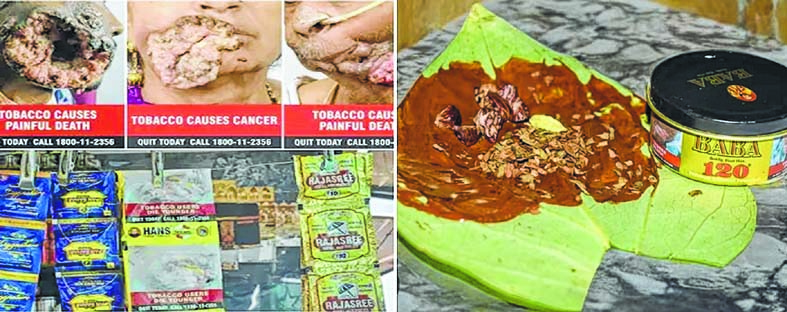
The sight of Manipuri women with disfigured cheeks from habitual chewing of betel quid is becoming disturbingly common. What was once a cultural practice has morphed into a public health disaster. Equally alarming is the rise among youth. Surveys reveal that two out of every ten students aged 10–17 have experimented with tobacco. Nicotine exposure during adolescence not only impairs brain development but also locks young people into lifelong dependence. The state risks nurturing a generation addicted before adulthood.
Tobacco is not just about cancer. It is a major risk factor for heart disease, hypertension, lung disease, and stroke. Passive smoking at home — often affecting housewives and infants — places Manipur among the top states for secondhand smoke exposure. The hidden epidemic is silently eroding health, one household at a time.
India’s Cigarettes and Other Tobacco Products Act (COTPA, 2003) prohibits smoking in public places, sale to minors, and advertising. Yet enforcement in Manipur is weak. Shops rarely display mandatory warning signs, sales near schools are rampant, and black-market activity thrives. The law exists, but its spirit is absent.
The National Tobacco Control Programme (NTCP) provides a framework, but Manipur needs urgent, localized action:
* Rigorous awareness campaigns in schools and communities.
* Strict enforcement of COTPA provisions, especially around schools.
* Accessible cessation centres to help users quit.
* Community empowerment, making tobacco control a collective responsibility.
Manipur cannot afford complacency. Tobacco is not just a personal choice; it is a public health emergency. Unless urgent steps are taken, the state risks losing the majority of its population to preventable tobaccorelated deaths.
As the world fights for a tobaccofree future, Manipur must decide: will it continue and remain a cautionary tale, or will it rise to protect its people? The answer lies not in global resolutions but in local action.
The writer is Assistant Professor, Department of Zoology, Manipur University
Email: [email protected]