A tribute to renowned football coach Oja Waribam Kamini Kumar and the World Cup dream he never sawBaba, we finally made it
|


Waribam Bhalindra
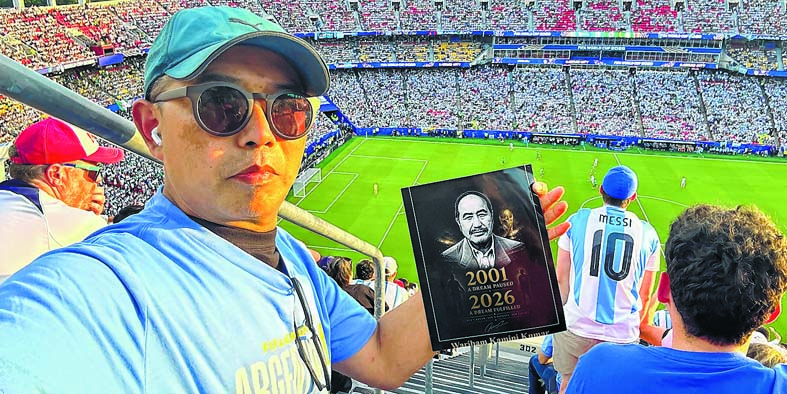
On a warm June evening inside Arrowhead Stadium in Kansas City, the roar of 70,000 supporters signalled the start of a World Cup campaign. Amid the sea of blue-and-white jerseys, I held a portrait of my father, a football coach from Manipur who had dreamed of attending the FIFA World Cup but passed away before he ever had the chance. Twenty-five years later, that dream arrived. Standing beneath the lights of football’s biggest stage, I whispered the words I had waited a lifetime to say: “Baba, we finally made it.”
For many, it was another unforgettable night. For me, it was the completion of a journey that began decades earlier on the football grounds of Manipur. Before this became a story about the FIFA World Cup, it was a story about the man whose dream inspired it.
The Man Behind the Legacy
My father, affectionately known as Oja Waribam Kamini Kumar, is remembered as one of the pioneering figures who helped shape the football culture of Manipur. While many coaches are remembered for the teams they led, he became known for something even more enduring: developing coaches themselves. Former players often recall that he could correct mistakes firmly, then dissolve the tension with a smile or a joke. Discipline and kindness were never opposites in his coaching; they worked together.
At a time when formal coach education was still evolving, he dedicated himself to training those who would go on to guide generations of young footballers across Manipur. His influence extended far beyond a single club or tournament. Every coach he mentored carried forward a part of his philosophy, multiplying his impact across the countless football grounds of Manipur and across India.
Colleagues and former trainees remember him for his discipline, humility, patience, and unwavering belief that football was not merely about winning matches—it was about building character, nurturing leadership, and strengthening communities.
He belonged to a pioneering generation that helped establish the strong football culture for which Manipur is known today. Long before professional academies, lucrative leagues, and widespread television coverage trans- formed Indian football, these coaches worked with limited resources but limitless commitment. Their reward was the success of the players and coaches they helped shape.
His contribution continues to be remembered through the annual Oja Waribam Kamini Kumar Best Coach Award, instituted by my family after his passing. The award has become more than a memorial; it is an enduring reminder of the values he lived by and the standards he expected from every coach.
Football and the Spirit of Manipur
Football, for Manipur, is part of the State’s identity. Across villages, schools, local clubs, and leikai community grounds, football has long been woven into everyday life. Despite limited infrastructure and resources, Manipur has consistently produced some of India’s finest footballers, coaches, referees, and administrators, earning its reputation as one of the country’s football heartlands.
This success was built upon the dedicated efforts of teachers and coaches like Oja Kamini Kumar. Their commitment on the touchlines established the foundations of the sport in the region, creating a lasting influence that continues to inspire and shape generations of young athletes.
This story is not only about my father. It is also about the generations that quietly built the foundations of Manipuri football.
An Unfinished Journey
Like countless football lovers around the world, Oja Kamini Kumar dreamed of experiencing the FIFA World Cup in person. When FIFA announced that the 2002 tournament would be jointly hosted by South Korea and Japan—the first World Cup ever held in Asia—it felt especially meaningful. For a football educator from Manipur, it represented more than an international sporting event; it was an opportunity to witness the highest level of the game, observe coaching methods first-hand, and bring those lessons back to the football fields of Manipur. The journey was about learning and about bringing home new ideas for the next generation.
But fate intervened. In 2001, before that lifelong aspiration could be realised, he passed away unexpectedly. The passport remained unused, the ticket was never purchased, and the journey remained unfinished.
Carrying the Dream Forward
Life eventually carried me far from Manipur. Nearly two decades ago, I settled in the United States, where I built a career, raised a family, and established a new life. Yet distance never weakened my connection to home.
Whenever I watch sport on television or live, I always remember my father as a silent companion beside me. This feeling is especially profound during the World Cup, as every match serves as a reminder of the journey he never got to complete. Every World Cup brought the same quiet thought: “Baba should have been here.”
I often wondered what my father might have experienced walking into a World Cup stadium. What lessons would he have brought back ? What stories would he have shared with us, his fellow coaches, and friends ? Those questions lingered for years until 2026 arrived. When FIFA awarded the tournament to North America, something changed. For the first time, fulfilling my father’s unfinished journey was no longer just a thought; it became a responsibility. I realised that dreams do not disappear when someone leaves this world. Sometimes they simply wait for the people they leave behind.
Baba, We Finally Made It
On 16 June 2026, that long-awaited moment finally arrived. Inside Arrow- head Stadium, football history unfolded as defending champions Argentina opened their World Cup campaign against Algeria. The atmosphere was electric, and when Lionel Messi completed a memorable hat-trick, the stadium erupted in celebration.
Yet while history was being written on the pitch, another story—quieter, deeply personal, and twen-ty-five years in the making—was unfolding in the stands.
I came alone that evening, carrying only a tribute bearing my father’s portrait and the words:
“2001 – A Dream Paused. 2026 – A Dream Fulfilled. Father’s Dream. Son’s Journey. Our Legacy.”
As I held it towards the field, I whispered the words I had waited twenty-five years to say: “Baba, we finally made it.”
No one around me knew the story behind those words. To everyone else, I was simply another supporter celebrating football’s greatest tournament. But as I looked from the pitch to the portrait in my hands, twenty-five years seemed to disappear. For a brief moment, it felt as though you were there with me.
The journey did not end with that first match. A few days later, I returned to the World Cup for the Ecuador–Curaçao match. This time, I came back with my family. My wife, Rajshree, stood beside me, along with our sons, Leo and Austin—the two grandsons you never had the chance to meet.
Rajshree knew this was far more than a family outing. She understood that we were completing a promise that had lived quietly in my heart for many years.
As the boys looked at your portrait, I realised they were meeting their grandfather in a different way. They knew you through our stories, old photographs, and the memories shared by family, friends, and the many players whose lives you touched. They may never hear your voice, but they will know the values you stood for.
Twenty-five years ago, your dream was interrupted. Today, it continues through the people who know your story and the family that proudly carries your memory.
We came to honour your dream. We returned with something even more precious. Our children now know why it mattered.
Baba, we finally made it. Together.