Chatric bridge demolished by suspected Kuki militants
|


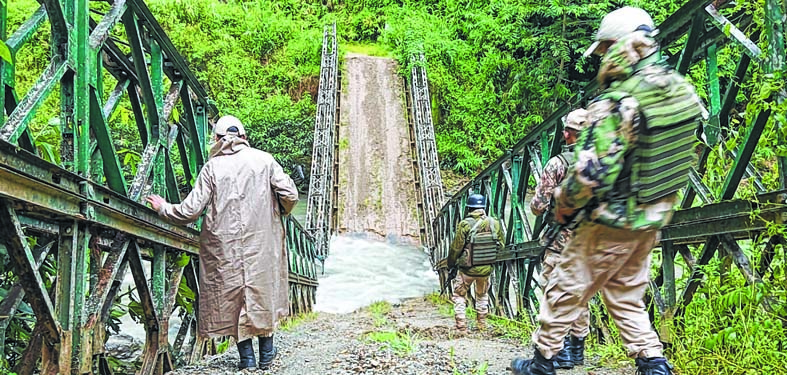
Mungchan Zimik/OSR
UKL/IMP, Jul 22: Suspected Kuki militants have demolished a key bridge on Chatric-Kamjong district headquarters road.
Suspected Kuki militants first tried to blow up the bridge at around 10.30 pm on July 21, 2026 but the blast was not effective enough to cripple the bridge.
They made another attempt at around 2.30 am on July 22, 2026 using a powerful IED and this time the bridge collapsed completely.
The Kuki narco-terrorists also set ablaze a Bolero jeep belonging to BSNL parked beside the bridge at around 8.30 am today.
Notably, Chatric bridge built over Namban River is located somewhere near border pillar No. 114 between India and Myanmar.
A viral picture circulated on social media clearly shows Kuki narco-terrorists assembling and planting a powerful IED to demolish the bailey bridge.
There are two Kuki villages on the southern side of Namban River––Kultuk and Movailuk, about 7 Kms away from the demolished bridge.
The powerful explosion snapped the Chatric bridge in the middle. It was the only bridge connecting villages of Chatric area with Kamjong district headquarters.
After the explosion and destruction of the bridge, a team from Chassad police station rushed to the spot to take stock of the ground situation.
Local villagers said that they heard a blank fire from Kuki militants recently from around Chatric bridge, apparently to scare off villagers and showing their presence in the area.
Meanwhile, the Working Committee of Tangkhul Naga Long (TNL), Khanuithot-Khon (Voice of the Naga Youth), Chatric Village Authority and the Tangkhul Naga Zingsho Longphang (TNZL) have vehemently condemned the demolition of the bailey bridge connecting Kamjong to Sahamphung sub-division via Chatric Khullen and Chatric Khunou villages by Kuki narco-terrorists in collusion with the Kuki National Army-Burma (KNA-B).
In the early hours of Wednesday, the 130-foot span bailey bridge constructed under PMGSY in the year 2016 collapsed in the mid-point at the impact of the powerful blast.
As a result, connectivity between Kamjong district headquarters and Sahamphung sub-divisional headquarters has been cut off.
Reports collected from the spot said that Kuki narco-terrorists made a series of attempts to sabotage the bridge and they were successful in their third attempt.
In addition to blasting the key bridge, the Kuki narco-terrorist also set ablaze a Bolero jeep belonging to the Telecom Department which was left behind after it reportedly broke down near the bridge.
According to the TNL Working Committee, the Kuki narco-terrorists who demolished the bridge are currently stationed at the Kuki villages of Kultuh, Phaikoh and Molnoi inside Myanmar's territory.
For the past few months, the Kukis with the support of KNA-B and People's Defence Force (PDF)- an armed group based in Myanmar have been unleashing violence in Kamjong district along the Indo-Myanmar border.
The TNL Working Committee has called upon the authorities concerned to immediately take necessary actions against the targeted sabotage and restore the key connectivity of border villagers. The perpetrators must be arrested, booked and put on trial in the Court of law, it said.
On the other hand, the Khanuithot-Khon said that the bridge was demolished by Kuki narco-terrorists, allegedly with assistance from Assam Rifles personnel.
The primary duty of every security force is to protect the lives, dignity and fundamental rights of civilians.
Actions that render essential public infrastructure unusable without authorization and colluding with armed Kuki narco-terrorists cannot be reconciled with this responsibility, the Khanuithot-Khon said in a press release.
It has demanded immediate judicial or independent investigation into the destruction of Chatric bridge; registration of appropriate criminal cases against all Kuki narco-terrorists and AR personnel found to have involved in the sabotage; immediate suspension of all AR personnel involved in the sabotage from active duty and restoration of the destroyed bridge on a war footing. The Khanuithot-Khon added that the destruction of infrastructure essential to civilian life cannot be normalised or justified under any circumstance.