Sinakeithei Village : Government inaction, firearms training for newly recruited Kuki narco-terrorists
|


Mingyashin Shaiza
For decades, Sinakeithei was a name synonymous with abundance and harmony in the Ukhrul District of Manipur. Cradled by clean, winding brooks, this serene Tangkhul Naga village thrived as a bustling regional hub. It's fertile soil produced organic foods and vegetables that fed communities far and wide, drawing neighboring communities to settle, work, and build lives together. Sinakeithei was a testament to co-existence.
Today, that vibrant tapestry has been replaced by a suffocating blanket of terror, isolation, and trauma. For over four months, Sinakeithei has been under a relentless, low-intensity siege, an unprovoked spill-over of conflict that has upended lives, frozen the local economy, and has threatened to wipe out the future of an entire generation of children.
The peace of Sinakeithei shattered on February 23, 2026, weeks after a violent assault on a Tangkhul Naga individual in Litan that signaled the onset of local hostilities. Since that day, the village has been attacked many times by heavily armed Kuki Narco Terrorists operating from Shongmun on the southern ridge and the Lungter hill range to the west.
“Although, there are BSF stationed in the Lungter Hills, there are still sporadic instances of field workers being fired upon. The state mechanism has completely failed,” said a local volunteer who is deeply concerned about the situation.
The rhythm of life was dictated by the terrifying cadence of gunfire and mortar shells."When the Kuki Narco Terrorists start attacking Sinakeithei, the firing begins from 8:00 PM till 5:00 AM, and sometimes stretches until 7:00 AM," a village woman in her 60s shared, her voice heavy with exhaustion. "Old people like us and the sick are affected mentally. We are mentally ill. Families with young children are living in constant fear."
Whenever the sirens of gunfire sound, normalcy evaporates. Families are forced to prepare early dinner in hurry and move to reinforced shelters or safer pockets of the village, waiting out the darkness in absolute terror.
Furthermore, the government-provided security lifelines feel compromised. While the government established an escorted transit route from Sinakeithei to Imphal via Mahadev, civilians can no longer trust it. Memories are fresh of the recent tragedy at TM Kasom, where two Tangkhul Naga men were ambushed and killed along the Imphal-Ukhrul highway after being escorted as far as Litan by Central forces and Assam Rifles.
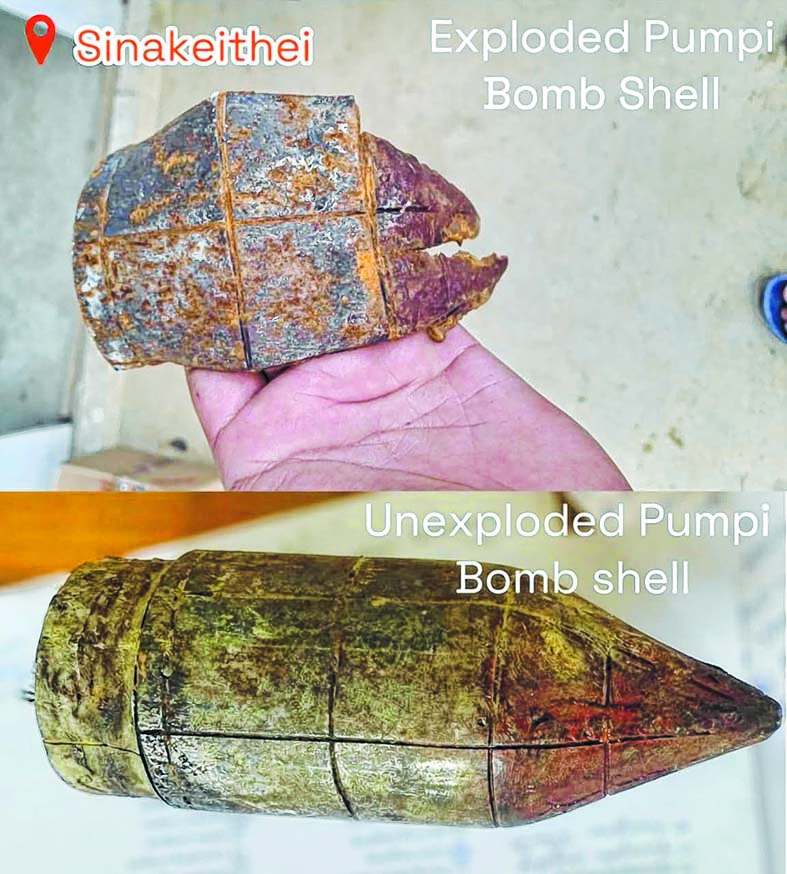
However, their only hope and faith remains unshaken as the Almighty God continues to protect them.The Sinakeithei women described the incidents as miraculous. One particular night they witnessed a phenomenal episode of mortar dysfunction when they were attacked with more than 30 mortar bombs and non stop firing. The women, who were in the midst of their daily fasting prayer narrated the incident and named it a God's miracle.The mortar attack miraculously did not kill anyone in the village. It either exploded in the sky before it reached the ground or those that reached the ground never exploded.
“I woke up the next morning and saw an object fallen in my front yard. I picked it up and shook it to see what’s inside. Later I found out that it was a bomb and I got so frightened”, narrated a woman, which shows the ignorance they have for weaponries. “It did not explode. Imagine if it could have exploded the house will be gone and I don’t know if I will even be alive”, she shuddered remembering the incident.
"We are not asking to remove the Central Forces," clarified the village authority representatives, "But we desperately need State Forces." The village authority has issued open letters, filed legal appeals, and personally pleaded the Home Ministry for a single battalion of the Indian Reserve Battalion (IRB) and an expansion of the Manipur Rifles. Currently, a single local police station with just 16 personnel stands as the sole adaptable line of state defence; experts estimate it requires at least 50 to secure the perimeter.
With the main highway deemed a death trap, Sinakeithei has been driven into near-total isolation. The village's only viable lifeline is a rugged bypass leading through Sirarakhong village. But this route is inherently dangerous, exposed to Kuki villages positioned on the hills directly overlooking the road from the illegally established bunkers by Kuki narco terrorists.
Worse still, a ticking environmental clock threatens to sever this final artery. The road is bisected by the Rumsu Kong (River), which currently lacks a bridge.
While the government has approved a new road alignment and promised a permanent RCC Bailey bridge, authorities admit construction will take four to five months. With the monsoon season looming, the Rumsu Kong will soon swell into an impassable torrent. Without an immediate, temporary bridge arrangement, Sinakeithei will be entirely cut off from food, medical supplies and essential items.
“About the bridge at Rumsu Kong, nothing came. And we had petitioned memorandums and letters to the CM, Home Minister and the SP about stationing temporary bunkers along the paddy fields for the cultivation season with nothing to show for it,” updated the village authority recently.
In Sinakeithei, land is life. The vast majority of the population are ancestral farmers. In the month of May, the backyard gardens were bursting with onions, garlic, and herbs, ready for harvest. But they were rotting on the soil. No one could step into the fields without risking a sniper's bullet. "Now the security force forbids us to enter our own garden while we can clearly see the Kukis roam freely on the other side ," said a woman.
More critically, the window for sowing paddy, the community’s irreplaceable staple food, was closing fast during my interaction with the locals.
"It is already the end of May, and the time to sow our seeds has passed," a women’s representative pleaded. "How will we survive if we cannot plant our paddy this year? We just want to begin our seed-sowing in peace. Let justice and tranquillity prevail soon. We want to live in harmony," continued the woman.
Majority of the Tangkhul populace depends on Sinakeithei's paddy for staple food. Since paddy plantation could not take place this year;as rice is a staple food for the Tangkhul Naga, it could lead to a drastic fall in the supply of indigenous paddy next year and in the future if this situation persists.
The village is surviving entirely on shared humanitarian aid sent by neighboring communities, distributed equally among the families alike. But a community built on proud self-sufficiency cannot survive indefinitely on emergency rations.
Perhaps the darkest shadow hanging over Sinakeithei is the psychological toll on its children. Local educators openly warn that the village is on the verge of losing a generation to the conflict.
A worried teacher spoke up and said that students here were already struggling to catch up on core math and science concepts following the structural disruptions of the COVID-19 pandemic.Now, the classroom environment has transformed into a war zone simulation. When gunfire erupts in the middle of the day, lessons stop instantly. Children do not reach for notebooks, instead they dive to the floor, scanning the room for structural walls to shield them from stray bullets.
A mother informed that home stability provides no escape. Evening study sessions are non-existent. Families eat rushed meals before dusk to move to safer locations before the nightly 8:00 PM firing begins.
For families with any degree of financial privilege, the solution has been to relocate to towns or safer neighboring villages like Teinem and Somdal. Neighboring schools have shown immense solidarity, generously exempting displaced Sinakeithei children from tuition and admission fees.
But this is an unsustainable band-aid. Private school teachers back in Sinakeithei are facing zero income as enrollment plummets, and impoverished farming parents unable to work their fields, cannot afford the long-term cost of boarding their children away from home.
Despite the overwhelming odds, the people of Sinakeithei has resolved not to abandon their ancestral home. Young and old have stood together in remarkable unity, vowing to protect their ancestral land from the gruesome attack by Kuki Narco Terrorists.
Their demands are not political; they are profoundly humane. They are asking for:
1. The immediate deployment of adequate state security forces (IRB/Manipur Rifles) to secure agricultural fields so planting can resume.
2. An immediate temporary bridge over the Rumsu Kong river before the monsoon seals their isolation.
It's July now and it has been raining incessantly. Anytime the lifeline could be cut off.
3. A structured government relief package to offset the financial ruin of a lost harvest.
The ungrateful nature of Kuki show casing in their action of arrogation of land and concoction of history to legitimise those areas within Tangkhul areas as theirs, using violent means has led to worsening situation.
Thereby, Sinakeithei is an epitome of the tragic collateral damage done by the Kuki Narco Terrorists, where ordinary farmers, mothers, and schoolchildren pay the daily price of structural paralysis. To let this village fall into starvation or total isolation is not a political failure. It is a humanitarian emergency that the government of the day cannot afford to ignore.