Possible way out of festering conflict in Manipur
|


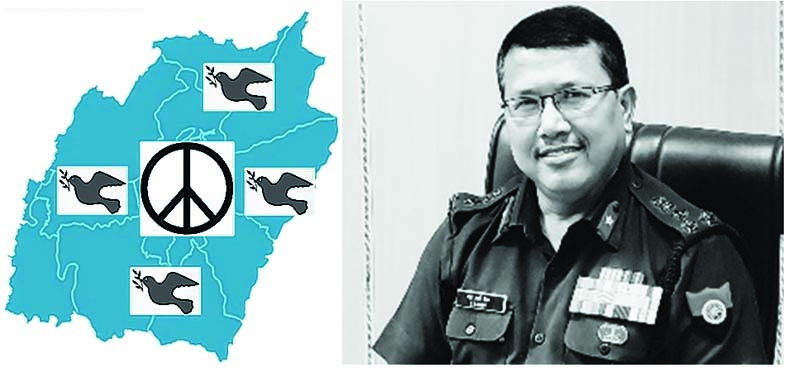
L Ibotombi Singh (Brigadier Retired)
(Only time will tell whether formation of a Government in February this year, after one year President’s rule, was to bring everlasting peace in Manipur or to extend footprints of ruling Government for one more term as the State is due for elections early next year.)
The protracted ethnic clash of interests in Manipur, started on 3rd May 2023, has evolved from a two-dimensional Meitei-Kuki conflict into a highly complex, multi-front crisis involving the Naga community, turning the State into a grid of hardened ethnic boundaries.
Whether by default or by design, the clash between Kuki-Naga communities started immediately after formation of a popular Government headed by Yumnam Khemchand Singh on February 4 this year. With highly polarized communities, severe economic disruptions, and fortified ethnic artificial geographical separations, the path forward is complex. For moving forward, the State faces deep socio-political fragmentation, structural gridlocks over land and governance, and a precarious security dynamic. The critical fault lines and what lies ahead for each community’s clashing interests which outline the trajectory of the conflict, are:-
Multidimensional Ethnic Conflict : What began in 2023 as a Valley (Meitei) vs. Hills (Kuki-Zo) conflict has expanded into a Three-Way Conflict, with the Naga Entry. Tensions has flared between Kuki and Naga groups over territorial jurisdiction, highway blockades, and retaliatory violence, such as the barbaric execution of six Liangmai Naga civilians, with regular torching of houses, the last as late as 35 houses torched at Kongkan Thana (a Naga village) and Phaimol (a Kuki village) in Kamjong district on 01 July and burning of all houses in Laikot (a Kuki village) in Noney district on 02 July by armed rival groups respectively. Therefore, the emer- gence of Naga-Kuki tensions, sparked by territorial disputes and civilian casualties, has complicated the State’s fragile ethnic map, making peace negotiations significantly more difficult.
Fragile Sub-Group Dynamics : Although the Kuki-Zo Council (KZC) issued a public apology for the killings, apex Naga bodies like the Naga People’s Front (NPF) and Naga student unions rejected the apology. This has entrenched a dangerous new front in the hill districts.
Federal Intervention and Administration: The State continues to navigate deep political instability. Central authorities are forced to maintain artificial geographical barriers and deploy paramilitary forces due to the partisan fragmentation of state and local law enforcement.
Structural Hardening of Borders (‘War of Maps’)
a) De Facto Partition : ‘Artificial Geographical Barriers’ patrolled by Central security forces have effectively transformed into permanent, militarised internal borders. The complete demographic cleansing of Meiteis from Kuki-dominated hills and Kukis from the Meitei-dominated Imphal Valley has institutionalised total segregation.
b) Armed Retaliation : Communities are heavily armed with thousands of weapons plundered from State armouries or sourced via cross-border smuggling from Myanmar. Armed ‘village defence volunteers’ and active insurgent groups dictate local security, severely limiting the State’s law-and-order capabilities.
c) Militancy and Disarmament Hurdles : Abrogating peace pacts, such as the Suspension of Operation (SoO) agreement with Kuki militant factions, alongside disarming civilian militias on all sides, remains a prerequisite for lasting peace.
Border Control and Migration Concerns : Demands for early completion of border fencing along the India-Myanmar border and the identification of illegal immigrants remain prominent. Concerns over demographic shifts and external cross-border influences continue to fuel security anxieties.
The Blockade Warfare : Like what happened or is happening during civil wars in African State (Congo, Somalia, Sudan and Lebanon,) in Manipur civil society groups like the Committee on Tribal Unity (CoTU) and Naga groups routinely weaponise National Highways (like NH-37 and NH-2) via counter-blockades. Which now has led to inter-district blockade which is not a healthy sign. This drives the cost of essential commodities to astronomical levels and deepens the economic strangulation of isolated pockets.
Irreconcilable Political Demands : The path to a peaceful resolution is gridlocked because the core aspirations of the three communities directly contradict one another. These are----
a) Meitei Position : Demand the absolute preservation of Manipur’s existing territorial integrity. They continue to push for Scheduled Tribe (ST) status while backing Government measures to detect illegal immigration and manage demographic shifts.
b) Kuki-Zo Position : Firmly demand a ‘Separate Administration’ (such as a Union Territory), effectively seeking a total administrative divorce from the Meitei-led State Government. They perceive State operations and Forest Acts as systematic tools used to brand indigenous land owners as illegal encroachers.
c) Naga Position : Fiercely oppose any Kuki homeland or administrative territory that overlaps with ancestral Naga land claims (Greater Nagalim) in the hills. While they share tribal status with the Kukis, they refuse to let Kuki political ambitions compromise their own territorial footprint.
Economic and Social Toll : Perennial blockades, strikes, and extortion networks drastically inflate the cost of basic commodities. Addressing the economic paralysis and healing deep communal wounds will require extensive and long- term truth and reconciliation efforts.
Comprehensive Disarmament & Truth Reconciliation : A heavy-handed federal crackdown completely disarms all community militias, followed by a South African-style Truth and Reconciliation Commission. This remains highly unlikely in the near term due to the severe trust deficit between communities.
Myanmar’s continued conflict, just across the border, has complicated the situation further. Manipur’s political fluctuations have always been tied to Myanmar due to the kinship ties that span the porous frontier, but the impact has been particularly visible in the past recent years. Every major power understands one simple reality; your neighbours are your biggest strategic and economic opportunity. During the recent visit of Myanmar’s President, U Min Aung Hlaing, it was conveyed that India remains Myanmar’s trusted neighbour, and first responder in times of crisis, in line with India’s Neighbourhood First, Act East and MAHASAGAR policies.
The visit re-galvanised momentum behind long-delayed foundational initia- tives. Both the countries have agreed to accelerate the Kaladan Multimodal Transit Transport Project (KMTTP) and the India-Myanmar-Thailand (IMT) Trilateral Highway and discussed a local currency settlement mechanism. The pre-requisite for fructifying above policies, is requirement of having a stable Manipur, the gateway for India’s Act East and MAHASAGAR projects.
Conflict resolution is an art, which require a strong political will, combined with shaping a conducive environment by the security forces for initiation of political dialogue by warring communities. In the case of Manipur as the present unified command has not given any tangible results for facilitating dialogues between different warring communities, is it the right time to restructure and change the approach towards the Unified Command. One of the suggested methodologies is that the Unified Command should be headed by the General Officer Commanding 3 Corps like in Assam. The complete Manipur State may be divided into four different Sectors, each sector given to IGAR (South), 57 Mountain Division, IGAR (East) and IGAR (North,) under overall command of 3 Corps. As temporary measures, a tactical Headquarters of 3 Corps may be established at Imphal, likewise Headquarters IGAR(East) and IGAR(North) with additional troops from Nagaland and Assam be shifted to Manipur. As it involves MoD and MHA, the arrangement, till conflict resolution in Manipur is achieved, should be coordinated by the PMO. This arrangement can be made for six months and reviewed accordingly.
Some of the recommended key focused areas for the Unified Command are: -
a) Clear Mandate and Rules of Engagement : A clear “Mandate” with “Rules of Engagement” need to be given, which has not been issued so far under existing unified command arrangement. The primary mandate or key result areas will be disarmament, stringent enforcement of cease fire ground rules, recovery of looted arms, preventing flow of weapons and warlike stores from Myanmar into Manipur, thereby bring the level of violence down, conducive for initiation of political dialogues. The primary role of the Unified Command will be to facilitate conflict resolution and NOT repeat NOT counter insurgency. The commander Unified Command, de facto will be security advisor to the Chief Minister of Manipur.
b) Disarmament : The foremost important tasks which require synergized efforts from all Govt machinery including the SF is disarmament without which no dialogue can take place.
Without disarmament normalcy will not return, instead the situation will worsen. Disarmament can be achieved by encouraging surrender or by use of kinetic means against all armed civilian personnel, including Kuki-Zo militant groups under Suspension of Operations (SoO), for violations of cease fire ground rules (CFGR). Thus, a holistic call needs to be taken.
Simultaneously, encourage surrender of arms by giving lucrative incentives, for which the Centre must chip in the State financially.
c) Strict Enforcement of CFGR : All the weapons, munitions and other warlike stores belonging to the various insurgent cum militant groups under SoO must be kept in separate armoury having triple locks, one key each with the SF, second with the Militant Groups and third with the Interlocutor to avoid misuse of these weapons while under SOO. Besides, punitive actions including confiscation of weapons and munitions, the SFs must pursue precision hard intelligence based surgical strikes towards violators of CFGR by SoO Militant Groups, village volunteers and any personnel who have taken up arms.
d) Intense Operations : Security Forces under the above proposed unified command in Manipur is one of the best means to lead to peaceful conflict resolution. Proactive intense and tangible operations must be applied at the centre of gravity, likely flash points and vulnerable areas, both in the Hills as well as in the valley, aim is key to bring down level of violence. The actions of the SFs should not only be transparent by means of daily press brief and but also made aware amongst the public.
e) Political Will : Strong political will both at the State level as well as at the Centre is need of the hour. Combined with intense disarmament operations by the SFs, side by side dialogues without pre-conditions must be initiated by the executives. Remember conflict resolution requires political dialogue from warring factions, the agenda should be without disintegrating unity of Manipur. The centre must give in all the support and initiate concrete steps, made aware to the public, so as to lead to conflict resolution.
f) Secured and Reliable Line of Communication : Establish a safe, secured, reliable and all-weather lines of communication to Imphal, the State Capital. National Highway 37 is a better choice as the alignment runs entirely through Manipur. Create a sizeable and strong National Highway Protection Force on similar line to Railway Protection Force. Stringent punitive actions must be taken against personnel who indulges in blockade of National Highways. Enact law as non-bailable for such offences.
In conclusion, Manipur faces an extended period of volatile and multi-ethnic fragmentation, which is deeply polarised, with the people and social media divided along ethnic lines, spreading false narratives. Peace cannot be achieved simply through ceasefires at gunpoint. Unless the Central Government initiates a grand political compromise that balances Meitei territorial integrity, Kuki administrative security and land rights for all communities, the State will remain a highly unstable, internally partitioned. While above suggested measures would help, durable peace will depend on addressing communal grievances. For the Meitei, that means allaying fears of losing land.
Besides, exploring the option of granting them Scheduled Tribe status, New Delhi should find ways to restrict the sale of land in the valley. As for the Kuki-Zo, addressing their demand for a Separate Administration is crucial but it would be too controversial, therefore; the government should look into replicating the autonomous district councils that administer some ethnic communities in the neighbouring states of Assam, Meghalaya, Tripura and Mizoram. Without decisive action by New Delhi, Manipur’s divides appear set to cause still more bloodshed. Only time will tell whether formation of a government in February this year, post one year President’s rule, was to bring everlasting peace in Manipur or to extend footprints of ruling government for one more term as the State is due for elections.