Suiciding birds of Jatinga-2
|


Akham Bonbirdhwaja Singh
My two days at Haflong were very hectic. I reached there on the 19th September last and immediately was on my programme, but very limited as I reached late. On 20th also, I had a long itinerary. During day time, I thought of meeting the local Divisional Forest Officer and ask about the activities of the matter but I could not make it as I came back late from the local tours. The viewpoints were so wonderful with the ranges in the yonder after the first range was so blue and the ethnic village displaying all the 13 ethnic groups of Dima Hasao was so attractive. When I came back it was already four and I did not want to be unwanted guest in closing hours of office, but God's plan are always beyond human apprehension. When I went to the bird tower again for the second time in the evening at 7 pm, I saw a few vehicles at the road side and I thought there must be a few visitors. But lo and behold, up in the tower, there were three people whom I would want to meet the most, the Chief Conservator of Forests Mr Muanthang Tungnung, DFO Tuhin Langthasa and Ranger Lojendra Langthasa.
I was so fortunate to have a chance to know the programme of the Forest Department and present state of the ‘bird mystery’. In fact, Mr Tungnung and Tuhin Langthasa were coming back from a meeting at Guwahati. A local entrepreneur Mr Andy Hakmaosa was also present as a bonus, his presence also threw in more issues. I am thankful to the Chief Conservator of Forests and the Divisional Forest Officer for the publications and documents made available to me.
The bird mystery, though generally presumed to be a natural phenomenon may not be so. The first incidence of it was by the end of the last century when a newly settled Naga village used lights here in the evening, and then the mystery occurred. Prior to that, there was no means of knowing whether the birds have been dying or not and there has not been any report.
The Nagas then left the village thinking that there are evil spirits there. Then the new settlers were of Khasipnar (Jaintias) and being Christians they were not afraid of the incidence, rather it was thought to have been given by God for their food. In 1910, the people settling there have discovered that the incidence occurred only during August to October with hanging mist without any rain or little rain and on moonless evenings (around 7-9 pm). According to EP Gee, the whole thing was extraordinary, the phenomenon happens only in Jatinga. In other neighbouring villages, this didn’t happen even if lights are put on in the evening. EP Gee found that the conditions conducive for this phenomenon are : "It must be sometime between August 15 and October 31. September is the best month. It must be foggy, cloudy or misty. Slight rain is even better.
The wind must be from south to the north, otherwise no birds will come. There must be no moon. It happens only on really dark nights. The lights must be bright and circular, not beamed like the light from an electric torch or a car headlight. An open space is preferred though under the above conditions birds even enter houses. The best time is between 7 and 10 pm. As many as 200 birds have been killed by one man during one night."
It was observed that the birds were not attracted to other villages other than Jatinga and hence it has been named as Jatinga Bird Mystery. A village just 2 km north of Jatinga has no such phenomenon like this one. Villagers made attempts by using lights, no birds responded. But inside Jatinga also, it has been found that there is a well-defined strip of 200 m wide and about 1.5 km long where the mystery is confined (recently, B Brahma, IFS, Conservator of Forests reported that a village called Doiheng, about 4 km away from Jatinga is having similar phenomenon. It is a Hmar and Kuki village).
There was an observation that the magnetic field of the earth here at this locality might be different than that of the surrounding areas, but then the role of magnetic field is not pronounced in the diurnal and non-migratory birds here in question. Sudhin Sengupta believes that the gravity and magnetism here could have affected the nervous system of the victim birds. The birds always fly in against the wind, when the wind blows from south to north. In fact, the birds flying against the wind is their habit and for safety not to be blown away and in cloudy darkness of moonless, starless nights the wind unsettling them birds would be dislocated and disoriented flying towards light is for their safety and navigation. The direction of wind is important.
Then, the speed of the wind also have been quoted, a high speed wind being the cause of disorientation of the birds, but high speed winds do not occur on too many nights during this part of the year.
On the change of magnetic behaviour of earth, the DFO Mr Langthasa was of the opinion that the rain water getting inside the folds of rocks in earth’s surface and causing seasonal change in local magnetic behaviour of the earth to cause disorientation of birds as one of the reason of suicide was most unlikely. As already mentioned earlier, this year, rain has been quite heavy to optimise such disturbance but no increase in the intensity of the phenomenon has been noticed.
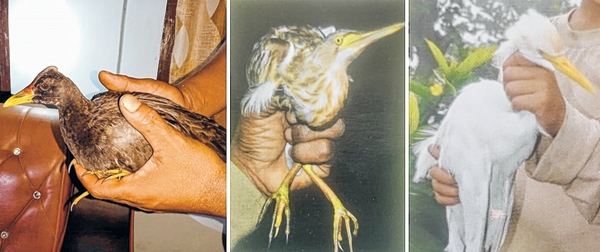
Though the birds die in thousands every year the number was high because the area is very rich in avifauna. But certain birds do not respond to this fatal instinct. According to the records maintained by Sudhin Sengupta of WII (who was then deputed by Wildlife Institute of India to investigate the mystery in early 1980s) and HP Phukan, (the then local DFO), there were 43 bird species which generally commit ‘suicide’ here. The list included Indian pitta, pond heron, partridges, green pigeons, bitterns, emerald doves, and other water birds like egrets, moorhens, Cotton teal, lesser whistling teal, many types of kingfishers etc.
There have not been any major migratory birds. The common birds like sparrows, mynas and thrushes do not respond to the siren call. In fact by 7 in the evening the birds being diurnal, should be asleep, instead they are attracted to Jatinga completely disoriented and confused. The lights dazzled them and they fly in to posts, walls, trees, bamboos and fall unconscious. Some simply hover above aimlessly to be brought down by using poles and sticks by the villagers. Some flies in and simply settle on the ground near the light.
Another earlier observation which formed a part of the mystery was that the birds refused food after they dropped from the sky. They came in fully dazed condition, those who didn’t die were tried to be brought to life. Another spanner is that the birds are mostly juvenile according to Dr Anwaruddin Choudhury (Mr Choudhury is a wildlife expert nicknamed Birdman of Assam). The one which dropped down on the 19th September night was also a juvenile. I examined a number photographs of earlier occasion and I noticed that almost all the birds captured were in condition of recovering and becoming normal. There are also observations that the birds definitely take food if not disturbed.
On 19th September, there was a little rain by around 8.30 pm and it was a windy day. The wind was carrying the fogs (or say clouds) very fast with trees swaying a lot. The wind here can move from north to south or south to north as other side is blocked by the high ridge of Barail Range. A bird came and dropped by the bird tower maintained by the Forest Department late in the evening. The bird was allowed to recover for two hours and released.
So, it is the lights and before the lights came, then also the natural disturbances propounded by Sudhin Sengupta could have been there in Jatinga but the mass “suicide” could have come only after lights came and human beings settled there. So, it is ultimately the wind and fogs (or clouds) and dark night that does the trick. I was observing the turbulent movement of low clouds in the dark of the night, it moved so fast disturbing the trees and it could disturb any bird’s nests too. (To be contd)
My two days at Haflong were very hectic. I reached there on the 19th September last and immediately was on my programme, but very limited as I reached late. On 20th also, I had a long itinerary. During day time, I thought of meeting the local Divisional Forest Officer and ask about the activities of the matter but I could not make it as I came back late from the local tours. The viewpoints were so wonderful with the ranges in the yonder after the first range was so blue and the ethnic village displaying all the 13 ethnic groups of Dima Hasao was so attractive. When I came back it was already four and I did not want to be unwanted guest in closing hours of office, but God's plan are always beyond human apprehension. When I went to the bird tower again for the second time in the evening at 7 pm, I saw a few vehicles at the road side and I thought there must be a few visitors. But lo and behold, up in the tower, there were three people whom I would want to meet the most, the Chief Conservator of Forests Mr Muanthang Tungnung, DFO Tuhin Langthasa and Ranger Lojendra Langthasa.
I was so fortunate to have a chance to know the programme of the Forest Department and present state of the ‘bird mystery’. In fact, Mr Tungnung and Tuhin Langthasa were coming back from a meeting at Guwahati. A local entrepreneur Mr Andy Hakmaosa was also present as a bonus, his presence also threw in more issues. I am thankful to the Chief Conservator of Forests and the Divisional Forest Officer for the publications and documents made available to me.
The bird mystery, though generally presumed to be a natural phenomenon may not be so. The first incidence of it was by the end of the last century when a newly settled Naga village used lights here in the evening, and then the mystery occurred. Prior to that, there was no means of knowing whether the birds have been dying or not and there has not been any report.
The Nagas then left the village thinking that there are evil spirits there. Then the new settlers were of Khasipnar (Jaintias) and being Christians they were not afraid of the incidence, rather it was thought to have been given by God for their food. In 1910, the people settling there have discovered that the incidence occurred only during August to October with hanging mist without any rain or little rain and on moonless evenings (around 7-9 pm). According to EP Gee, the whole thing was extraordinary, the phenomenon happens only in Jatinga. In other neighbouring villages, this didn’t happen even if lights are put on in the evening. EP Gee found that the conditions conducive for this phenomenon are : "It must be sometime between August 15 and October 31. September is the best month. It must be foggy, cloudy or misty. Slight rain is even better.
The wind must be from south to the north, otherwise no birds will come. There must be no moon. It happens only on really dark nights. The lights must be bright and circular, not beamed like the light from an electric torch or a car headlight. An open space is preferred though under the above conditions birds even enter houses. The best time is between 7 and 10 pm. As many as 200 birds have been killed by one man during one night."
It was observed that the birds were not attracted to other villages other than Jatinga and hence it has been named as Jatinga Bird Mystery. A village just 2 km north of Jatinga has no such phenomenon like this one. Villagers made attempts by using lights, no birds responded. But inside Jatinga also, it has been found that there is a well-defined strip of 200 m wide and about 1.5 km long where the mystery is confined (recently, B Brahma, IFS, Conservator of Forests reported that a village called Doiheng, about 4 km away from Jatinga is having similar phenomenon. It is a Hmar and Kuki village).
There was an observation that the magnetic field of the earth here at this locality might be different than that of the surrounding areas, but then the role of magnetic field is not pronounced in the diurnal and non-migratory birds here in question. Sudhin Sengupta believes that the gravity and magnetism here could have affected the nervous system of the victim birds. The birds always fly in against the wind, when the wind blows from south to north. In fact, the birds flying against the wind is their habit and for safety not to be blown away and in cloudy darkness of moonless, starless nights the wind unsettling them birds would be dislocated and disoriented flying towards light is for their safety and navigation. The direction of wind is important.
Then, the speed of the wind also have been quoted, a high speed wind being the cause of disorientation of the birds, but high speed winds do not occur on too many nights during this part of the year.
On the change of magnetic behaviour of earth, the DFO Mr Langthasa was of the opinion that the rain water getting inside the folds of rocks in earth’s surface and causing seasonal change in local magnetic behaviour of the earth to cause disorientation of birds as one of the reason of suicide was most unlikely. As already mentioned earlier, this year, rain has been quite heavy to optimise such disturbance but no increase in the intensity of the phenomenon has been noticed.
Though the birds die in thousands every year the number was high because the area is very rich in avifauna. But certain birds do not respond to this fatal instinct. According to the records maintained by Sudhin Sengupta of WII (who was then deputed by Wildlife Institute of India to investigate the mystery in early 1980s) and HP Phukan, (the then local DFO), there were 43 bird species which generally commit ‘suicide’ here. The list included Indian pitta, pond heron, partridges, green pigeons, bitterns, emerald doves, and other water birds like egrets, moorhens, Cotton teal, lesser whistling teal, many types of kingfishers etc.
There have not been any major migratory birds. The common birds like sparrows, mynas and thrushes do not respond to the siren call. In fact by 7 in the evening the birds being diurnal, should be asleep, instead they are attracted to Jatinga completely disoriented and confused. The lights dazzled them and they fly in to posts, walls, trees, bamboos and fall unconscious. Some simply hover above aimlessly to be brought down by using poles and sticks by the villagers. Some flies in and simply settle on the ground near the light.
Another earlier observation which formed a part of the mystery was that the birds refused food after they dropped from the sky. They came in fully dazed condition, those who didn’t die were tried to be brought to life. Another spanner is that the birds are mostly juvenile according to Dr Anwaruddin Choudhury (Mr Choudhury is a wildlife expert nicknamed Birdman of Assam). The one which dropped down on the 19th September night was also a juvenile. I examined a number photographs of earlier occasion and I noticed that almost all the birds captured were in condition of recovering and becoming normal. There are also observations that the birds definitely take food if not disturbed.
On 19th September, there was a little rain by around 8.30 pm and it was a windy day. The wind was carrying the fogs (or say clouds) very fast with trees swaying a lot. The wind here can move from north to south or south to north as other side is blocked by the high ridge of Barail Range. A bird came and dropped by the bird tower maintained by the Forest Department late in the evening. The bird was allowed to recover for two hours and released.
So, it is the lights and before the lights came, then also the natural disturbances propounded by Sudhin Sengupta could have been there in Jatinga but the mass “suicide” could have come only after lights came and human beings settled there. So, it is ultimately the wind and fogs (or clouds) and dark night that does the trick. I was observing the turbulent movement of low clouds in the dark of the night, it moved so fast disturbing the trees and it could disturb any bird’s nests too. (To be contd)