The Idea of Manipur
17 Jun 2023 01:06:58
M Asnikumar Singh
In the prevailing situation, Manipur and its humble people (who have always represented the best of Indian values) find themselves at a crossroad.
At such a critical juncture, the "idea of Manipur" ought to be solidly reaffirmed for the generations to come.
'Manipur' as a title (nomenclature) has been referred to our land, since the time of Pamheiba or Garibaniwaz (King) in the beginning of the 18th century. Before that the land had been indigenously known by a plethora of local names. However the Burmese remember us as Kathe; the Chinese and Shans call us Kase; Ahoms identify us as Makeli or Moglai.
State formation and Kingship started in the beginning of the first century AD. We have a recorded history since Circa 33 AD. In the same year the coronation of the first king Pakhangba took place at Kangla and the ceremony was attended by almost all the clan/tribe chiefs of both hills and valley.
They together witnessed the game of Sagol Kangjei (polo) just after the coronation ceremony ('Cheitharol Kumbaba' and 'Manipur Past & Present' Vol -1).
Although one is not very sure about the dates of the pre-historic period of Manipur; historians opine that our civilization is about 3000 years old in the hills and approx. 2500 years old in the valley. Makhel a primordial place at Mao is now recognised as the legendary place of common origin of oldest ethnic families of the land.
Today Manipur is the home of 37 ethnic groups. Manipuri language is the lingua-franca (communication language) of the people of Manipur. There are more than 35 living dialects in the State. Each ethnic group is proud of its dialect. Authorities have great difficulty to accommodate the dialects as medium of education, broadcasting, publication etc.
Racially we are predominantly Mongoloids. Our present population is about 3.2 million. The theory of Indo-Aryan or Tibeto-Burman origin still remains a polemic issue among scholars and historians. To me Manipur is a melting pot of many ethnic groups. Historical reasons like migration, amalgamation and settlement greatly influenced the people in terms of their cultural and material advancement.
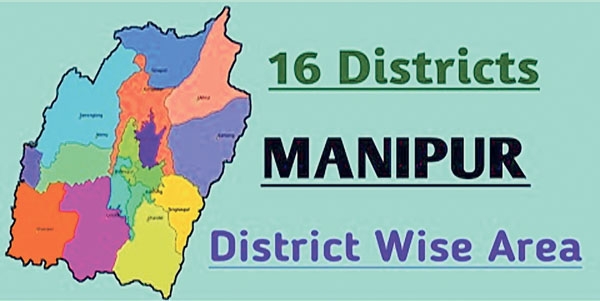
At present the geographical area of Manipur is about 22,327 sq. km. It is a hilly region with a plateau having an altitude of about 2500 ft above the sea level. Manipur is surrounded by Nagaland in the north, Myanmar in the east, Mizoram in the south, and Assam in the west.
In the past, the geographical area of Manipur fluctuated from time to time depending on the military might and capability of our erstwhile rulers. The Kingdom of Manipur had the largest geographical extent during Garibniwaz Maharaj whose area of influence and control extended beyond Chindwin river (Ningthi) in the east and beyond Brahmaputra in the south-west.
In modern period the present political boundary of Manipur was more or less recognized as early as 1826 (Treaty of Yandabo) and then in 1891 (Anglo- Manipuri war); by 1947 (Independence Act) and 1949 (Merger with India) Manipur as a geo-political entity was well established.
Manipur got political emancipation from British Raj in August 1947. With the enactment of the Manipur State Constitution Act, 1947 by the then King, Maharaj Bodh Chandra , the election of the Manipur Assembly (Parliament) was held in July 1948 on the basis of adult franchise, the first of its kind in entire sub-continent.
In all 52 Members were elected for a period of three years. It was a unicameral legislature. The law making and policy framing authority of the legislature was subject to the assent of the Maharaj. That was a kind of Constitutional Monarchy.
However Manipur got merged with the Dominion of India on 15 Oct 1949. With the application of the Constitution of India on 26 Jan, 1950 Manipur became a 'Part C' State of India. The Union Territories (laws) Act 1950 came into force in April and Chief Commissioner became the Adminis- trator of Manipur.
(To be contd)