The Manipur Violence; a persecution of Christians ?
|


Dr John Parrat
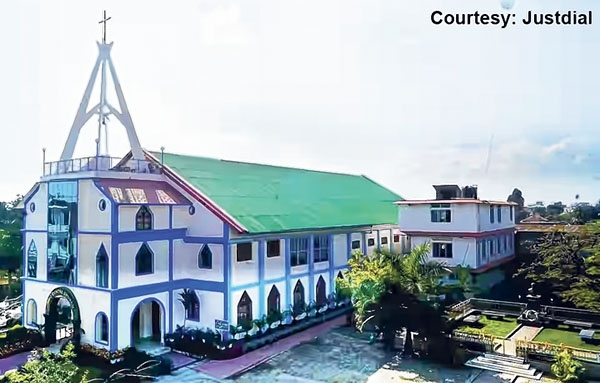
The secular press in the UK largely ignored the violent conflict in Manipur which began on May 3rd - at least until the emergence of a video showing sexual abuse in the village on Phainom two months later. The Christian media, however, both in the UK and in America, had seized upon the conflict, claiming it was a striking example of the persecution of Kuki tribal Christians by Hindu Meeteis. A headline on the web of the charity Opendoorsconfidently proclaimed it was an orchestrated attack on Christians, in which ‘Christians have been killed and Churches burnt down.’ (4th May). The Church Times followed with a headline article (on the basis of a single opinion) that,‘Religion is at the heart of Manipur clashes’ (9 June). The American based charity fiacona asserted that Christians had been evicted from their land as Churches were burnt down. An Archbishop in Kerala (3400km distant from the action) described it as ‘an ethnic cleansing of Christians’. Thus began a narrative, subsequently taken up by further publications that tribal Christians were being abused and killed because of their faith, and they were being forcibly removed from their land because of the violence of Hindu extremists.
It is perhaps not surprising that such a narrative should have seemed plausible, for after all Modi’s BJP Government in India had already come under justifiable criticism for its harassment of non-Hindu minorities elsewhere in the country. So the assumption that Manipur was yet another example of Modi’s aggressive Hindutva policy seemed all too reasonable. The crucial fallacy with this stance is an ignorance (widespread even in India itself) of the unique nature of the country’s North East region in general, and of Manipur in particular. Manipur’s history (which stretches back to the early centuries of the Christian era), its culture, its complex ethnic mix– racially Mongloid rather than Aryan-and its idiosyncratic form of Hinduism, are all markedly different from what has been pejoratively called the Hindi cowbelt.
Manipur is one of India’s smallest States, with a land area very not much greater than that of Wales. Its heartland is the Imphal valley, which includes Loktak lake, and which is the traditional home of the Meetei people (though their oral traditions show that they inhabited the surrounding hills long before settling in the valley). The northern hills are inhabited by the Naga people, although there are also some Kuki settlements, notably around Kangpokpi. The Kuki (a generic term embracing a number of different clans) inhabit the southern hills. Though some of these clans (‘Old Kukis’) have settled there for some time, the majority migrated in the 19th century, exchanging their traditional jhum (‘slash and burn’) agriculture for a more settled existence. More recently an influx of Chin (who are ethnically akin to the Kuki), fleeing the violent military regime in Myanmar with which Manipur has a 400 km unprotected border, has increased the Kuki-Chin population considerably, and this has posed considerable problems for both State and Central Governments. The Kuki-Chin, like the Nagas, were evangelised from the end of the 20th century, mainly by American Baptist and Presbyterian missionaries.
Roman Catholicism was permitted in the valley shortly after 1949, and has had a huge impact on education. Curiously there is also a small community of Kuki-Mizo professing Jews some of whom have made aliyah to Israel. To claim the Meetei are Hindus is only partially true. Brahmins introduced Vaishnavite Hinduism into Manipur in the 18th century. Meetei Hinduism is, as one scholar has put it, an ‘amalgum’ of Vaishnavism and the pre-Hindu traditional religion. The latter has revived during the last century in the form ‘Sanamaiism’ (named after one of the main traditional deities). Around 10% of Meetei are Muslims. Christianity has expanded considerably in the last few decades and there are an estimated 100,000 Meetei Christians. The Meeteis have lived peacefully together with the tribal peoples for decades, many of whom work in Imphal as public servants and other professionals. Thus the sudden outbreak of violence was wholly unexpected: many on both sides have expressed shocked dismay that peaceful co-existence should have been so brutally shattered.
The trigger for the violence is usually traced to the decision of the Manipur High Court, on 20th April, recommending that the Meetei should be considered for Scheduled Tribe status. Both Nagas and Kukis had been granted ST status when Manipur was annexed by India in 1949. Meeteis, as officially Hindus, were not considered as eligible. The crucial aspect of this, apart from preferential treatment appointment to Government posts (‘positive discrimination’), was the issue of land. As it stands Meeteis, who are more than 50% of the population are not able to buy land in the hill areas, which are reserved for STs. Meeteis can live there only with the agreement of local councils. The huge rally in Churchandpur, the main town in the Kukis hills, on May 3 was to demonstrate opposition the High Court’s ruling. The ‘peace march’ was organised under the banner of the All Tribal Students’ Union Manipur (ATSUM). Thousands of Kukis took part, and eye witnesses report that they were joined by armed cadres of Kuki militant groups. When the march ended it descended into violence, and activists began attacking the houses and businesses of Meeteis living in Chrachandpur. It is estimated that over a hundred Meetei buildings were burnt down, including three Meetei Baptist Churches, and Meeteis were physically attacked.
There were around seventy deaths and many injuries. The Manipur police present, which were 90% ethnic Kukis were unable or unwilling to restrain the mob. It is reported that the paramilitary Assam Rifles made no attempt to engage the rioters, but evacuated around 9,000 Meetei civilians to safe camps. As the news reached Imphal Meetei mobs reacted with revenge violence against the Kukis living there, many of whom occupied senior and professional positions in the state administration. Fuelled by false rumours Kuki areas were looted, burnt and decimated, and the houses of politicians, both Kuki and Meetei were attacked. Towards the end May there was a lull in the conflict, but localised armed fighting began again, especially in the peripheral areas where hill and valley met. This has been perceived by Meetei farmers as a land grab on the part of Kukis. The presence of the some 40,000 troops of the Indian army and paramilitaries has done little to restore normalcy. In fact, the civilian population has little trust in the paramilitaries, especially the Assam Rifles. This is largely because this force, recruited from India, was responsible for a catalogue of atrocities against civilians during the four decades from the 1970s during India’s attempt to eradicate separatist irredentist groups. Atrocities perpetrated by the paramilitaries included multiple homicides, rape and gang rape, abductions, beatings and other forms of abuse. No charges ever reached the Courts, since under the Armed Forces Special Powers Act the ‘security forces’ were given total immunity from prosecution. It is hardly surprising therefore that Manipuris do not see the military as contributing to their safety, and indeed the Meetei womens’ movement, the Meira Paibis (‘women with flaming torches’), are now protesting for the removal of the Assam Rifles from the State.
It is clear that the basic issue behind the conflict has little to do with religion. On the contrary, it concerns the possession land. The valley area in which the Meeteis live, is just 10% of the land area of the State, and ‘tribals’–Kuki and Naga–may live there and buy property. The remaining 90% is classed as ‘tribal land’, which, as we seen cannot be bought by Meeteis and they can only live and trade there with the agreement of tribal councils. So in effect more than 50% of the population is barred from 90% of the land. This is the dilemma has endured since the beginning of British control of Manipur in 1891 and is now enshrined in Indian ST legislation. The recommendation of the High Court to consider declaring Meeteis as ST was an attempt to begin to address this anomaly.
The land issue has spawned other problems. The Chief Minister, Biren Singh, has attempted to preserve the State forest lands in the hills from destruction and illegal settlement. Illegal occupation by migrant Chin for Myanmar has exacerbated this problem. A potentially even more serious threat has been the spread of opium production from Myanmar to the Kuki hills (Myanmar is the second biggest producer of opium in the world: the Times of India for 31st May examined what it termed ‘cross border narco-terrorism’). The ‘war’ on the drugs trade has involved the destruction of poppy fields, at Government order, carried out both by the Kuki police and the paramilitaries. An estimated 80,000 acres have been destroyed in the past five years. But at the same his has caused unrest among the day-wage labourers who rely on it for survival, and has angered the corrupt elites on both sides of the border who control the opium trade. The involvement of politicians and other high ranking elites was dramatically revealed when the Chief Minister pressurized a police Superintendant, Thounaojam Brinda, to drop her carefully documented prosecution against a former ADC Chairman (Indian Express for July 26th).
Behind all these issues stand the armed irredentist extremists like the Kuki National Army and Zomi Revolutionary Army (umbrella organisations which embrace some seventeen smaller groups), and which for decades have been agitating for a separate Kukiland which would include, besides the Kuki hills, swathes of Myanmar and Bangladesh and incorporate the State of Mizoram. The Indian Government had a truce (SoS, suspension of operations) with the KNA and ZRA, but this has in practice broken down. There is also evidence that armed Myanmarese (identifiable by their wearing of lungis) are fighting along alongside the Kuki militants in attacks on peripheral areas of the valley. The proliferation of sophisticated weapons, often of Chinese manufacture, has meant that the police, and sometimes the paramilitaries, have been outgunned. Thus militants, though relatively few in number, have been able to intimidate civilians in the interests of their own agenda. On the Meetei side, while most of the irredentist groups have faded in the last decades, there has been a growing influence of ultra-traditionalist groups like Arambai Tenggol and Meitei Leepun, whose actions have also on occasion been aggressively anti-tribal, and they too have been accused of anti-Christian atrocities.
The narrative of persecution of Christian in Manipur is a selective one, which ignores the complexity of the interlinking realities of the situation. It extrapolates from a limited number of accounts of personal tragedy to a general theory of violence perpetrated on tribal Christians by Hindu Meeteis. It is significant that the media in India itself, despite the actions of the BJP Government elsewhere in the country, does not include persecution of Christians as a factor in the violence. Indeed the BJP connection is puzzling. Seven out of the ten Christian Kuki MLAs (members of the Manipur State Legislative Assembly) belong to the BJP, and the leader of the militant United Kuki Liberation Front has claimed that his organisation actively assisted the BJP to gain power in the 2017 State election. A Kuki BJP Minister was one of the first victims of the violence in which he received life changing injuries. It is also significant that the Nagas of Manipur, who would also be affected if Meeteis are accorded ST status, have not reacted, but to the contrary, mainly through Christian institutions, are making strenuous attempts to mediate. Informed accounts of the destruction of Christian Churches, many of them in the villages and of local construction, also contradict narrative of Meetei Hindus persecuting Christian Kukis. Of the over 300 Churches torched more than a third belonged to Meetei Christian congregations. In addition dozens of Hindu shrines and mandaps, along with several ancient traditional religious sites, have been devastated by professing Christian Kukis. The evidence suggests that some Churches simply became collateral damage in the general mayhem (as is probably the case with the two or three Naga Churches) but it is quite likely that other Meetei Churches may have been vandalised by extremist Meetei groups. There is little to support the allegation by one Kuki Pastor, that Kuki Churches were deliberately targeted. A moving account of the violence in Imphal, in which Dr Tara Hangzo, a Kuki tribal executive, describes the flight of her family, indicates that an out of control mob attacked the houses of professionals first before turning on the Christian compound. Dr Hangzo had been living securely in the capital for decades, and explicitly declared the violence was ‘not at all’ a Hindu-Christian conflict (Times of India 3rd July). The Manipur Christian Churches Council issued a statement on the 17th July stating that ‘the ongoing ethnic violence is not a case of the dominant community (ie. Meeteis) attacking a Christian minority.’ They attributed the violence the illegal immigration of militants from Myanmar, and rejected the claim that it was an orchestrated attack on Christians in the State.
A meeting of Meetei Church leaders subsequently challenged ‘the narrative being presented to the world that the violence in Manipur is targeted especially at Christians.’ Dominic Lumon, the Catholic Archbishop of Imphal had much earlier stated that ‘it was categorically wrong to say that the disorder was a religious conflict.’ However he acknowledged that some ‘religiously motivated’ attacks might have taken place - probably referring to the devastation of some Churches by extremist ultra-Meetei groups (The Pillar 19th June). Likewise the United Christian Forum in North East India, in its appeal for prayers for peace, attributed the conflict to ‘a power struggle between different groups’ (Indian Express 11th July). The charismatic humanitarian and Churches’ spokesman, Philem Rohan Singh, has emphasised that the conflict is at root ethnic, not religious. As the highly decorated Manipuri Lt-Gen. Konsam Himalay Singh, now of the Institute of Defence and Strategic Studies, well put it, ‘this is not violence between Hindu and Christian, nor between tribal and non-tribal, but between groups of militants on both sides.’
Remarkably throughout all this conflict there have been moving examples on both sides of help and protection given to the other. The unanimous condemnation by individuals and civil groups on both sides of the appalling abuse in the village of Phainom, which has becomethe focus of so much media attention, has begun to bring the two ethnicities together in a common quest for justice, reconciliation and peace.’ But the violence in Manipur has also highlighted the danger Christian organisations which have the very laudable aim of exposing religious persecution, can be guilty of propagating misinformation by failing to investigate each alleged case thoroughly. The American website persecution.org is now engaging with academics to vet charges of persecution of Christians throughout the world. It is a course which other Christian organisations would do well to follow.
Kind courtesy-The Tablet. August 3, 2023.
John Parratt was formerly Professor of Third World Theologies at the University of Birmingham, UK. He has visited and researched in Manipur for over fifty years, and is author and co-author of several books on Manipur, including Wounded Land: Politics and Identity in Modern Manipur
The secular press in the UK largely ignored the violent conflict in Manipur which began on May 3rd - at least until the emergence of a video showing sexual abuse in the village on Phainom two months later. The Christian media, however, both in the UK and in America, had seized upon the conflict, claiming it was a striking example of the persecution of Kuki tribal Christians by Hindu Meeteis. A headline on the web of the charity Opendoorsconfidently proclaimed it was an orchestrated attack on Christians, in which ‘Christians have been killed and Churches burnt down.’ (4th May). The Church Times followed with a headline article (on the basis of a single opinion) that,‘Religion is at the heart of Manipur clashes’ (9 June). The American based charity fiacona asserted that Christians had been evicted from their land as Churches were burnt down. An Archbishop in Kerala (3400km distant from the action) described it as ‘an ethnic cleansing of Christians’. Thus began a narrative, subsequently taken up by further publications that tribal Christians were being abused and killed because of their faith, and they were being forcibly removed from their land because of the violence of Hindu extremists.
It is perhaps not surprising that such a narrative should have seemed plausible, for after all Modi’s BJP Government in India had already come under justifiable criticism for its harassment of non-Hindu minorities elsewhere in the country. So the assumption that Manipur was yet another example of Modi’s aggressive Hindutva policy seemed all too reasonable. The crucial fallacy with this stance is an ignorance (widespread even in India itself) of the unique nature of the country’s North East region in general, and of Manipur in particular. Manipur’s history (which stretches back to the early centuries of the Christian era), its culture, its complex ethnic mix– racially Mongloid rather than Aryan-and its idiosyncratic form of Hinduism, are all markedly different from what has been pejoratively called the Hindi cowbelt.
Manipur is one of India’s smallest States, with a land area very not much greater than that of Wales. Its heartland is the Imphal valley, which includes Loktak lake, and which is the traditional home of the Meetei people (though their oral traditions show that they inhabited the surrounding hills long before settling in the valley). The northern hills are inhabited by the Naga people, although there are also some Kuki settlements, notably around Kangpokpi. The Kuki (a generic term embracing a number of different clans) inhabit the southern hills. Though some of these clans (‘Old Kukis’) have settled there for some time, the majority migrated in the 19th century, exchanging their traditional jhum (‘slash and burn’) agriculture for a more settled existence. More recently an influx of Chin (who are ethnically akin to the Kuki), fleeing the violent military regime in Myanmar with which Manipur has a 400 km unprotected border, has increased the Kuki-Chin population considerably, and this has posed considerable problems for both State and Central Governments. The Kuki-Chin, like the Nagas, were evangelised from the end of the 20th century, mainly by American Baptist and Presbyterian missionaries.
Roman Catholicism was permitted in the valley shortly after 1949, and has had a huge impact on education. Curiously there is also a small community of Kuki-Mizo professing Jews some of whom have made aliyah to Israel. To claim the Meetei are Hindus is only partially true. Brahmins introduced Vaishnavite Hinduism into Manipur in the 18th century. Meetei Hinduism is, as one scholar has put it, an ‘amalgum’ of Vaishnavism and the pre-Hindu traditional religion. The latter has revived during the last century in the form ‘Sanamaiism’ (named after one of the main traditional deities). Around 10% of Meetei are Muslims. Christianity has expanded considerably in the last few decades and there are an estimated 100,000 Meetei Christians. The Meeteis have lived peacefully together with the tribal peoples for decades, many of whom work in Imphal as public servants and other professionals. Thus the sudden outbreak of violence was wholly unexpected: many on both sides have expressed shocked dismay that peaceful co-existence should have been so brutally shattered.
The trigger for the violence is usually traced to the decision of the Manipur High Court, on 20th April, recommending that the Meetei should be considered for Scheduled Tribe status. Both Nagas and Kukis had been granted ST status when Manipur was annexed by India in 1949. Meeteis, as officially Hindus, were not considered as eligible. The crucial aspect of this, apart from preferential treatment appointment to Government posts (‘positive discrimination’), was the issue of land. As it stands Meeteis, who are more than 50% of the population are not able to buy land in the hill areas, which are reserved for STs. Meeteis can live there only with the agreement of local councils. The huge rally in Churchandpur, the main town in the Kukis hills, on May 3 was to demonstrate opposition the High Court’s ruling. The ‘peace march’ was organised under the banner of the All Tribal Students’ Union Manipur (ATSUM). Thousands of Kukis took part, and eye witnesses report that they were joined by armed cadres of Kuki militant groups. When the march ended it descended into violence, and activists began attacking the houses and businesses of Meeteis living in Chrachandpur. It is estimated that over a hundred Meetei buildings were burnt down, including three Meetei Baptist Churches, and Meeteis were physically attacked.
There were around seventy deaths and many injuries. The Manipur police present, which were 90% ethnic Kukis were unable or unwilling to restrain the mob. It is reported that the paramilitary Assam Rifles made no attempt to engage the rioters, but evacuated around 9,000 Meetei civilians to safe camps. As the news reached Imphal Meetei mobs reacted with revenge violence against the Kukis living there, many of whom occupied senior and professional positions in the state administration. Fuelled by false rumours Kuki areas were looted, burnt and decimated, and the houses of politicians, both Kuki and Meetei were attacked. Towards the end May there was a lull in the conflict, but localised armed fighting began again, especially in the peripheral areas where hill and valley met. This has been perceived by Meetei farmers as a land grab on the part of Kukis. The presence of the some 40,000 troops of the Indian army and paramilitaries has done little to restore normalcy. In fact, the civilian population has little trust in the paramilitaries, especially the Assam Rifles. This is largely because this force, recruited from India, was responsible for a catalogue of atrocities against civilians during the four decades from the 1970s during India’s attempt to eradicate separatist irredentist groups. Atrocities perpetrated by the paramilitaries included multiple homicides, rape and gang rape, abductions, beatings and other forms of abuse. No charges ever reached the Courts, since under the Armed Forces Special Powers Act the ‘security forces’ were given total immunity from prosecution. It is hardly surprising therefore that Manipuris do not see the military as contributing to their safety, and indeed the Meetei womens’ movement, the Meira Paibis (‘women with flaming torches’), are now protesting for the removal of the Assam Rifles from the State.
It is clear that the basic issue behind the conflict has little to do with religion. On the contrary, it concerns the possession land. The valley area in which the Meeteis live, is just 10% of the land area of the State, and ‘tribals’–Kuki and Naga–may live there and buy property. The remaining 90% is classed as ‘tribal land’, which, as we seen cannot be bought by Meeteis and they can only live and trade there with the agreement of tribal councils. So in effect more than 50% of the population is barred from 90% of the land. This is the dilemma has endured since the beginning of British control of Manipur in 1891 and is now enshrined in Indian ST legislation. The recommendation of the High Court to consider declaring Meeteis as ST was an attempt to begin to address this anomaly.
The land issue has spawned other problems. The Chief Minister, Biren Singh, has attempted to preserve the State forest lands in the hills from destruction and illegal settlement. Illegal occupation by migrant Chin for Myanmar has exacerbated this problem. A potentially even more serious threat has been the spread of opium production from Myanmar to the Kuki hills (Myanmar is the second biggest producer of opium in the world: the Times of India for 31st May examined what it termed ‘cross border narco-terrorism’). The ‘war’ on the drugs trade has involved the destruction of poppy fields, at Government order, carried out both by the Kuki police and the paramilitaries. An estimated 80,000 acres have been destroyed in the past five years. But at the same his has caused unrest among the day-wage labourers who rely on it for survival, and has angered the corrupt elites on both sides of the border who control the opium trade. The involvement of politicians and other high ranking elites was dramatically revealed when the Chief Minister pressurized a police Superintendant, Thounaojam Brinda, to drop her carefully documented prosecution against a former ADC Chairman (Indian Express for July 26th).
Behind all these issues stand the armed irredentist extremists like the Kuki National Army and Zomi Revolutionary Army (umbrella organisations which embrace some seventeen smaller groups), and which for decades have been agitating for a separate Kukiland which would include, besides the Kuki hills, swathes of Myanmar and Bangladesh and incorporate the State of Mizoram. The Indian Government had a truce (SoS, suspension of operations) with the KNA and ZRA, but this has in practice broken down. There is also evidence that armed Myanmarese (identifiable by their wearing of lungis) are fighting along alongside the Kuki militants in attacks on peripheral areas of the valley. The proliferation of sophisticated weapons, often of Chinese manufacture, has meant that the police, and sometimes the paramilitaries, have been outgunned. Thus militants, though relatively few in number, have been able to intimidate civilians in the interests of their own agenda. On the Meetei side, while most of the irredentist groups have faded in the last decades, there has been a growing influence of ultra-traditionalist groups like Arambai Tenggol and Meitei Leepun, whose actions have also on occasion been aggressively anti-tribal, and they too have been accused of anti-Christian atrocities.
The narrative of persecution of Christian in Manipur is a selective one, which ignores the complexity of the interlinking realities of the situation. It extrapolates from a limited number of accounts of personal tragedy to a general theory of violence perpetrated on tribal Christians by Hindu Meeteis. It is significant that the media in India itself, despite the actions of the BJP Government elsewhere in the country, does not include persecution of Christians as a factor in the violence. Indeed the BJP connection is puzzling. Seven out of the ten Christian Kuki MLAs (members of the Manipur State Legislative Assembly) belong to the BJP, and the leader of the militant United Kuki Liberation Front has claimed that his organisation actively assisted the BJP to gain power in the 2017 State election. A Kuki BJP Minister was one of the first victims of the violence in which he received life changing injuries. It is also significant that the Nagas of Manipur, who would also be affected if Meeteis are accorded ST status, have not reacted, but to the contrary, mainly through Christian institutions, are making strenuous attempts to mediate. Informed accounts of the destruction of Christian Churches, many of them in the villages and of local construction, also contradict narrative of Meetei Hindus persecuting Christian Kukis. Of the over 300 Churches torched more than a third belonged to Meetei Christian congregations. In addition dozens of Hindu shrines and mandaps, along with several ancient traditional religious sites, have been devastated by professing Christian Kukis. The evidence suggests that some Churches simply became collateral damage in the general mayhem (as is probably the case with the two or three Naga Churches) but it is quite likely that other Meetei Churches may have been vandalised by extremist Meetei groups. There is little to support the allegation by one Kuki Pastor, that Kuki Churches were deliberately targeted. A moving account of the violence in Imphal, in which Dr Tara Hangzo, a Kuki tribal executive, describes the flight of her family, indicates that an out of control mob attacked the houses of professionals first before turning on the Christian compound. Dr Hangzo had been living securely in the capital for decades, and explicitly declared the violence was ‘not at all’ a Hindu-Christian conflict (Times of India 3rd July). The Manipur Christian Churches Council issued a statement on the 17th July stating that ‘the ongoing ethnic violence is not a case of the dominant community (ie. Meeteis) attacking a Christian minority.’ They attributed the violence the illegal immigration of militants from Myanmar, and rejected the claim that it was an orchestrated attack on Christians in the State.
A meeting of Meetei Church leaders subsequently challenged ‘the narrative being presented to the world that the violence in Manipur is targeted especially at Christians.’ Dominic Lumon, the Catholic Archbishop of Imphal had much earlier stated that ‘it was categorically wrong to say that the disorder was a religious conflict.’ However he acknowledged that some ‘religiously motivated’ attacks might have taken place - probably referring to the devastation of some Churches by extremist ultra-Meetei groups (The Pillar 19th June). Likewise the United Christian Forum in North East India, in its appeal for prayers for peace, attributed the conflict to ‘a power struggle between different groups’ (Indian Express 11th July). The charismatic humanitarian and Churches’ spokesman, Philem Rohan Singh, has emphasised that the conflict is at root ethnic, not religious. As the highly decorated Manipuri Lt-Gen. Konsam Himalay Singh, now of the Institute of Defence and Strategic Studies, well put it, ‘this is not violence between Hindu and Christian, nor between tribal and non-tribal, but between groups of militants on both sides.’
Remarkably throughout all this conflict there have been moving examples on both sides of help and protection given to the other. The unanimous condemnation by individuals and civil groups on both sides of the appalling abuse in the village of Phainom, which has becomethe focus of so much media attention, has begun to bring the two ethnicities together in a common quest for justice, reconciliation and peace.’ But the violence in Manipur has also highlighted the danger Christian organisations which have the very laudable aim of exposing religious persecution, can be guilty of propagating misinformation by failing to investigate each alleged case thoroughly. The American website persecution.org is now engaging with academics to vet charges of persecution of Christians throughout the world. It is a course which other Christian organisations would do well to follow.
Kind courtesy-The Tablet. August 3, 2023.
John Parratt was formerly Professor of Third World Theologies at the University of Birmingham, UK. He has visited and researched in Manipur for over fifty years, and is author and co-author of several books on Manipur, including Wounded Land: Politics and Identity in Modern Manipur