Efforts on conservation and genetic improvement of the State tree Uningthou
|


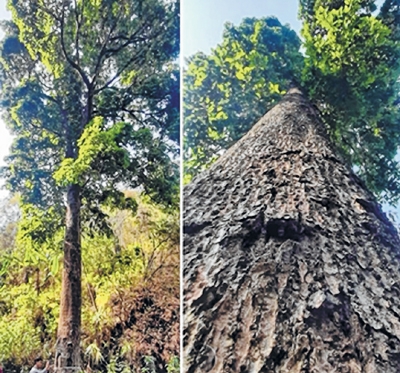
Yengkhom Devajit
In 2021, we met with a striking realization that efforts are needed for conservation and mass propagation of the State tree of Manipur, Uningthou, which had been rare in sightings. Despite its cultural significance and eco- nomic importance, crucial details about its taxonomy, ecology, silviculture, wood characteristics, and conservation status were either fragmented or completely lacking.
The Laboratory for Conservation and Genetic Improvement of Forest Trees (Lab C&GIFT), Department of Forestry, Mani- pur University, and State Forest Development Agen-cy (SFDA), Manipur Forest Department partnered with the aim to bridge this knowledge gap. Together, a comprehensive research effort was aimed not just at documenting Uningthou but also at conserving and enhancing it for future generations.
A Timber of Value
Our investigation revealed why Uningthou has been treasured for generations. It is a substantial timber-yielding species, prized for its durability and workability. According to the State Forest Department of Manipur, Uningthou timber falls into the ‘A1’ category, used for premium furniture and construction. We found that the wood densities range from 450 kg/m³ to 800 kg/m³, highlighting its variation and adaptability.
During a 2022 survey of local sawmills, we found that round log prices ranged between Rs 760 and Rs 800 per cubic foot, while lumber fetched Rs 850 to Rs 1000 per cubic foot. Demand in the local furniture market remains robust, placing pressure on natural populations and raising a clear call for genetic improvement to balance utility with sustainability.
Geographical Distribution
In the forests of Manipur, Uningthou stands tall between 1000 and 2100 meters above sea level, spread across six forest divisions-Churachandpur, Noney, Senapati, Tengnou-pal, Tamenglong, and Ukhrul. Beyond Manipur, it extends its reach into parts of Assam, Arunachal Pra-desh, Meghalaya, and Naga- land. Despite this diverse range, the populations are isolated and fragmented. For this reason, genetic improvement through conventional selection and ex-situ conservation emerged as an urgent need, both for productivity and long-term preservation.
Challenges for Identification
The scientific journey to accurately identify Uning-thou has not been straight- forward. The genus of the species, Phoebe is taxo-nomically ambiguous, with eight accepted species currently recognized in the Indo-Burmese region. Through extensive study, we confirmed that the Phoebe bootanica (Meisn.) M Gangop is a taxono-mically accepted name for the species, and is distinct, largely due to a key diagnostic trait, ie, its pedicels are articulated at the base, allowing the fruit or flower to detach cleanly, a feature absent in other species.
Another unique identifier is the fruiting perianth comprising six persistent tepals (three inner and three outer) that anchor the fruit to the peduncle. In addition, Uningthou is characterized by dense bud scale scars, pubescent inflorescences, and broad leaves with a glaucous underside.
Interestingly, the first herbarium specimen was collected in 1893 by HH Haines from West Sikkim and is preserved at the Royal Botanical Garden, Kew (Catalogue no. K000778867). Species like P hainesiana, P goalpa-ren-sis, and P cooperiana were once considered separate, but have now been merged under P bootanicaas syno- nyms. Of all the species of the Indo-Burma re- gion, P attenuata bears the closest resemblance but differs in its smaller flowers and non-articulated pedicels.
Threat and Conservation Status Today, Uning- thou is on the edge of extinction. It is officially listed as “Endangered” on the IUCN Red List (https://www. iucnredlist.org/species/177756483/62020480).
(To be contd)