Efforts on conservation and genetic improvement of the State tree Uningthou
|


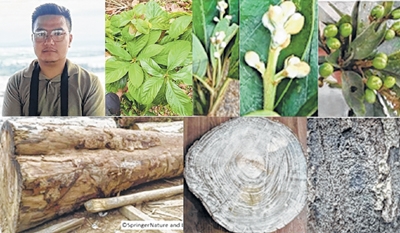
Yengkhom Devajit
Contd from previous issue
Our surveys confirmed a severe population decline in Manipur.
The primary reasons are unsustainable harvesting and illegal logging, fuelled by high market demand. Adding to the pressure are shifting cultivation and the lack of natural regeneration, which are eroding both population size and genetic diversity.
Regeneration Fitness : A Bottleneck in Recovery
Natural regeneration has proven to be one of Uningthou’s biggest challenges. Its recalcitrant seeds, which cannot tolerate drying or prolonged storage, make germination in the wild difficult. Among all the surveyed areas, only Ta-menglong showed promi- sing natural regeneration.
Complicating matters, seedlings are highly shade-dependent and perish under direct sunlight, an increasing threat due to human disturbances.
Our efforts in artificial propagation showed moderate success through seeds, with up to 50% germination. However, vegetative propagation has been largely unsuccessful. Even under auxin hormone treatments, very few cuttings were rooted, revealing a natural difficulty with vegetative reproduction, some- thing we’ll need to study more closely.
Genetic Improvement and Ex-Situ Conservation
To tackle all these issues proactively, we adopted a rigorous genetic improvement strategy focused on selection and breeding. Our work began by identifying plus trees (phenotypically superior trees) with individuals showing superior traits such as height, clear bole height, girth, bark thickness, and wood density. Using a selection index scoring system, we evaluated these traits meticu- lously. Wood density was measured using the gravimetric method, involving the ratio of oven-dried weight to the fresh weight of core samples extracted using a Pressler’s increment borer.
From the selected plus trees (phenotypically superior trees), we collected seeds and cuttings and established a nursery propagation trial at Manipur University’s Department of Forestry.We selected 40 superior individuals from the propagated seedlings, each tagged and recorded properly, to form the foundation of a germplasm bank.
India’s First Germplasm Bank of Uningthou
In a landmark achievement, the Manipur Forest Department established India’s first National germ- plasm bank for Uningthou in the Nongmaiching Hill (GPS location - 24°47’48’’N, 94°1’40’’E) of Imphal East in late 2024, for ex-situ conservation, with the support of the Department of Forestry, Manipur University.
The germplasm bank will safeguard the genetic heritage of Uningthou and serve as a dependable resource for restoration efforts, scientific research, and the production of quality planting stock. It guarantees that Uningthou will not fade into memory but will continue to flourish and shape the landscapes where it rightfully belongs.