Of horses, humans and hollow work Why Manipur’s work culture produces fatigue, not progress
|


Dr Raj Singh
When Japan’s first woman Prime Minister, Sanae Takaichi, declared that citizens should “work like a horse” and discard “work-life balance” as a Western luxury, it reignited a global debate on the meaning of productivity. A week later, Finland’s former Prime Minister Sanna Marin proposed the exact opposite - a four-day work week and six-hour day, insisting that “the future of productivity lies in balance, not burnout.”
Their two statements - one glorifying endless toil, the other celebrating deliberate rest seem oceans apart. Yet their contrasting philosophies resonate deeply in an unlikely corner of the world : Manipur, a small, strife-torn Indian State where people seem to work endlessly yet achieve little. Not because they lack talent or energy, but because their work environment rewards neither honesty nor efficiency.
Here, presenteeism, absenteeism, and systemic corruption have become the triad that defines labour - a culture where everyone is seen to be working, few actually are, and productivity flows only when “speed money oils the machine.”
The Irony of Hard Work without Outcome
In theory, Manipuris are among India’s most industrious people. The farmer toils from dawn; the teacher takes extra tuitions; the officer stays late at the office; the entrepreneur runs from pillar to post. Yet, the results are thin. Roads remain half-built, files move only after palms are greased, and the honest worker often feels like an alien.
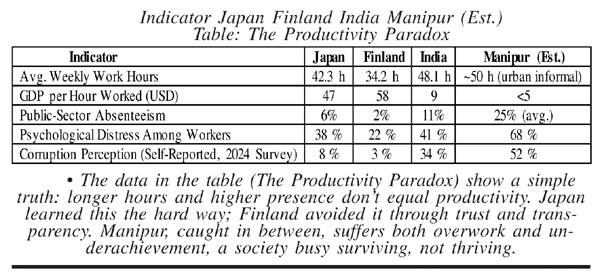
The paradox recalls Takaichi’s Japan - a country that once made long hours its religion, only to find diminishing returns. The OECD 2024 report revealed that Japan, despite working over 42 hours a week on average, ranks below the OECD median in productivity per hour, while countries with shorter workweeks like Finland and Germany outperform it.
In Manipur, this paradox is amplified by dysfunction: people are overworked, but the system underperforms. As one young Government Engineer confessed, “We attend office every day, but work begins only when ‘something moves under the table.’ Efficiency isn’t rewarded; networking is.”
The Presenteeism Trap: Seen, Not Productive
In much of India, but especially in Manipur, being present has become more important than being productive. This phenomenon, presenteeism, is a relic of feudal bureaucracy where visibility equals loyalty. In most Government offices, clerks clock in early, shuffle papers meaninglessly, or pretend busyness on phones. Meetings abound, memos fly, but output remains invisible.
A 2023 internal audit of Manipur’s Public Works Department revealed that only 34% of projects were completed on schedule, though 92% of employees had perfect attendance. Presence without performance has become the norm - a modern karoshi without the productivity.
Contrast this with Finland’s approach: focus on results, not presence. There, an employee can leave early if their work is done; in Manipur, one must stay late to look diligent, even if nothing gets accomplished. The State thus resembles an engine running on neutral gear: roaring, noisy, but motionless.
Absenteeism: The Silent Partner in Decay
Ironically, presenteeism in Manipur coexists with its twin evil - absenteeism. Many Government schools, health centres, and offices operate in “ghost mode.”
A 2022 survey by the Centre for Policy Research (CPR) found that in Manipur’s hill districts, one in four Government employees were absent from duty on a given day, often living in Imphal or even outside the State.
When presence is performative and absence is unpunished, institutions decay. The manipulative dance between being seen and being missing destroys accountability. In such an environment, citizens lose faith not only in Government but also in the moral logic of work itself.
Corruption: The Real Currency of Labour
Then comes the most corrosive element: corruption as a lubricant. It is said in jest in Imphal: “Work doesn’t move by file, it moves by feel.” The so-called “speed money” culture has become so normalized that efficiency depends less on competence and more on cash flow.
A contractor seeking payment for completed work must “grease” several desks; an applicant for a teaching job must “contribute” to the process. In effect, the economy of bribery has replaced the economy of merit.
A 2023 study by Transparency India ranked Manipur among the top five Indian States where “administrative tasks are routinely expedited by unofficial payments.” In other words, corruption isn’t an exception; it’s the workflow.
This explains why productivity remains stagnant despite high labour intensity. When honesty slows the system, and corruption speeds it up, efficiency loses all meaning. The moral economy becomes inverted. Laziness is disguised as survival.
Lessons from Finland’s Balance Model
Finland’s proposed four-day work week may sound extravagant for a poor State like Manipur, but the philosophy behind it - trust-based efficiency, is transformative. Finnish firms focus on output metrics, invest in automation, and maintain low corruption levels through strong ethics education. The result : workers enjoy rest, yet produce more.
A 2022 Microsoft Japan pilot, ironically in the land of overwork, found a 40% productivity boost when employees worked fewer days. The reason ? More focus, less fatigue. Imagine such discipline applied in Manipur: four honest days could easily outperform seven corrupt ones.
Why the Finnish Idea Fits India More Than Japan’s
India’s Prime Minister Narendra Modi often invokes hard work as a moral duty, and rightly so in a Nation striving for growth. But in States like Manipur, hard work without integrity only deepens decay. The challenge is not laziness but misdirected energy.
Finland’s philosophy, work smarter, live better, could revolutionize India’s governance, where time, not outcome, is still the performance metric. Pilot projects on flexible schedules and productivity-linked evaluation in Indian Railways and Karnataka’s IT sector have already yielded positive results.
If India aspires to be a $5 trillion economy, it cannot afford bureaucracies where files move more slowly than glaciers and progress depends on envelopes. Productivity must be redefined, from man-hours to meaningful outcomes.
Manipur’s Dilemma: Energy Without Ethics
Manipur’s youth are vibrant, educated, and restless. But their work ecosystem suffocates initiative. Offices reward conformity; contracts reward contacts. Presenteeism keeps the honest chained to their chairs; absenteeism frees the corrupt to prosper elsewhere.
The tragedy is moral, not material. A young officer in the Power Department admitted, “I used to be idealistic, but files don’t move unless I play along. So now I’m just practical.”
This slow corrosion of ethics - death by small compromises, has made Manipur’s economy less about productivity and more about performativity.
From Horses to Humans: Rethinking the Meaning of Work
The metaphor of Takaichi’s “horse” is powerful. But horses don’t choose their burden. Humans do. Finland’s Marin trusts citizens as thinking adults who can self-regulate work and rest. Manipur’s system, by contrast, treats workers as both beasts of burden and opportunists to be watched, blamed, and occasionally bribed.
The result is neither Japanese efficiency nor Finnish happiness, but a peculiar hybrid: overworked yet underperforming, busy yet broke.
A Way Forward for Manipur
1. Replace Attendance with Accountability: Introduce digital attendance tied to measurable outputs, not mere presence.
2. Performance-Linked Pay: Reward efficiency and integrity; penalize delays and corruption.
3. Transparent File Tracking : Digital dashboards should publicly display the stage of every file, ending “speed money” dependency.
4. Work-Life Balance in Public Service: Encourage 5-day workweeks, mental health programs, and regular audits of work quality.
5. Ethics in Education: Embed honesty, responsibility, and civic duty into school curricula- Finland’s secret weapon.
6. Volunteerism and Civic Pride: Channel idle youth into structured community projects that rebuild trust in work and the nation.
Conclusion: Balance as a Moral Imperative
Work-life balance is not just about leisure; it is about restoring ethics and purpose to work itself. Japan’s call for harder labour may have rebuilt a war-torn Nation, but in places like Manipur, where corruption is institutional and fatigue is chronic, harder work only strengthens dysfunction.
Finland’s model - humane, accountable, transparent- offers a template for India’s next leap. The challenge is not to imitate its short hours, but to embrace its long vision: a culture where honesty is rewarded, presence means productivity, and work once again becomes a matter of pride, not pretense.
In Manipur, the path to prosperity may begin not with working harder but with working cleaner, fairer, and smarter.
The author is a Manipuri expat settled in Canada. He can be reached at [email protected].
When Japan’s first woman Prime Minister, Sanae Takaichi, declared that citizens should “work like a horse” and discard “work-life balance” as a Western luxury, it reignited a global debate on the meaning of productivity. A week later, Finland’s former Prime Minister Sanna Marin proposed the exact opposite - a four-day work week and six-hour day, insisting that “the future of productivity lies in balance, not burnout.”
Their two statements - one glorifying endless toil, the other celebrating deliberate rest seem oceans apart. Yet their contrasting philosophies resonate deeply in an unlikely corner of the world : Manipur, a small, strife-torn Indian State where people seem to work endlessly yet achieve little. Not because they lack talent or energy, but because their work environment rewards neither honesty nor efficiency.
Here, presenteeism, absenteeism, and systemic corruption have become the triad that defines labour - a culture where everyone is seen to be working, few actually are, and productivity flows only when “speed money oils the machine.”
The Irony of Hard Work without Outcome
In theory, Manipuris are among India’s most industrious people. The farmer toils from dawn; the teacher takes extra tuitions; the officer stays late at the office; the entrepreneur runs from pillar to post. Yet, the results are thin. Roads remain half-built, files move only after palms are greased, and the honest worker often feels like an alien.
The paradox recalls Takaichi’s Japan - a country that once made long hours its religion, only to find diminishing returns. The OECD 2024 report revealed that Japan, despite working over 42 hours a week on average, ranks below the OECD median in productivity per hour, while countries with shorter workweeks like Finland and Germany outperform it.
In Manipur, this paradox is amplified by dysfunction: people are overworked, but the system underperforms. As one young Government Engineer confessed, “We attend office every day, but work begins only when ‘something moves under the table.’ Efficiency isn’t rewarded; networking is.”
The Presenteeism Trap: Seen, Not Productive
In much of India, but especially in Manipur, being present has become more important than being productive. This phenomenon, presenteeism, is a relic of feudal bureaucracy where visibility equals loyalty. In most Government offices, clerks clock in early, shuffle papers meaninglessly, or pretend busyness on phones. Meetings abound, memos fly, but output remains invisible.
A 2023 internal audit of Manipur’s Public Works Department revealed that only 34% of projects were completed on schedule, though 92% of employees had perfect attendance. Presence without performance has become the norm - a modern karoshi without the productivity.
Contrast this with Finland’s approach: focus on results, not presence. There, an employee can leave early if their work is done; in Manipur, one must stay late to look diligent, even if nothing gets accomplished. The State thus resembles an engine running on neutral gear: roaring, noisy, but motionless.
Absenteeism: The Silent Partner in Decay
Ironically, presenteeism in Manipur coexists with its twin evil - absenteeism. Many Government schools, health centres, and offices operate in “ghost mode.”
A 2022 survey by the Centre for Policy Research (CPR) found that in Manipur’s hill districts, one in four Government employees were absent from duty on a given day, often living in Imphal or even outside the State.
When presence is performative and absence is unpunished, institutions decay. The manipulative dance between being seen and being missing destroys accountability. In such an environment, citizens lose faith not only in Government but also in the moral logic of work itself.
Corruption: The Real Currency of Labour
Then comes the most corrosive element: corruption as a lubricant. It is said in jest in Imphal: “Work doesn’t move by file, it moves by feel.” The so-called “speed money” culture has become so normalized that efficiency depends less on competence and more on cash flow.
A contractor seeking payment for completed work must “grease” several desks; an applicant for a teaching job must “contribute” to the process. In effect, the economy of bribery has replaced the economy of merit.
A 2023 study by Transparency India ranked Manipur among the top five Indian States where “administrative tasks are routinely expedited by unofficial payments.” In other words, corruption isn’t an exception; it’s the workflow.
This explains why productivity remains stagnant despite high labour intensity. When honesty slows the system, and corruption speeds it up, efficiency loses all meaning. The moral economy becomes inverted. Laziness is disguised as survival.
Lessons from Finland’s Balance Model
Finland’s proposed four-day work week may sound extravagant for a poor State like Manipur, but the philosophy behind it - trust-based efficiency, is transformative. Finnish firms focus on output metrics, invest in automation, and maintain low corruption levels through strong ethics education. The result : workers enjoy rest, yet produce more.
A 2022 Microsoft Japan pilot, ironically in the land of overwork, found a 40% productivity boost when employees worked fewer days. The reason ? More focus, less fatigue. Imagine such discipline applied in Manipur: four honest days could easily outperform seven corrupt ones.
Why the Finnish Idea Fits India More Than Japan’s
India’s Prime Minister Narendra Modi often invokes hard work as a moral duty, and rightly so in a Nation striving for growth. But in States like Manipur, hard work without integrity only deepens decay. The challenge is not laziness but misdirected energy.
Finland’s philosophy, work smarter, live better, could revolutionize India’s governance, where time, not outcome, is still the performance metric. Pilot projects on flexible schedules and productivity-linked evaluation in Indian Railways and Karnataka’s IT sector have already yielded positive results.
If India aspires to be a $5 trillion economy, it cannot afford bureaucracies where files move more slowly than glaciers and progress depends on envelopes. Productivity must be redefined, from man-hours to meaningful outcomes.
Manipur’s Dilemma: Energy Without Ethics
Manipur’s youth are vibrant, educated, and restless. But their work ecosystem suffocates initiative. Offices reward conformity; contracts reward contacts. Presenteeism keeps the honest chained to their chairs; absenteeism frees the corrupt to prosper elsewhere.
The tragedy is moral, not material. A young officer in the Power Department admitted, “I used to be idealistic, but files don’t move unless I play along. So now I’m just practical.”
This slow corrosion of ethics - death by small compromises, has made Manipur’s economy less about productivity and more about performativity.
From Horses to Humans: Rethinking the Meaning of Work
The metaphor of Takaichi’s “horse” is powerful. But horses don’t choose their burden. Humans do. Finland’s Marin trusts citizens as thinking adults who can self-regulate work and rest. Manipur’s system, by contrast, treats workers as both beasts of burden and opportunists to be watched, blamed, and occasionally bribed.
The result is neither Japanese efficiency nor Finnish happiness, but a peculiar hybrid: overworked yet underperforming, busy yet broke.
A Way Forward for Manipur
1. Replace Attendance with Accountability: Introduce digital attendance tied to measurable outputs, not mere presence.
2. Performance-Linked Pay: Reward efficiency and integrity; penalize delays and corruption.
3. Transparent File Tracking : Digital dashboards should publicly display the stage of every file, ending “speed money” dependency.
4. Work-Life Balance in Public Service: Encourage 5-day workweeks, mental health programs, and regular audits of work quality.
5. Ethics in Education: Embed honesty, responsibility, and civic duty into school curricula- Finland’s secret weapon.
6. Volunteerism and Civic Pride: Channel idle youth into structured community projects that rebuild trust in work and the nation.
Conclusion: Balance as a Moral Imperative
Work-life balance is not just about leisure; it is about restoring ethics and purpose to work itself. Japan’s call for harder labour may have rebuilt a war-torn Nation, but in places like Manipur, where corruption is institutional and fatigue is chronic, harder work only strengthens dysfunction.
Finland’s model - humane, accountable, transparent- offers a template for India’s next leap. The challenge is not to imitate its short hours, but to embrace its long vision: a culture where honesty is rewarded, presence means productivity, and work once again becomes a matter of pride, not pretense.
In Manipur, the path to prosperity may begin not with working harder but with working cleaner, fairer, and smarter.
The author is a Manipuri expat settled in Canada. He can be reached at [email protected].