Mera Hou Chongba highlights hill-valley bond
|


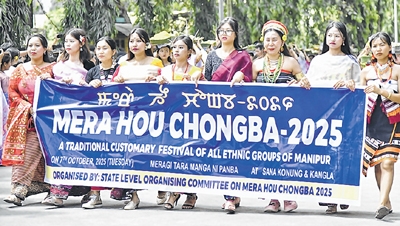
OSR/DIPR
IMPHAL, Oct 7: As celebrated every year on the 15th day of the Manipuri calendar month Mera, the Mera Hou Chongba 2025 was celebrated today at the royal palace and Kangla.
Mera Hou Chongba festival is a special festival in the sense that it celebrates the unbreakable bond shared between hill people and plain people and is participated by both plain people and hill people including those from remote and far off corners of Manipur.
Mera Hou Chongba, also known as Mera Waayungba or Mera Thaomei Thaanba, is one of the oldest and most significant traditional festivals of Manipur. It is celebrated by all indigenous ethnic communities of the State, including the Meitei people and tribes such as the Tangkhul, Kabui, Anal, Aimol, Chiru, Chothe, Kharam, Koireng, Kom, among others.
This year too, the festival was celebrated on the theme of strengthening the bond of brotherhood shared between hill people and plain people, bringing peace, harmony and stability, and making Manipur a strong and progressive State.
The festival started in the morning with a grand procession participated by both hill people and plain people from the royal palace to Kangla where “Men Tongba” and “Yenkhong Tamba” rituals were performed.
The afternoon session of the festival was also held at Kangla and it was graced by titular king of Manipur and Rajya Sabha Member Meidingu Leishemba Sanajaoba as the chief guest.
Several village chiefs representing various indigenous tribes from across the State also took part in the festival, making it a truly inclusive event.
There, cultural dance and music items were presented by different communities of both the hills and the valley.
One major and striking feature of the festival was exchange of gifts between hill people and plain people.
A symbolic exchange of home-grown produce, including fruits, vegetables, and local delicacies, also took place—reflecting the spirit of mutual respect, cooperation, and shared prosperity that defines the festival.
Speaking on the occasion, Leishemba Sanajaoba stated that the Mera Hou Chongba festival celebrated at Kangla and the royal palace is the only festival of Manipur, jointly participated by both the hill people and the plain people.
Citing ancestors, Leishemba Sanajaoba stated that the Mera Hou Chongba festival was introduced by Ebudhou Pakhangba.
Generally, each of the festivals celebrated across the world is based on a single religion or faith, tradition and is celebrated by a single community.
However, Mera Hou Chongba is not based on any single religion or faith and is not restricted to any single community. It is a unique festival open to diverse communities, he said.
That is why, Mera Hou Chongba is described as a common customary and traditional festival of the indigenous people of Manipur, he said and called upon all the communities living together in Manipur to strengthen the bond of fraternity, build unity and stand firm and together to protect Manipur.
He further underscored the importance of preserving this age-old tradition of Mera Hou Chongba and passing down its values to the younger generations.
Highlighting the symbolic ritual of Mera Waa Yungba—the lighting of the lamp—the titular king said it represents the bond of assurance and safety between the brothers from the hills and the valley, signifying mutual trust, peace, and harmony.
Leishemba Sanajaoba expressed heartfelt gratitude to the Governor for arranging such a grand celebration in a short span of time. He also lauded the collective efforts of all concerned departments and organisers for making the event a success.
18 cultural troupes from Sana Konung, Senapati, Ukhrul, Noney, Kangpokpi, Andro, Tamenglong, Sugnu, Tengnoupal, Senapati, Sawombung etc presented their cultural item in the afternoon.
A souvenir on Mera Hou Chongba 2025 was also released by the State Level Organising Committee, Mera Hou Chongba 2025.
The festival once again highlighted the collective commitment of the people of Manipur to preserve and promote their rich cultural traditions, while fostering unity, brotherhood, and understanding among all ethnic groups of the State.