The Poverty–Opium Cycle in Manipur
09 Oct 2025 08:22:25
Chongboi Haokip
In the hills of Manipur, where terraced fields line steep slopes and villages sit isolated along narrow paths, thousands of farming families face a choice that reflects the most profound contradictions of rural India. Each planting season brings the same calculation : cultivate legal crops that barely sustain life or turn to poppy ? A crop that promises quick cash but carries the weight of criminality, social stigma, and State constraint.
Choice and Desperation - Two Faces of Poppy Cultivation in Manipur
There are two distinct groups cultivating opium/poppy in Manipur's hill districts. The first is organised networks, which associates with capital, political connections, and protection bought with money and power, sometimes (or even often) even financing violent conflicts. They treat poppy as a commodity in a global supply chain, driven by profit, not desperation, and marked by disregard for human welfare.
The second group is entirely different, where roads are non-existent or impassable during monsoon, where the nearest health centre may be a far journey away, and where a child's school fees or a medical emergency can push a family into debt bondage for years.
Coming from humble roots myself, I could understand the thoughts of these families. However, I do not recommend doing something illegal and inhumane. When your children are hungry, when debt collectors arrive at your door, when illness strikes, and there is no safety net, then is the dilemma for many.
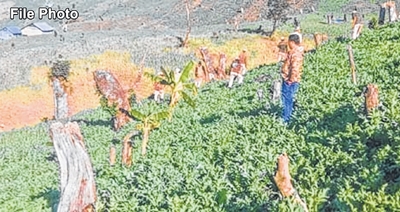
I know a family in Churachandpur district who grows opium poppy not because they want to, but because they literally cannot send their children to school without the money it brings. As subsistence farmers, legal crops cannot generate enough cash income. There are many families like this, genuinely struggling, who keep planting opium even after Government forces destroy their fields. The question is not whether poppy cultivation is right or wrong - the question is how we as a society can support these families to break free from a bondage they never chose.
A Rational Response to Impossible Conditions
The remote hill districts present farming families with economic realities that make poppy cultivation almost inevitable. A small plot of maize or rice feeds a household for a few months but brings little cash. Vegetables provide higher returns but spoil quickly and depend on markets that most hill villages lack access to. Transportation costs can eat up profits, as carrying produce down mountain paths to the nearest road and then paying for truck transport to distant markets often results in net losses once post-harvest spoilage is factored in.
Poppy solves multiple problems simultaneously. The dried latex is lightweight and concentrated, meaning a farmer can carry significant value in a backpack across terrain where no vehicle can pass. Buyers come directly to villages, paying cash on the spot-no need for credit, intermediaries, or delayed payments. Poppy farming pays far more per weight than any legal crop. This high return drives real choices in many villages. Farmers grow poppy because it clears debts, funds schooling, and buys medicine. Legal crops cannot provide the same income.
Why Crop Destruction Alone Cannot Work
Eradication without viable alternatives deepens poverty and desperation. Families whose fields are destroyed face immediate destitution-debts remain, but income disappears. Many are forced to take loans from the same networks that facilitate poppy cultivation, creating new dependencies. Others migrate to urban areas where they join the ranks of the informal workforce, vulnerable and exploited.
The underlying pressures that pushed farmers toward poppy remain firmly in place. Infrastructure has not improved, and market access has not expanded. State support for legal agriculture sometimes cannot reach farmers due to various factors. Alternative livelihood programs, where they exist, often cannot benefit every needy farmer, as they are frequently ineffectively designed, inadequately funded, and plagued by corruption.
Corruption Where It Hurts Most
Development funds intended to provide alternatives for horticulture, animal husbandry, irrigation, rural roads, and market linkages have too often been diverted by intermediaries before reaching the intended beneficiaries. Farmers frequently receive only a fraction of the allocated resources, or sometimes not at all.
Any honest discussion must acknowledge this systemic corruption. Alternative livelihood schemes have been launched repeatedly over the few decades, each accompanied by budgetary allocations and official optimism. Yet outcomes remain dismal. Why ? Because money intended for farmers rarely reaches them as it should.
Infrastructure projects often remain stalled, never start, or are initiated with low-quality input, which is quite common. According to India Today NE (October 1, 2025), former Chief Minister N Biren Singh emphasised the need for safety and durability in terrain already burdened by severe logistical and weather challenges. It is important to remember that both cost-effectiveness and lasting quality matter, and saving costs should never compromise long-term quality.
This corruption is not incidental - it is structural, reflecting patronage networks and political economy dynamics that extract rents from development budgets intended for the poorest citizens. It directly undermines any possibility of creating genuine alternatives to poppy cultivation.
Farmers see through this charade. For example, farmers lose trust when promised support fails. Irrigation projects often fail to materialise, seeds are usually adulterated, and market assistance is frequently superficial. They conclude Government schemes are hollow. Poppy becomes their only dependable source of income.
Not all irregularities are present in every project, but even in a few, they can have a significant impact on many.
A Different Path Forward
Breaking the poverty-opium nexus requires fundamentally different approaches, grounded in economic realism, institutional accountability, genuine respect for farmer agency and dignity, and a strong political will.
First, Intimidation will not solve this problem. Eradication that removes livelihoods without offering alternatives is a harmful and often inhumane way of solving this crisis.
Second, Infrastructure investment is essential, as roads, storage, processing units, cold chains, and market links make legal farming profitable and realistic.
Third, Government support must reach farmers directly, without the involvement of intermediaries. Transparency, community cooperation, and strict action against corruption are essential.
Fourth, alternative crops should align with local conditions and actual market demand, as farming is driven by demand and supply. Horticulture, spices, and high-value vegetables can work, but only with proper support systems, training, and guaranteed market access. Schemes imposed from above without farmer consultation inevitably fail.
Fifth, and perhaps most crucially, we must extend empathy and support to families caught in this impossible situation. This group of genuine farmers on subsistence is not criminals deserving punishment, but people exercising the only agency available to them under conditions of structural poverty and State neglect. They deserve solidarity and concrete assistance in building better futures for their children.
On recovery road
By the way, it is not all gloomy. As reported by The Sangai Express (Epao, April 28, 2025), Mr K Debadutta Sharma, Director, Horticulture and Soil Conservation mentioned that under Manipur state plan scheme, one cold storage unit is located in the Churachandpur district, known for poppy cultivation. The department may already have, or in the pipeline, facilities to empower genuine farmers who are willing to cooperate with the Government in breaking free from poppy bondage.
Conclusion
The farmers cultivating poppy in Manipur's hill districts are trapped in a bondage not of their making - trapped by geography, infrastructure deficits, absent markets, corruption, debt, and the simple arithmetic of survival.
Breaking this bondage requires more than enforcement and eradication. It requires economic transformation, institutional reform, and a fundamental reorientation of development policy toward the actual needs and realities of hill farming communities.
Those of us who come from humble roots, who understand what it means to face impossible choices, have a particular understanding here. We must refuse the easy moralism that condemns desperate people for desperate decisions. We must insist on policies that create genuine alternatives rather than empty promises/or the promises that are not fulfilled due to various circumstances. We must raise accountability from institutions that claim to serve people experiencing poverty, but too often serve only their own interests.
The poverty-opium cycle in Manipur can be broken- but only if we are willing to see farmers not as problems to be managed, but as people deserving dignity, opportunity, and hope, and only if we commit the resources, honesty, and political will, will it be necessary to make those principles a reality. Of course, farmers should work with the Government because cooperation benefits them as well. Oh well, when all is said and done, life’s true meaning is found in sharing and mutual trust!
As Gandhi warned, poverty is the worst form of violence. In Manipur, this violence is repeated each planting season until real alternatives are created.
Chongboi Haokip, MCIHort, is an international development consul- tant specialising in Agriculture, horticulture and trade facilitation. She can be reached at chongboi4 community@gmail.com.