Free Movement Regime (FMR) : A historical and contemporary impression
|


Hareshwar Goshwami, Writer & Political Activist
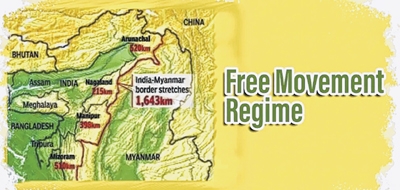
The Indo-Myanmar border, extending approxi- mately 1,643 km through the rugged hills and valleys of the North East, represents not only a political boundary but also a deeply socio-cultural one, traversing the organic boundaries of the erstwhile kingdom of Manipur. To understand the Free Movement Regime (FMR), it is important to observe the historical setting in which this boundary was established and the socio-cultural and demographic realities it continues to impact.
The origin of the present-day Indo-Myanmar boun- dary can be traced to the Treaty of Yandaboo (Myan-mar), signed on 24 February 1826, which brought an end to the First Anglo-Burmese War (1824–1826). With this agreement, much of India’s North East region, including Manipur, was liberated from temporary Burmese occupation and partly brought under the British influence. The treaty thus laid the groundwork for the modern political geography of the region that would be connected with Free Movement Regime.
However, this demarcation done by the British was a purely colonial paradigm, executed against the will of the then kingdom of Manipur. It divided many communities that shared a common language, culture, and social fabric of the region. People living in this area suddenly found themselves separated from their kin by an artificial line drawn on tables by colonial cartographers for their convenience. For most of people, the boundary did not exist in their social or cultural consciousness; their familial ties continued to flow freely across it. It was this historical and cultural background that gave rise to the concept of the FMR—a mechanism designed to balance India's National sove- reignty with the preservation of ethnic and cultural connections across the border.
The origin of the FMR can be traced to the early years of independent India. In 1950, the Ministry of Home Affairs (MHA) issued a notification (No. 4/15/50-F.I, dated 26 September 1950) amending The Passport (Entry into India) Rules, 1950. This amendment allowed the hill tribes living along the Indo-Myanmar frontier to travel up to 40 km (25 miles approximately) into each other’s territory without the need for a passport or visa. This arrangement, though modest in scope, was revolutionary in its spirit—it acknowledged that the people along the border were not aliens to each other but members of an extended socio-cultural entity that was once united under the vast kingdom of Manipur.
In 1968, this understanding was formalised through a Government notice (G.S.R. 1265, dated 28 June 1968), which officially introduced what we term today as the Free Movement Regime (FMR) under certain conditions. The FMR allowed cross-border movement up to 40 km on either side, primarily to facilitate familial interactions, traditional festivals, and local trade. For decades, this casual arrangement helped withstand the socio-economic life of borderland communities, who depen-ded on each other for essen- tial goods, livestock etc.
However, as the security landscape evolved, so too did the FMR. The emergence of insurgency, arms trafficking, drug smuggling, and cross-border militancy compelled both Governments to reassess the open nature of the border. In 2004, the free movement limit was formally reduced from 40 km to 16 km. This review was an attempt to strike a delicate balance between maintaining socio- economic and cultural exchanges and ensuring the security of the Indian frontier.
A renewed emphasis on the FMR emerged with India’s Act East Policy under which, in May 2018, India and Myanmar signed a bilateral land border crossing agreement. Preceding this agreement, the then Union Home Minister, Rajnath Singh chaired a review meeting in June 2017 at Aizawl, Mizoram. The meeting was attended by Chief Ministers of Aru-nachal Pradesh, Mizoram, Manipur and Nagaland for streamlining the Free Movement Regime (FMR) for better facilitation of movement of people across the border.
This land border crossing agreement reaffirmed the 16-kilometre limit and sought to institutionalize cross-border movement through designated points under regulated procedures. The 2018 version of the FMR aimed to promote people-to-people connectivity while ensuring stronger border management mecha- nisms through collaboration between the Indian and Myanmar authorities.
Nevertheless, by the early 2020s, perhaps due to worsening political instability in Myanmar and an increase in cross-border infiltration, narcotics trade, and human trafficking compelled the Government of India into revisiting the arrangement once again. In 2024, the Ministry of Home Affairs undertook a comprehensive review of the Free Movement Regime, a step the Government of India had decided to enhance after consulting the Chief Ministers concerned in 2017. While initial statements hinted at a complete scrapping of the regime, the final decision— announced in December 2024—opted instead for a significant tightening of rules rather than outright termination.
Under the revised FMR of 2024, the free movement distance was reduced from 16 kmto 10 km on either side of the border. The new guidelines stipulated that only residents living within the 10-km border area would be eligible to apply for QR-code-enabled border passes. These passes, presently issued by the Assam Rifles, serve both as identity verification and as a security measure. Each pass is valid for a period of up to seven days, during which the traveller’s stay and movement are subject to verification by the State Police and local authorities. This new system represents a shift from a friendly, governed arrangement to a technology-driven, security-sensitive framework that seeks to monitor every movement across the frontier.
The 2024 reform of the Free Movement Regime underscores the profound complexity of governing a frontier that was once united and culturally inseparable. For India, the challenge lies not merely in safeguarding its National interests, but in doing so with sensitivity toward the ethnic and cultural realities of the borderland communities—people for whom the man-made international boundary is not a wall of separation, but an illogical line cutting through a shared organic homeland that once formed (mostly) part of the then kingdom of Manipur.
Thus, the Free Movement Regime remains one of the most characteristic border management systems in the world—an arrangement borne out of historical necessity and cultural continuity at the beginning. Its gradual evolution from the liberal framework of 1950 to the highly regulated system of 2024 reflects the shifting priorities of the State in response to changing socio-political and security dynamics. Yet, at its heart, the FMR continues to embody the idea that improper political boundaries cannot erase the ancient ties of kinship and culture that bind the peoples of the North East and Myanmar.
To me, the implementation or scrapping of the FMR and the boundary fencing should not be driven by the politics of division—by turning one community against another or framing it as a clash of demands and counter-demands—but through mutual understanding, sincere dialogue, and a collective commitment to preserving the shared heritage, culture and identity that has bound these communities together for centuries.
To conclude, how amazing it is that those who once stood as fervent champions of the Free Movement Regime (FMR) and resisted the idea of boundary fencing now find themselves opposing the very same. Perhaps it is the shifting tide of time—the changing dynamics of politics, security, and identity—that has turned yesterday’s ardent demands into today’s passionate dissent. Or perhaps, somewhere behind the visible stage, an unseen hand quietly rewrites the script, shaping opinions and orchestrating outcomes in ways the public eye can hardly notice for reasons best known to the unknowns.