The unseen cost of being a bridesmaid : Beyond the raniphee and rituals
|


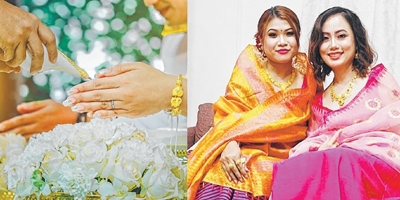
Sonia Meitram
There is a quiet anxiety that now comes with a beautiful Manipuri wedding invitation. It is not just about the joy for the couple. It is the mental math that starts immediately. As a young woman who has been a bridesmaid more times than I can count, the celebration now feels as much about financial survival as it is about sacred rituals.
Let us talk about numbers, because that is where the problem becomes clear. A traditional raniphee, once a cherished heirloom, now has a price tag that starts at Rs 15,000 and can easily cross Rs 30,000. This is for a shawl we are expected to wear for one day. The unspoken rule is that you cannot repeat it in wedding photos, lest someone notices. So, we buy, we wear, we store and we buy another new raniphee for the next wedding.
But the raniphee is just the beginning. To look ‘put together’, we need a perfectly matching blouse and phanek. A simple blouse now starts at Rs 1,500, and a phanek starts at Rs 3,000, not to mention about the phige phanek which starts around Rs 15,000. How can we forget about the matching potlis or senggao/senkhao. Some senggao/senkhao costs as low as Rs 450 only, but those labelled as ‘designer’ starts around Rs 3500. With gold prices through the roof, the cost of good imitation pieces has followed, adding another significant amount to our invisible bill. And this is just for one event, the Luhongba, the main wedding ceremony.
A Manipuri wedding is not a single day event. It is a marathon of three main events: the Heijingpot, the Luhongba, and the Mangani Chakkouba. Here, I am not mentioning about the Waroipot and Luhong-nonganba. For the Heijingpot, the muka suit is the standard. The cheapest one we can find starts at around Rs 6,000. And here is the catch: after wearing it for the Heijingpot, we do not feel like repeating the same outfit for the Chakkouba. The pressure to have a unique look for every event, fuelled by social media, pushes us to buy yet another set of clothes.
Then, there is the face we present to the world. A professional makeup artist (MUA) is no longer a luxury but an expectation. Their services start from Rs 3,000 per event. For the three main events, that’s a minimum of Rs 9,000 just on makeup. Some opt to do their own makeup. But for the wedding day, the bridesmaid makes sure to get it done by the professional makeup artist.
Add it all up. The raniphee, the blouse, the phanek, the muga suit, the extra outfit for Chakkouba, and the makeup for three events. The total is not just a number. It is a weight. It is a sum that could be a month's salary or the start of a small savings fund, all spent on the performance of being a wedding guest.
We have forgotten that the heart of our weddings is the community. It is the blessing of the elders, the joyful tears during the Luhongba, and the festive feast of the Chakkouba. These moments do not need a Rs 25,000 price tag to be meaningful.
It is time for a change. It is time to be brave enough to re-wear a raniphee with pride and to reuse the muga suit. It is time to remember that our presence as supportive friends and family is the real gift, not the cost of our outfit. Let us free ourselves from this financial trap. A wedding should be a time of joy, not a source of debt. Our culture is rich in tradition, not in demands that empty our pockets. Let us start valuing the sisterhood more than the raniphee, and the community more than the cost.
The writer is a research scholar in the Department of Mass Communication, Manipur University and can be reached at [email protected]