Sankaradeva Kalakshetra, the repository of Assamese culture
|


S Balakrishnan
“No, no, no! Nothing doing; we did not come to Kalakshetra, the cultural heritage centre of Assam, merely to buy a sari for you”, I boldly objected to my wife. She cleverly countered that saris (handloom textiles) are also part & parcel of any culture and especially a hand-woven sari with local motif definitely reflected the arts & crafts heritage of that particular State. Saying so, she went ahead, without waiting for my meek approval,to swipe her debit card to buy a sari at ‘Srimanta Sankaradeva Kalakshetra’, Guwahati. As if to avenge her I too bought a few handicraft items at the souvenir shop there, though they did not equalise the cost of a single sari.
The Cultural Complex of ‘Srimanta Sankaradeva Kalakshetra’ (SSK) was set up in 1998 to serve as a centre of activities in the fields of Assam’s traditional dance, drama, music, fine-arts, literature, etc., with a view to protecting, preserving and promoting the cultural heritage of the Assam in particular and North-East in general. It is, therefore, named after the great unifier of Assam and one of the greatest integrator of the Indian society of the 15th century, Srimanta Sankaradeva. The Kalakshetra Society attempts to capture and convey the essence of the great seer’s spirit, who preached unity in diversity and universal brotherhood. The institution attempts for the preservation, restoration, research, promotion and development of the rich cultural heritage of the diverse ethnic communities inhabiting the state – a grand exposition of the life & culture of the people of Assam. SSK also assists cultural exchange in the fields of performing arts, fine arts and crafts with other states.
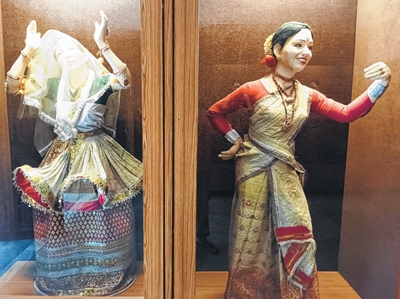
Spread over a sprawling campus of 17.5 hectares at Panjabari, Guwahati, the Kalakshetra complex houses Sahitya and Sangeet Natak building, Lalit Kala building, Cultural Museum (Purbajyoti Museum), Library, Heritage Park,Dr. BhupenHazarika Museum, International Convention Centre (300 & 1250 capacity auditoriums), SrimantaSankaradeva Study Centre, SrimantaSankaradevaSangrahalaya, A/C Art Gallery, Portrait Gallery (2 Nos.), Dolls Museum, Audio recording Studio & Archives Section, Dr. BhabendraNathSaikia Children Park, Sound & Light Show, Open Air Theatre, Children’s Auditorium, Artists’ Village, VIP Guest House, and a Souvenir Shop. All these components strive to make the complex a living nerve centre of cultural excellence of Assam and the region. I had an opportunity to watch a kathak performance at SSK.
The great saint of Assam,Mahapurusha Srimanta Sankaradeva, brought about a renaissance in the mediaeval Assam with his reforms to the society and also contributions in the fields of literature, dance & drama, music, painting and other areas, thus laying the foundation of Assamese culture. The SSK Complex strives to portray the life of the saint, the performing art forms initiated by him, the literary contributions, philosophical views, teachings, art & crafts among others. The museum also houses objects and artefacts associated with the saint and the movement initiated by him.
The museum houses more than 4000 artefacts, as follows, displayed in different galleries of the museum-Sattriya Dance Masks, Musical Instruments, Terracotta & Clay Art, Textiles & Costumes, Cottage Industries products of Assam and the North East, Basketry & Wood Products, Bell Metal &Brass Products, and Objects of Sankari Culture of Neo-Vaishnavite Sect. The Purbajyoti Museum, an important part of the SSK, is an ethnographic as well as a heritage museum that presents the story of the past and present in the realms of material culture and indigenous technology. The Centre also regularly holds crafts fairs to boost the morale of the cottage industry.
The Lalit Kala wing of the Kalakshetra organises exhibitions and workshops on paintings, drawings, graphics, sculptures, woodcrafts, photographs, and others at its A/C art gallery; the wing also has a graphics studio, workshop space and conference hall for the benefit of the artist community.
The Sahitya(literature) Wing of Srimanta Sankaradeva Kalakshetra, on its part, strives to preserve & promote the rich written and oral literary traditions of the region. A unique library of rare books and manuscripts is attached to this Wing.
Another highlight of Srimanta Sankaradeva Kalakshetrais the “Dr. BhupenHazarika Museum” to preserve & showcase the various objects associated with the life &works of the legendary music icon Dr. BhupenHazarika. This mini Museum displays photographs, awards and honours received by Dr. Hazarika, and objects like musical instruments, furniture, dresses, etc., used by him.The museum was set up and inaugurated during his life time itself.
The vast Kalakshetra complex is a tobacco- and alcohol-free zone. Even betel-nut and paan are not allowed inside the Campus.Hence it is neat & clean, and also green. And it is also a vegetarian campus. One can leisurely spend a day at SSK and soak in the rich cultural heritage of Assam.
The writer can be reached at [email protected]
“No, no, no! Nothing doing; we did not come to Kalakshetra, the cultural heritage centre of Assam, merely to buy a sari for you”, I boldly objected to my wife. She cleverly countered that saris (handloom textiles) are also part & parcel of any culture and especially a hand-woven sari with local motif definitely reflected the arts & crafts heritage of that particular State. Saying so, she went ahead, without waiting for my meek approval,to swipe her debit card to buy a sari at ‘Srimanta Sankaradeva Kalakshetra’, Guwahati. As if to avenge her I too bought a few handicraft items at the souvenir shop there, though they did not equalise the cost of a single sari.
The Cultural Complex of ‘Srimanta Sankaradeva Kalakshetra’ (SSK) was set up in 1998 to serve as a centre of activities in the fields of Assam’s traditional dance, drama, music, fine-arts, literature, etc., with a view to protecting, preserving and promoting the cultural heritage of the Assam in particular and North-East in general. It is, therefore, named after the great unifier of Assam and one of the greatest integrator of the Indian society of the 15th century, Srimanta Sankaradeva. The Kalakshetra Society attempts to capture and convey the essence of the great seer’s spirit, who preached unity in diversity and universal brotherhood. The institution attempts for the preservation, restoration, research, promotion and development of the rich cultural heritage of the diverse ethnic communities inhabiting the state – a grand exposition of the life & culture of the people of Assam. SSK also assists cultural exchange in the fields of performing arts, fine arts and crafts with other states.
Spread over a sprawling campus of 17.5 hectares at Panjabari, Guwahati, the Kalakshetra complex houses Sahitya and Sangeet Natak building, Lalit Kala building, Cultural Museum (Purbajyoti Museum), Library, Heritage Park,Dr. BhupenHazarika Museum, International Convention Centre (300 & 1250 capacity auditoriums), SrimantaSankaradeva Study Centre, SrimantaSankaradevaSangrahalaya, A/C Art Gallery, Portrait Gallery (2 Nos.), Dolls Museum, Audio recording Studio & Archives Section, Dr. BhabendraNathSaikia Children Park, Sound & Light Show, Open Air Theatre, Children’s Auditorium, Artists’ Village, VIP Guest House, and a Souvenir Shop. All these components strive to make the complex a living nerve centre of cultural excellence of Assam and the region. I had an opportunity to watch a kathak performance at SSK.
The great saint of Assam,Mahapurusha Srimanta Sankaradeva, brought about a renaissance in the mediaeval Assam with his reforms to the society and also contributions in the fields of literature, dance & drama, music, painting and other areas, thus laying the foundation of Assamese culture. The SSK Complex strives to portray the life of the saint, the performing art forms initiated by him, the literary contributions, philosophical views, teachings, art & crafts among others. The museum also houses objects and artefacts associated with the saint and the movement initiated by him.
The museum houses more than 4000 artefacts, as follows, displayed in different galleries of the museum-Sattriya Dance Masks, Musical Instruments, Terracotta & Clay Art, Textiles & Costumes, Cottage Industries products of Assam and the North East, Basketry & Wood Products, Bell Metal &Brass Products, and Objects of Sankari Culture of Neo-Vaishnavite Sect. The Purbajyoti Museum, an important part of the SSK, is an ethnographic as well as a heritage museum that presents the story of the past and present in the realms of material culture and indigenous technology. The Centre also regularly holds crafts fairs to boost the morale of the cottage industry.
The Lalit Kala wing of the Kalakshetra organises exhibitions and workshops on paintings, drawings, graphics, sculptures, woodcrafts, photographs, and others at its A/C art gallery; the wing also has a graphics studio, workshop space and conference hall for the benefit of the artist community.
The Sahitya(literature) Wing of Srimanta Sankaradeva Kalakshetra, on its part, strives to preserve & promote the rich written and oral literary traditions of the region. A unique library of rare books and manuscripts is attached to this Wing.
Another highlight of Srimanta Sankaradeva Kalakshetrais the “Dr. BhupenHazarika Museum” to preserve & showcase the various objects associated with the life &works of the legendary music icon Dr. BhupenHazarika. This mini Museum displays photographs, awards and honours received by Dr. Hazarika, and objects like musical instruments, furniture, dresses, etc., used by him.The museum was set up and inaugurated during his life time itself.
The vast Kalakshetra complex is a tobacco- and alcohol-free zone. Even betel-nut and paan are not allowed inside the Campus.Hence it is neat & clean, and also green. And it is also a vegetarian campus. One can leisurely spend a day at SSK and soak in the rich cultural heritage of Assam.
The writer can be reached at [email protected]