Chemistry Nobel Prize 2025 From Inorganic to Organic to Developing Metals Organic Frameworks (MOFs)
|


Prof Homendra Naorem
We all understand that Chemistry is the fundamental science that deal with every known atom or matter in the universe right from their physico-chemical properties to their structural identities and, most importantly, their chemical transformations. Within the vast domain of Chemistry, there is a distinct branch known as Organic Chemistry initially limited to the ‘Chemistry of Carbon Compounds’ mostly dealing with carbon-based molecules with hydrogen and oxygen as the main constituents with nitrogen occasionally as guest atom. So rigid were the early boundaries that when atoms like Nitrogen or Sulfur sneak into an organic cyclic compound, they are labelled as ‘hetero- cyclic’, literally meaning the atoms as alien to the organic framework – a little bit of xenophobia therein! Over the decades, however, Organic Chemistry rapidly expanded both its vision and horizon accepting as many hetero or alien atoms within its ambit transforming Organic Chemistry from that of ‘Chemistry of Carbon Compounds’ to Che- mistry’s most cosmopolitan community with as many alien elements into its fold save the sub set of elements known as metals! The Chemistry of metals, and their coordination complexes, crystal structures, etc. broadly come under the domain of Inorganic
Chemistry. But, as early as 1900s, Victor Grignard developed a versatile reagent known as Grignard reagent (RMgBr) where the organic carbon is directly linked to Magnesium (a metal) like linking Inorganic to Organic that earned him the Nobel Prize in Chemistry in 1912. This eventually led to the birth of another class of compounds known as Organometallic in which one of the carbon atoms of the organic entity is directly bonded to a metal blurring the once-sacred boundary between organic and inorganic realms. The rapid expansion of Organometallic Chemistry gave rise to a fascinating array of inorganic (metal) complexes, in which diverse organic moieties act as ligands to the metal - a glaring example of fusion of inorganic rigidity with the organic creativity. Meanwhile, organic chemists continue to create newer type of organic molecules that can self-assemble through weak, non- covalent interactions like hydrogen bonds and p-p stacking giving birth to supramolecular assemblies, a kind of weak organic framework. They can be designed to be dynamic and responsive to external stimuli like light, heat, or chemicals making them as elegant smart assemblies or framework but a bit too delicate. Unfortunately, such supramolecular frameworks often lacked the robustness needed for real-world applications, compe- lling organic chemists to develop a framework material that would be both porous and precise, and structurally ordered as a crystal with functional versatility as an organic molecule. What, if we could make such porous materials as regular and well- defined as crystals? Well, the Chemistry Nobel Prize 2025 is all about the development of such organic framework intertwined and reinforced with metals, which are very different from the organometallic compounds.
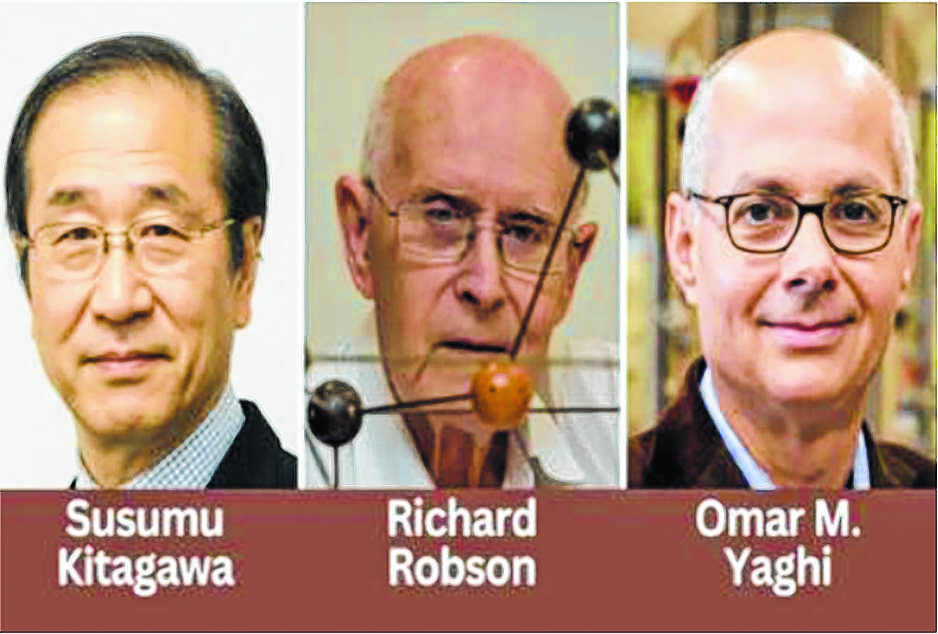
As announced, the Chemistry Nobel Prize for 2025 will jointly be awarded to Prof. Omar Yaghi (University of California, Berkeley, USA), Prof. Susumu Kitagawa (Kyoto University, Japan) and Prof. Hong-Cai Zhou (Texas A&M University, USA) for the design and development of Metal Organic Frameworks (MOFs), crystalline materials with extraordinary porosity and transformative potential in energy, environment, and materials science. The award will actually be presented in a solemn ceremony to be held on Dec 10, 2025, the death anniversary of the noble chemist, Alfred Nobel.
What makes MOFs truly remarkable is their exceptional versatility and structural tunability. In essence, MOFs can (i) entrap gases such as carbon dioxide or hydrogen within their nanoscopic pores, offering an environmentally sustainable approach to gas storage, (ii) act as highly selective filters and purifiers, enabling the development of water purification systems potentially much more efficient than the current technologies, and (iii) serve as catalysts that accelerate chemical transformations without being consumed in the process paving the way for cleaner and more cost-effective chemical processes, among others. In effect, the discovery of MOFs represents the advent of a new class of materials whose properties can be precisely manoeuvred at the molecular level. Their remarkable degree of structural and functional customization makes them a quintessential example of programmable materials that embody the seamless integration of inorganic rigidity and organic design.
Omar Yaghi, now known as the visionary of organic frameworks, set out to create organic frameworks in the late 1990s after his pioneering works on ‘reticular chemistry’ linking molecular building blocks in predictable ways to form extended networks. In 1995, Yaghi and his team synthesized the first stable MOF (called MOF-5), a zinc-based framework which is so porous that it made activated charcoal look like a brick. His later creations, like MOF-177 and ZIFs (zeolitic imidazolate frameworks), broke every record for surface area and gas storage. He also brought MOFs into the public spotlight when his lab showed that these materials could harvest water from desert air literally pulling drinkable water from the atmosphere using nothing but sunlight. On the other hand, Susumu Kitagawa developed the art of making holes in molecules distinguishing himself as the porosity pioneer. He was among the first to show that porous coordination polymers, precursor of MOFs, could retain their pore structure even after solvent molecules were removed. Kitagawa made them stable and reusable, turning fragile laboratory curiosities into robust, functional materials. They even demonstrated how MOFs change its shape when they absorbed or released molecules like a breathing lung making them as ‘soft porous crystals’ - a self-contradictory term! The real architect, of course, is Hong-Cai Zhou who took MOFs from laboratory to the real world by scaling up its production from milligrams to kilograms through new synthetic methods. His group also created MOFs optimized for hydrogen storage, carbon capture, and methane storage, which are crucial in overcoming the biggest roadblocks in the production sustainable energy.
Remarkably, one such MOF can store greater amount of hydrogen at ambient conditions than even the high-pressure liquid hydrogen tanks that has not only stunned the energy industry but also redefined the possibilities in clean fuel storage. If Yaghi built the blueprints, Kitagawa ensured stability, and Zhou built the factories. The technical details of their works are not highlighted herein since it is meant to be a popular article.
MOFs that have dazzled the chemists for more than two decades erupted in the 2010s and 2020s into an era of rapid breakthroughs and bold innovations finding real-world applications in gas separation, sensors, catalysis, and even drug delivery. The world has now acknowledged that MOFs had quietly become one of the most versatile materials ever discovered or created. The Nobel Committee’s citation described them as ‘a new class of materials that merges inorganic precision with organic creativity.’ These frameworks made Chemistry modular, beautiful, and useful, all at once. The 2025 Chemistry Nobel Prize, therefore, subtly highlights the growing imperatives of interdisciplinary, or better still, multidisciplinary collaboration in scientific research signalling the beginning of the end of the era of working within rigid orthodox boundaries with the loud message that the future belongs working across and beyond boundaries.
With every Nobel Prize announcement, one question that becomes increa- singly pertinent is: why there has not been a single scientist working in an Indian University or Institute among the laureates despite rich pull of scientific talents in the country since the days of Dr CV Raman ? Should it simply be dismissed as a mere case of, ‘blame it on Rio,’ or be interpreted as a desperate May Day call for introspection on how the Indian Universities/ Institutes are being administered ? Why is that most recruitment processes in Universities/ Institutes often end up entangled in law courts, as if the men in black robes could discern scientific merit? And, the lucky ones who made it through are often propelled not by the spark of original innovative ideas but by a feverish chase for numbers like publication counts, impact factors, or h-indices to somehow land as VCs or Directors elsewhere as if these are the barometer of Indian Scientific achievements! In this mad race for numbers driven by myopic gain, the very soul of scientific inquiry, the courage to challenge the old ideas with new out- of-the-box ideas, to take risks, and to think differently are, alas, quietly sacrificed.
Though there are good number of Indian scientists who proudly parade hundreds or even thousands of their publications with good metrics, they are yet to be amongst the Nobel list – classic example of ‘good but not good enough’! After all, who cares about the publication list, impact factors or h-indices of the Nobel laureates ? Because science is not a mad race for papers or citations that define one’s worth, but a creative human endeavor in pursuit of new ideas and innovations with a view to transforming the universe we inhibit a better place to live. It, therefore, is high time we replaced this obsession of digital metrics by a transparent system that X-rays the ideas rather than the metric-numbers! Such a system should bypass the glitter of publication or citations to the brilliance of creative imaginations, and quantity of papers to quality of thought paving the way for healthy competition for innovations through which the right eco system for the growth of noble ideas worthy of Nobel breakthroughs can be nurtured.
Finally, the underlying message of this year’s Nobel Prize in Chemistry resonates far beyond the world of science, it also holds profound relevance for the human society, especially for a society like Manipur, where many ethnic communities exist sharing the same space. Unless these communities learn to coexist transcending the rigid, man-made boundaries of ethnicity, they all risk fading together into irrelevance and oblivion. It is high time that those fantasizing separate existence realized that their future, and the future of generations to come, rests not in division but in harmonious coexistence with the courage to build together rather than break apart.
The writer is with the Department of Chemistry, Manipur University and can be reached at [email protected]