The looming silent spring in Ukhrul
|


Arati Ningombam, Aruna Beemrote, Ajitkumar Ningthoujam and S Khogen Singh
‘Silent Spring’ by Rachel Carson, a book published in 1962, is widely recognized as a revolutionary work that sparked the modern environmental movement. The book meticulously documents the environmental damage caused by the indiscriminate use of synthetic pesticides, particularly DDT (dichloro-diphenyl-tri-chloroethane) and exposes both the chemical industry’s public disinformation and the Government’s irresponsible acceptance of its claims. Carson combines scientific evidence and compelling narrative to reveal how these chemicals devastate ecological systems—contaminating water, soil, plants, birds, and ultimately, humans. She warns that pesticides, which she terms “biocides” due to their broader destructive impact, accumulate within food chains and cause lasting harm, including cancer and the disruption of vital biological processes. Car-son’s depiction of a future where spring is eerily silent without birdsong underscores the ecological conse- quences of ignoring these threats.
The book challenges the dominant view of man’s sovereignty over nature and advocates a more respectful, interconnected approach—an idea central to the “deep ecology” movement.
Carson calls not for the total abolition of pesticides, but for prudence, further scientific study, and the pursuit of natural alternatives, such as biological pest control strategies. The impact of ‘Silent Spring’ was profound. It raised public awareness, galvanised activists, and led to significant policy changes, including the US ban on DDT for agriculture and the esta- blishment of the Environmental Protection Agency in 1970. Carson’s work also set the foundation for global environmental regulation efforts and continues to inform debates about new threats to ecological and public health. In essence, ‘Silent Spring’ transformed environmental concerns into a mainstream issue and empowered generations to champion the conservation of nature.
This article is not a book review of “Silent Spring” but rather a call to action to prevent an environmental crisis unfolding before our eyes in Ukhrul district, Manipur. The whole of humanity around the world gradually works towards a sustainable and healthier planet, seeking better, cleaner and greener alternatives to existing pest control chemicals and we should not be left behind.
Some age-old traditional practices that are part of the hunting and gathering lifestyle are still practised in Ukhrul today. One is the rearing of wasps and hornets to eat immature grubs, and the other is the capture of small birds for food using glue or air gun.
The immature wasp grubs are considered a delicacy among the ethnic tribes of Manipur, especially the Tangkhul. This insect is harvested once a year, especially during November- December. The wholesale price of a wasp nest containing immature grubs is around 25-30 thousand and the retail price is set per grub. Although immature grubs are nutritious and a good source of valuable minerals and vitamins as food and feed, there is a negative aspect to rearing these wasps that far outweighs the benefits. Wasps are predatory insects which feed on other insects. They belong to the same Order Hymenoptera as honeybees, which are beneficial insects. Honeybees not only produce honey but also provide ecosystem services such as pollination. Bees, are essential pollinators, pollinating more than 75% of flowering plants and nearly 35% of the world’s food crops. Bees pollinate plants that sustain birds, mammals and other wildlife. Bee pollination supports cover crops that prevent erosion. A thriving plant life helps store carbon, cleaning our environment. The Royal Geographical Society of London has rightfully declared that bees are the most important living beings on the planet.
Rearing honeybees provides beekeepers with a substantial additional income source while also giving them the flexibility to pursue other professions. The income source provided by honeybees is year- round and much more profitable, annually, whereas that provided from rearing wasps for food is once a year and limited.
These wasps, however, prey on the foraging honeybees and attack bee colonies after following them home. Once a beehive location is known, the wasps come to catch the honeybees right from their hives, and the bees must fly away in search of a different site for safety. A single wasp can kill 30-50 bees per day, and small group (5-10 wasps) can destroy or force the abandonment of one bee colony within a week.
The wasp’s easiest target and source of food is a known beehive. Wherever these wasps are reared, beekeeping activities cannot be taken up within a 2 km radius. If at all, wasp rearing must be done to satisfy the human palate; the wasp rearer can feed the wasps by providing small meat or fish pieces every day in the proximity of the wasp nest, so the wasps need not hunt for food.
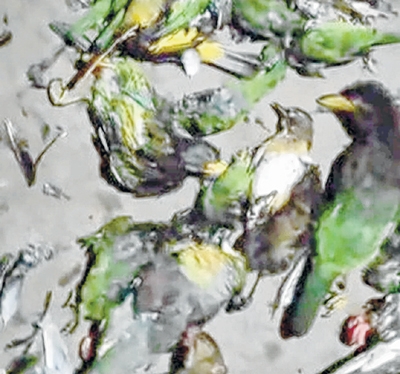
Crop protection experts have been getting reports from Ukhrul farmers of the increasing pest damage and incidence in their crops. Increase in pest incidence and damage may be a fallout of climate change, but certain practices also encourage their population, such as killing birds and lizards that prey on them. Using glue and air gun to catch small birds for food is a practice that is destroying the agro-ecosystem indirectly by removing a critical trophic level in the food chain/web, allowing the pest population to rise exponentially without the presence of natural enemies that keep them in control. If this practice of killing birds, big and small, is not stopped, hard days are coming for the farmers of Ukhrul.
However, not all is lost, a ray of hope shines through. Some village like Shirui village in Ukhrul district has imposed a ban on hunting animals and birds, including the use of firearms/airguns, for an initial period of three years (starting from October 2023). No wonder, rare and elusive birds like the colourful Blyth’s Tragopan and Hume’s Pheasant have been captured in the wild on cameras. This is a sign that conservation efforts are bringing the wildlife back. The same restrictions on banning the use of firearms/airguns for hunting and trapping have been initiated in villages like Nungshang Chingkha, Nungshang Chingthak, etc. Collective effort, tiny and small, is the key to successful nature conservation.
Birds and lizards play indispensable roles in nature’s pest management by regulating populations of insects, small mammals, and other pests that threaten ecological balance and agricultural productivity. These animals are direct biological control agents, reducing the reliance on synthetic chemical pesticides while suppor- ting biodiversity and ecosystem health.
Birds are among the most efficient natural pest controllers, with more than half of bird species being predominantly insectivorous. For example, sparrows, chickadees, and warblers consume a wide array of insect pests, including aphids, caterpillars, beetles, and grasshoppers. During the breeding season, especially, birds intensify their search for caterpillars, providing vital protection to plants and crops.
Lizards also serve as ecosystem bioindicators, signa- lling environmental health through their presence and abundance. Their interactions support nutrient cycling and biodiversity, and some species contribute to seed dispersal and pollination, indirectly influen- cing plant health. In agricultural fields, herpetofauna, including lizards, can consume a diverse array of crop pests, support organic farming and reduce pest outbreaks. For example, in rice and cotton fields, lizards eat insect pests that threaten yields. The role of lizards extends to disease prevention as well; their consumption of mosquitoes lowers the risk of mosquito-borne illnesses such as Dengue or Zika.
Predator-prey dynamics among birds, lizards, and pests create self-regulating feedback loops. The more pests available, the higher the abundance of these predators, maintaining system equilibrium. Conser- vation of birds and reptiles is essential to sustain their pest-control services; measures such as providing habitat, limiting chemical pesticide use, and monitoring populations ensure their continued role in natural pest regulation.
In summary, birds and reptiles are vital, sustainable allies in pest management, offering ecosystem services that sustain natural and agricultural productivity, en- hance biodiversity, and foster healthier environments.
We need to go hand in hand with nature for our own survival. Any idea, practice, or mindset that pits humans against nature has ended in disaster. A thorough understanding and respect for the role of each organism, big or small, in the ecosystem and in the natural ways of the world is needed for mankind to prosper.
The authors are subject experts at ICAR, Manipur Centre and ICAR-KVK-Ukhrul