Vithalbhai Patel, another illustrious Patel
02 Nov 2025 08:05:58
S Balakrishnan
Until I came across an old Indian postal stamp in my collection I was not aware of Vithalbhai Patel (What a shame!) Was he related to Sardar Vallabhbhai Patel ? This was my very first thought. Yes, indeed. The search confirmed Vithalbhai as Vallabhbhai’s elder (‘bhai’) brother, and here is the elder bhai’s life story that is as illustrious as his younger bhai’s.
Vithalbhai Jhaverbhai Patel was born on September 27, 1873 as the third of the five sons of Jhaverbhai Patel and Ladba of Karamsad, Gujarat. He passed the University School Final Examination in 1891; then, passing the exam of District Pleader in 1895, he started practice at Godhra. (Remember Godhra, where a train coach was burnt on 27.02.2002?). He joined the Lincoln’s Inn in England in April 1906 for further law studies and was called to the Bar on 1st July 1908.
Coming back to India the same year, he started his legal practice as a Barrister in Bombay. Vallabhbhai, who was also to go to London for law studies, stayed back out of respect for the elder brother and later attended Middle Temple and was called to the Bar there in 1913.
First Elected Indian Speaker : Vithalbhai has to his credit as the first elected Indian Speaker of the Imperial Legislative Assembly (ILA) / Central Legislative Assembly (CLA) in Delhi on August 24, 1925. The post was also called as the President of ILA / CLA. Earlier in 1924, he had become a member of ILA. He was re-elected to the post for a second term in 1927 and was in the Speaker’s chair during a historic moment in our freedom struggle movement; on April 8, 1929, Bhagat Singh and Batukeshwar Dutt threw two non-lethal bombs and pamphlets in the Legislative Assembly from visitors’ gallery. He resigned the Spea- kership in 1930 and became a member of the Congress Working Committee.
India Post released a Commemorative Postage Stamp on 24th August 2025, marking the centenary of Shri Vithalbhai Patel being elected as the first Indian Speaker of the Central Legislative Assembly on 24th August 1925. It was a tribute to his fearless and impartial conduct as a Speaker, besides his historic leadership and pioneering role in India’s freedom movement. His tenure as Speaker/President of CLA was marked by impartiality, unwavering adherence to Parliamentary procedures, protection of legislative independence, promotion of meaningful debate, and a resolute commitment to democratic values. Earlier, on 27th Sept 1973, a 50 paise stamp was issued under “Personalities’ Stamps Series” as homage to Vithalbhai Patel on his birth centenary.
Tilak Vs. Gandhi : Vithalbhai and Vallabhbhai, the brother duo, differed in their political approach; while the elder brother supported Bal Gangadhar Tilak’s direct action, the younger brother (Vallabhbhai) aligned with Gandhi’s ahimsa (non-violent) path. Vithalbhai met and interacted with Bal Gangadhar Tilak in 1919 during one of his visits to England. (Vithalbhai was in England in connection with the Government of India Bill as a member of the Congress delegation to present the case before the Joint Select Committeeof the British Parliament and the people of England.) More aligned towards Tilak’s philosophy of direct actions, Vithalbhai believed in creating as much obstruction as possible to bring the colonial British Government to a standstill, yet staying within the law during such direct actions. However, Vithalbhai was also practical enough to support Gandhiji whenever they had a common strategy, their main goal being the freedom of motherland. In 1922, he differed with Congress’ decision and supported being elected to Bombay Municipality. For this purpose he formed ‘Municipal Nationalist Party’ to fight the elections of BMC. He, along with 37 members of the newly-formed party, won the elections. Based on this council-entry rift with Congress, in December of the same year, the Swarajya Party was formed by Motilal Nehru, Netaji, CR Das, Vithalbhai and other prominent leaders. In 1924, Vithalbhai Patel was elected to the Imperial Legislative Council as a candidate of the Swarajya Party.
Patel and Bose : While undergoing treatment in Vienna (Austria) in 1933, Vi- thalbhai met Subhas Chandra Bose (Netaji) there. Netaji was also in Vienna for treatment. Both the leaders issued a joint statement ‘Bose-Patel Manifesto’ criticising Gan-dhiji’s leadership and seeking a shift in strategy; they were against Gandhiji’s suspension of the civil disobedience movement, and even sought leadership change.
Vithalbhai finally succumbed to his disease (not specified as what, but it could be due to infection while attending to a plague-affected associate?) at a clinic in Vienna on October 22, 1933. His embalmed body reached Bombay on November 10, 1933 by sea. The British authorities, fearing ‘undesirable provocation’, rejected his last wish to be cremated at Chowpatty Beach in Bombay alongside where Tilak, his political guru, was cremated. Neither was Vallabhbhai, who was under detention in Nasik Jail, allowed to attend the funeral. Only on reaching Sonapur crematorium did the authorities permit the coffin to be opened for final rites by his nephew, Dahyabhai (Vallabhbhai’s son). His wife Diwaliben, whom he married in 1882, had died earlier in 1910 itself.
In 1930, he was arrested as a Congress member and jailed at Ambala for five months. He fell ill there. So, after his release in early January 1931, he went to Vienna for a year-long medical treatment, returning only in late December of that year. But he was rearrested in early January 1932 and sent to Byculla Jail where his health further deteriorated. After release a few months later, despite his illness, he toured America to garner the support of influential people for India’s freedom struggle. As his health worsened, he returned to Vienna for medical treatment. Much against the doctor’s advice, he went to Geneva (Switzerland) to attend a meeting. There his health further deteriorated, forcing him to continue treatment in Vienna. The disease, however, overtook him finally on 22nd October 1933. The year 2025 is his 92nd death anniversary.
Vithalbhai devoted himself to bringing about both social and political reforms to successfully fight for India’s freedom. He joined the Indian National Congress in 1915. When the Special Session of Congress was held in Bombay in August 1918, Vithalbhai was appointed Chairman of the Reception Committee. He also served as a member of Bombay Legislative Council (1912), as Member (1918) & then Speaker of Imperial Legislative Council (1925-30), as well as the Mayor of Bombay Municipal Corporation.
At an early age, Vithalbhai shared with his father the fondness for chess which possibly helped shape his tactical and strategic skills, and which he used effectively during his remarkable social and political career. Sarojini Naidu, India’s Nightingale, praised Vithalbhai Patel as having “... the qualities that carried him from the ploughboy to the President” (of Central Legislative Council).
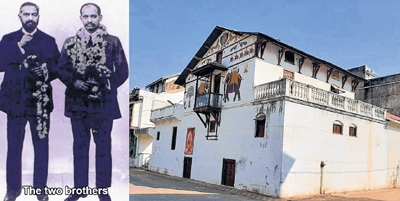
Sardar Patel Trust maintains and manages the Patel family’s ancestral “Sardar House” in Karamsad town. A huge Memorial for the duo has also been established a kilometre away from this house. The Vallabhbhai Patel and Vithalbhai Patel Memorial is spread across seven acres of land donated by the people of Karamsad.