Bhagwat shares thoughts with Manipur
|


By Our Staff Reporter
IMPHAL, Nov 20 : Rashtriya Swayamsevak Sangh (RSS) Sarsanghchalak Dr Mohan Bhagwat arrived in Manipur today on a three-day visit, landing at Imphal International Airport around 10.20 am.
This marks Bhagwat’s first visit to Manipur since the ethnic crisis erupted on May 3, 2023.
He was warmly welcomed by senior leaders of the RSS Manipur Prant upon his arrival.
Journalists attempting to pose questions to the RSS chief at the airport were prevented from doing so owing to tight security protocols in place.
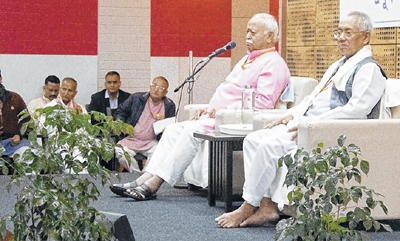
From the airport, Bha-gwat went to Yoga and Na- turopathy Kendra Bhaskara Prabha at Konjeng Leikai near the airport and addressed a programme on "100 years journey of RSS and the roadmap.
It is reported that the RSS chief will meet different distinguished persons and youths during his visit.
Meanwhile, a press release issued by RSS Manipur said that Bhagwat addressed a distinguished gathering of dignitaries in Imphal today during the first day of his three-day visit to Manipur.
In his address, Bhagwat commended Manipur’s strong cultural traditions, including the wearing of traditional attire during special occasions and use of native languages, and encouraged strengthening these further.
On the current situation in Manipur, the RSS chief stated that efforts are underway both at community and societal level to restore stability.
“Destruction takes minutes, but construction requires years, especially when done inclusively and without harming anyone. Peace-building requires patience, collective effort, and social discipline,” he observed.
Awareness of the general public is the main factor, he said and added that everything should not be expected from the Government as the responsibility of the society is very much required.
He also reflected on the Sangh’s civilisational role, National responsibilities, and the ongoing efforts for a peaceful and resilient Manipur.
Bhagwat added that the RSS continues to be a subject of daily discussion across the country, often shaped by perceptions and propaganda.
While stating that the Sangh’s work is unparalleled, he said that there is no organisation comparable to the RSS, just as the sea, the sky, and the ocean have no comparison.
The growth of RSS is organic and the methodology was resolved after 14 years of its foundation, he said and added that the objective of RSS is to organise the whole Hindu society including those who oppose the Sangh, not creating a power centre within the society.
He highlighted that misinformation campaigns against the RSS began as early as 1932-33, including from sources outside Bharat that lacked an understanding of Bharat and its civilisational ethos.
The RSS chief stressed the need for understanding of the organisation based on truth rather than perception-driven narratives.
Recalling the life of RSS founder Dr KB Hedgewar, Dr Bhagwat underlined his academic excellence, born patriotic activities, and involvement in all streams of the freedom struggle.
He noted that Dr Hedgewar’s realisation of the need for a united and qualitatively improved society led to the creation of the RSS.
“The Sangh is a man-making methodology,” he said, urging people to understand the organisation through its shakha system on ground.
He noted that the term “Hindu” in this context is a cultural and civilisational descriptor rather than a religious identity.
Hindu is not a noun but an adjective, he said.
For a strong Rashtra he emphasized the need for “quality and unity”.
The progress of a Rashtra not only depends on leaders alone but on a strong and united society, he added.
He praised the inclusive nature of Hindu thought, citing, “Ekam Sat Vipra Bahudha Vadanti.”
“Vividhata (diversity) is not a myth. Diversity is the manifestation of inherent unity within the society,” he said.
Speaking on Bharat’s ancient Nationhood, he said the Rashtra emerged not through western State mechanisms but through the “tapasya” of great ancient seers for the welfare of humanity.
Principles like Vasudhaiva Kutumbakam reflect the universal vision of Hindutva.
Emphasising the need for expanding apanatva (sense of belonging), Bhagwat remarked that "the world listens to us as our societal strength increases."
Nobody listens to the weak, the RSS chief said and added that "The mission of the Sangh is to nurture capable individuals for a strong and harmonious Hindu Samaj.”
He added that the RSS does not work for its own glory.
During his address, Bhagwat outlined the Panch Parivartan initiatives being undertaken during the centenary year of the RSS : Samajik Samarasata (Social Harmony), Kutumb Pravodhan (Family awakening), Paryavaran Sanrakshan (Environment protection), Swabodh (understanding our own identity and promoting swadeshi thoughts and products) and Nagarik Kartavya (Civic responsibility).
"We must be self-reliant as a society for a Swavalambi Bharat and RSS always emphasises on a strong social capital," Bhagwat said.
He also emphasised the need for skill development for an economically empowered society.
He concluded by reiterating the Sangh’s long-standing ideal: “Sampoorna Samaj ka Sangathan by Sajjan Shakti.”
The Sarsanghchalak also interacted with the participants on issues ranging from skill development, youth and reservation.