"Current Govt policy does not favour creation of new Union Territories" Centre, Kuki-Zo armed groups hold talks on demand for UT
|


NEW DELHI, Nov 8
The Ministry of Home Affairs (MHA) held another round of talks for two days with representatives of the Kuki-Zo armed groups under the Suspension of Operation (SoO) agreements — the Kuki National Organisation (KNO) and the United People’s Front (UPF) — on November 6 and 7 in New Delhi.
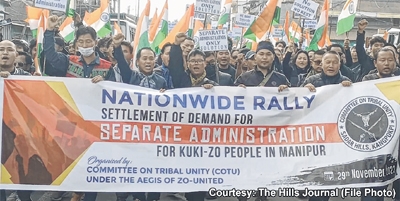
The discussions primarily focused on the community’s core political demand for the creation of a Union Territory with a Legislative Assembly which the Centre reportedly rejected.
The KNO and UPF delegations, representing the Kuki-Zo political and armed leadership, were led by senior leaders from both the umbrella groups, while the Centre was represented by AK Mishra, Advisor (North East), MHA.
The first day of the talks reviewed the implementation of the September 4 tripartite agreement signed between the MHA, the Government of Manipur, and the SoO groups.
Kuki-Zo representatives highlighted the breakdown of governance and law and order in Kuki-Zo inhabited areas following the ethnic conflict, calling for an alternative administrative arrangement to ensure security and development.
On the second day, deliberations centred on the Kuki-Zo demand for a Union Territory with Legis- lature. The delegations reiterated that “coexistence under the present Manipur State administrative structure is no longer possible” following what they described as “ethnic cleansing” beginning on May 3, 2023, in Imphal.
The Kuki-Zo leaders argued that their demand is both historically and constitutionally justified. They pointed out that before Independence, the Kuki-Zo hills were never under the Manipur State Durbar’s control and were classified as an “Excluded Area” under the Government of India Act, 1935—administered directly by the British Political Agent, not the Meitei monarchy. They further explained that the tribal chief-owned land tenure system is fundamentally incompatible with the State-controlled land model in the valley, reflecting historically distinct adminis- trative systems.
Describing their demand as a “restoration of pre-Independence autonomy,” the Kuki-Zo representatives said it is not aimed at division but at ensuring equitable governance, safety, and socio-economic development within the Indian Union.
They recalled that during Manipur’s merger with India in 1949, while the Meitei king received compensation, the tribal chiefs did not — leaving the traditional governance rights of Kuki-Zo chiefs unacknowledged.
In response, AK Mishra conveyed that the Centre remains sensitive to the Kuki-Zo people’s concerns, but clarified that current Government policy does not favour the creation of new Union Territories.
He stressed the importance of consulting all communities in Manipur before any potential administrative restructuring.
However, the KNO and UPF urged the Centre to revisit its stance, asserting that constitutional provisions outweigh policy limitations. They called on the Government to invoke constitu- tional safeguards to protect the lives, land, and property of the Kuki-Zo people.
The discussions touched upon land and forest rights, protection of traditional chieftainship, and tribal development.
The SoO leaders requested MHA’s direct intervention to safeguard community ownership of land, streamline succession procedures for village chiefs, and simplify land registration processes—currently requiring travel to Imphal, which they described as “unsafe and inaccessible” since the outbreak of violence.
The issue of Internally Displaced Persons (IDPs) featured prominently, with the Kuki-Zo groups urging the Government to expedite rehabilitation and ensure adequate security, housing, and amenities for displaced tribal families. Both sides agreed to pursue confidence-building measures and maintain open channels of dialogue as part of the ongoing peace process. The talks are being seen as a crucial step toward addressing long-standing political aspirations and restoring stability in Manipur’s conflict-affected regions. India Today NE