Kanghi Festival helps Maram Khullen keep traditional sports alive
15 Dec 2025 00:12:38
Our Correspondent
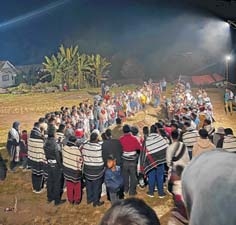
Senapati, Dec 14: Kanghi festival, also known as Kanghisangi, a significant post-harvest celebration of the Maram tribe in Manipur, is being observed with traditional fervour at Maram Khullen, highlighting the community's rich cultural heritage and age-old sporting practices, including the rare tradition of naked wrestling.
Celebrated annually for ten days, mostly in December as per the ancestral calendar, the Kanghi festival draws villagers and visitors alike.
One of its most striking features is the traditional naked wrestling held every year in front of the Maram Khullen chief's residence.
The unique sporting event, considered among the rarest surviving indigenous practices in the country, continues to serve as an ancestral display of strength, skill and unity among different clans, while also attracting villagers.
The festival begins with the ceremonial decoration of buffaloes and cows, followed by cockfights and wrestling competitions for the youth. On the third day, married couples exchange gifts and the entire community comes together for a grand feast. As part of the traditional rituals, a dog is sacrificed, and its head is given to the girls' dormitory.
Various indigenous sports and activities such as long jump competitions, wrestling, and the exchange of rice-beer among boys and girls form an integral part of the celebrations.
The festival also showcases Maram tribe's traditions, music and dance, reinforcing strong community bonds and preserving cultural identity.
Addressing the media, the chief of Maram Khullen, K Namba stated that Kanghi is a post harvest festival where all villagers including the Mathak Sagei, Makha Sagei and Khullakpa Sagei, come together to celebrate unity and strength through traditional wrestling.
He added that the Naked wrestling is a competitive display of strength and inter-clan entertainment.
During the Naked Wrestling events, the three clans are seated separately, maintaining customary distinctions. After the conclusion of the ten-day festival, villagers return to field work in preparation for the next agricultural cycle, stated K Namba.
The festival continues to stand as a living testament to the Maram tribe's commitment to preserving its ancestral customs and traditional sports for future generations.