Young woman redefines entrepreneurship with Hentak
23 Dec 2025 00:37:31
By Our Staff Reporter
IMPHAL, Dec 22 : Meet Henry, a young mother of two children, who is keeping the aged tradition of making hentak alive.
Hentak is a popular Manipuri fermented fish paste.
An emerging entrepreneur, Konsam ningol Moirangthem ongbi Henry is 28, and is a resident of Heirok Part-III Litan Wangma. Her husband is in active service.
The hentak she makes is gaining popularity and is selling like hot cakes. She is even shipping it outside Manipur.
On an average, she makes around 50 Kg hentak daily, but is unable to meet demand at current processing capacity.
She now employs 6 people from her locality.
Speaking to The Sangai Express, Henry said she started making hentak to earn some income.
"I wanted to earn some income to chip in running the family. So, I started small. I never thought so many people would come to buy it," Henry said.
In the beginning, Henry said, she used to make only a few kilograms of hentak and sell it to people in her locality and relatives.
She would buy small quantities of dry fish, Ngashang, Phabou Nga, Ngamhai and Khajing from her locality and use it to make hentak.
As demand grew, she found the local market inadequate, and started buying dry fish in bulk from wholesalers in Imphal.
1 Kg of dry fish costs Rs 200 to Rs 250 depending on the types.
She now processes 40-60 Kg of dry fish daily to make hentak.
Henry said she used to include Khajing as an ingredient, but stopped including it to suit all customers.
"There are many people who don't like Khajing. So, I stopped using it as an ingredient to suit all customers," Henry said.
Sharing the ingredients, Henry said she uses Ngashang, Phabou Nga, Ngamhai and Hongu (giant taro plant).
Hongu is the key ingredient. The quantity of hongu is carefully measured for the quality of the hentak depends on it, she said.
Explaining how she prepares hentak, Henry said she strictly follows hygienic practices, keeping in mind the safety and health of people who would consume her product.
First, the dry fishes are cleansed thoroughly to remove impurities and dried in the sun, she said.
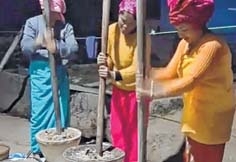
The clean dry fishes and a measured quantity of hongu are then ground in a Shumbal, wooden traditional tool.
The mixture is then transferred into a large earthen pot, the inner surface of which is evenly coated with edible oil.
After 5 days in storage, the paste/mixture is taken out and ground again. The hentak thus processed is ready to be stored and eaten.
Henry packs her hentak in smaller pots of 1 Kg, 2Kg, 3Kg and 4Kg.
The smaller pots containing hentak are kept covered with breathable clothes/fabric.
The breathable fabric is used to promote air circulation and prevent fungal growth.
10 Kg of dry fish yields around 11 Kg of hentak.
Henry said 1 Kg of hentak is sold at Rs 400.
After deducting labour charge, Henry said she makes a profit of Rs 5,000 in selling 50 Kg of hentak.
While she is successfully running the business and keeping alive the aged tradition, Henry is also active on social media.
On Facebook, she shares the processes of making hentak. This has also helped her find more customers.
People from far off places are buying the hentak from her home at Heirok, and she is also shipping it outside Manipur.
She receives more than 100 orders in a day.
To meet the demand, Henry said she is planning to increase production.