Angkor Wat and Kangla : A shared cosmology
30 Dec 2025 23:23:43
BB Sharma
It was November end, we reached Phnom Penh, the capital city of Cambodia. From there the Team-38, proceeded to Siam Reap, the gateway to the magnificent Angkor Wat Temple Complex. Few days back the famous “Bon-Om-Tauk”, the water festival of Cambodia heralding the end of monsoon season was just over. Yet, the festivity and gaiety of the “Bon-Om-Tauk” was seen.
The Team-38 was drawn from different professions like engineers, medical doctors, teachers from the higher education and of course from business. Everybody in the group had their own taste and interest. The next day, after arrival, our guide announced that we are proceeding to the temple complex the Angkor Wat, listed in the UNESCO World Heritage site. I was so thrilled that I was going to see the long-awaited temple site spread over 400 sqkm, having over seventy shrines.
After we got down from the bus and entered the main gate from the western side through a cause-way over the vast moat, guarded by Naga Serpents raised on a short square column on both sides, I asked Shri Ch Sangram Ji, our team member, what the snake looked like ? He replied, it could be a Buddhist Temple feature. I was not satisfied. Somebody amongst us murmured that it may be Shesh-Nag, the icon of the Lord Pakhangba as some section of population perceived it. This pricked my conscience. Central Angkor Wat which houses the main temple of Lord Vishnu, the orientation is westward rather than eastward. This raised many questions including why the temple is faced westward ? There was no answer. The historical site of Kangla which lies at the heart of the Imphal City is also oriented westward. Like Angkor Wat, the main entrance of the Kangla is from the west. In Angkor Wat the main entrance is guarded by lion guardians standing westward. The Kangla is also protected by two animals standing westward which is called “Kangla Sha”.
I climbed up to the second level of the main temple, where the endless world- serpent floating in the cosmic sea and surrounding the Lord Vishnu as he sleeps through the night of Brahma before rebirth of the earth. Besides, Lord Vishnu there are many statues of Lord Buddha both seated and standing. I was told that Angkor Wat has become a Buddhist pilgrimage site giving the name “Hall of Thousand Buddha”. Now, many Buddha statues were removed in 1970s for safety of the temple building and many were destroyed by Khmer Rouge during their reign of terror.
The history of Angkor is known from its inscriptions. The temple begins in the 9th Centrury, when the young King Jaya Varman II, declared himself the supreme sovereign and established his capital. Upto that point, Khmer history had been that of a small independent State occasionally consolidating into larger empires but never for long. Over the Khmer empire as a whole, Hinduism dominated until the end of the 12th Century. Hinduism over the centuries had changed its focus, with different Gods in ascendancy, but by the time it reached the Khmers there were two principal cults–that of Vishnu and that of Shiva. In the 13th Century with the rise of Therevada Buddhism, the influence of Hinduism gradually shifted to Buddhist way of life. However, the kingdom of Angkor endured until the end of 16th Century.
Our colleague Shri H Bhogendra Singh engaged a guide, who explained that Angkor Wat as a microcosm of the Hindu Universe. The moat represent the mythical ocean surrounding the earth and the galleries around the temple representing mountain ranges that surround Mount Meru, the home of Gods.
According to him, Angkor means Universe (Brahmand). The Khmer word Angkor is derived from the Sanskrit word Nagara, a Hindu City State. I recall a classroom lecture of Prof Miniketan Singh, when I was a student in DM College that the Kangla Moat is not only for defense purposes but also a depiction of Manipuri Cosmo- logy. At that time, I did not grasp the idea. But after seeing the Angkor moat, my sense is that there is syno-nymity of both the moats. Surprisingly, Angkor Wat is located about 30 kms north of the famous lake “Tonie Sap” while the Kangla also stands about 30 kms north of famous Loktak Lake.
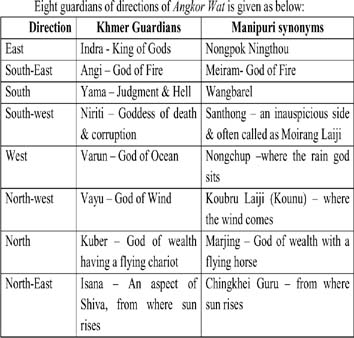
Afternoon, we took tuk-tuk (a locally fabricated three-wheeler auto-rickshaw) ride around the Angkor Wat complex. The forest in and around the temple complex gave us a winter chill in the scorching heat of Cambodia. After the ride, I could see the temple complex is guarded by the Dikapalas, the eight guardians of directions, which in Manipur we called “Maikei Ngakpa Lai”. Every year the Manipuris forecast the seasonal phenomenon including rainfall based on which guardians of directions rules the year. This belief also prevails amongst the Khmers of Cambodia.
In the early century of the Christian Era, Cambodia witnessed many town States: moated, fortified and frequently in conflict with each other, just like several principalities in Manipur. The Chinese called the principal city State with which they traded as “Funan”. The Funan State had strategic importance in controlling the sea routes along the Mekong Delta and Gulf of Thailand. Funan controlled the narrow isthmus of Kra the neck of Malaya Peninsula which connect Eastern-Asia with India. Indeed, it was trade with India which gave the Khmers their primary cultural contact and introduced them to Hinduism and later Buddhism. The Khmers religious belief, iconography, arts and architecture all seem directly from India and this had a profound influence on the development of its civilization.
It is said that one Kaudinya Brahmin from Java came to Cambodia and established the Funan Kingdom in the First Century AD. The Funan Kingdom flourished and extended the kingdom far and wide. According to Chinese account in the 6th Century, there was a powerful city called Bhavapura with its King Bhava Varman-I. In 1010, King Surya Varman-I built a Royal Palace at Akhor Thom. Surya Varman-II seized power and built Angkor Wat and ruled from 1112 to 1150, which marks the peak of the Angkor power and influence.
I asked the local tourist guide, why the Khmers adopted the Hindu faith and Hindu God and Goddesses which came to Cambodia from several miles away ? The answer came as that the indigenous idea of cosmology and Hindu cosmology is the same. Though we are Buddhist, we still believe in our cosmology. He also said the Hindu traders coming from India were very prosperous with better living condition influenced the local population and they worship Lakshmi, Vishnu and other Hindu Gods so that they can also prosper like the Hindu traders.
Writers like Wahengbam Ibohal Singh, wrote that due to disturbances in Cambodia in 1057 AD, a group of people has moved to the north-west and finally arrived at Kingdom of Manipur. The Maring, a cognate tribe of Mon possibly arrived at the second half of the 11th Century AD. As recorded in the Manipuri Chronicle, Chei-tharol Kumbaba, it is stated that Taothingmang (1055-75 AD) the grandson of Pakhangba had a clash with a Funan Chief who was a great archer.
As a tourist, I was drawn to its serene country yards, grand galleries and timeless beauty of its iconic spires. I wonder how many years the restoration works will take for both the Government of India and Cambodia, after seeing massive strangler fig roots that are tearing the stones apart yet somehow holding the structure together. (The writer is a Retd. IIS officer, who recently travelled to Cambodia)