Explaining the 11th President’s Rule in Manipur
15 Feb 2025 01:01:18
Heigrujam Premkumar Singh
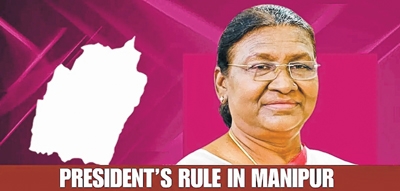
The President of India has proclaimed Constitutional emergency aka President’s Rule in Manipur on 13th February, 2025. This is the 11th time President’s Rule has been imposed in Manipur, the highest in any State of India. Consequently, the Manipur Legislative Assembly has been put under suspended animation.
What preceded this development ?
Let’s keep it short. Manipur has been under violent crisis since 3rd May, 2023. Both the Centre and State Government have not been able to resolve the crisis to the satisfaction of the people of the State. The State Legislative Assembly Session was to kickstart on 10th February, 2025. The Opposition in the Assembly was gearing up for a No Confidence Motion against the State Government and the ruling party didn’t want to take chances.
The Government thus was exploring ways to make the Opposition silent and escape legislative scrutiny. What followed was the resignation of the Chief Minister on 9th February, 2025 just one day before the beginning of the Assembly Session. Then, the Governor who summoned the Assembly Session declared his order ‘null and void’ and thus brought speculations and political uncertainty in the State for the last few days.
There were many guesses on the next move of the ruling party—some said a new Government may be formed under a new Chief Minister while others speculated President’s Rule. Now, President’s Rule is enforced in Manipur and the State Assembly is kept under suspended animation.
The President’s Rule and the political developments in Manipur
Article 356 of the Indian Constitution provides for the imposition of President’s Rule when “the State Government cannot be carried on in accordance with the provisions of the Constitution”. In plain words, President’s Rule implies suspension of State Government paving way for direct rule of the Union Government in the State.
When a State is under the President’s Rule, there are two important political implications: 1) the State Government is removed and the concerned State Governor, on behalf of the President, carries on the administration with the help of the State Chief Secretary or the Advisors appointed by the President; and 2) the State Legislative Assembly is either suspended or dissolved.
In Manipur’s present context, with the resignation of of the Chief Minister on 9th February, 2025, there is no longer a State Council of Ministers or State Government in true sense.
Regarding the State Legislative Assembly, it is kept in suspended animation. According to the National Commission to Review the Working of the Constitution (NCRWC) Consultation Paper on Article 356 (2001), when President’s Rule is proclaimed in a State, it is open to the President to dissolve a Legislative Assembly. However, such a power can be exercised only after both the Houses of Parliament approve the proclamation. Until then, the President can only keep the Legislative Assembly in suspended animation. Further, if the two Houses of Parliament disapprove or do not approve the proclamation within two months, the Legislative Assembly gets automatically reactivated after two months. This position was a reiteration of the Supreme Court judgement in SR Bommai vs Union of India (1994).
The above observation implies that, during President’s Rule, the State Assembly can be put under suspended animation without Parliamentary approval for a maximum duration of two months. After getting Parliamentary approval, the President can either dissolve the Assembly or continue to put it under suspended animation. Further, there is no legal limit as to how long the State Assembly can be kept under suspended animation. While keeping a State Assembly under suspended animation during President’s Rule, the only limit has to be the limit on Article 356 itself — the maximum duration Article 356 can be imposed in a State is three years and hence, the maximum duration a State Assembly can be put under suspended animation in this context is three years.
What may follow now ?
It’s interesting that the ruling party which still enjoys majority in the State Assembly, instead of forming a new Government under a new leader, chose President’s Rule. There is one possible reason, among others : the ruling party is buying time.
Forming a new Government under a new leader would still give the Opposition a chance to move a No Confidence Motion in the Assembly. On the other hand, there seems to be no consensus within the ruling party on who can succeed the outgoing Chief Minister. The imposition of President’s Rule and putting the State Assembly under suspended animation keeps the Opposition silent, helps the Government avoid legislative scrutiny, and allows the party high command to control infighting.
Dissolution of the State Assembly is most probably not happening. It is going to remain in suspended animation until the ruling party comes up with a solution. This is because the ruling party is at a numerically advantaged position in the current State Assembly which term will continue for two more years. There is no way it would want to lose this numerical advantage because they can form Government anytime with this number.
With current public support for the ruling party in elections remaining unfavourable in Manipur, as the recently concluded Lok Sabha election proved, the ruling party may not want to dissolve the Assembly and pave way for fresh Assembly election in the State. They have the number, they can form the Government, and two more years of the term is long way to go. Dissolving the Assembly thus may be ruled out as a politically irrational decision.
Keeping the State Assembly under suspended animation is a clever political strategy. It will give the ruling party time to explore ways to resolve the crisis in Manipur. It will also enable them to take time to decide on who will lead the State Government — the outgoing Chief Minister may return and form Government again or another leader from the party may be asked to form Government. All of these, without losing the numerical advantage and keeping the Opposition clueless.
(The writer is Faculty, Dr. Ambedkar Centre of Excellence, Manipur University. He is also a Senior Research Fellow of the University Grants Commission, Government of India at the Department of Political Science, Manipur University)