From Delphi to Kangla : A pilgrimage through civilizations A soulful journey across Greece and Italy that mirrors Manipur’s cultural crossroads
|


Dr Raj Singh
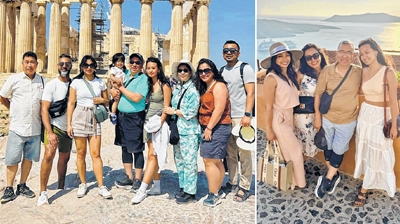
Some journeys are measured not in miles but in meaning. From June 8 to June 18, 2025, I was blessed with one such journey-ten days of family reunion and soulful wandering across Greece and Italy. It was a gift from my three daughters, who live in three different cities across Canada.
They gave me the rarest luxury in today’s scattered world-time, togetherness, and an exotic landscape to frame it all. Our party of nine included my sister and her husband from Manipur and my darling 17-month-old granddaughter, Kaya, who carried with her the innocence of tomorrow and the hopes of many generations.
We walked through ancient marble ruins, drove through mountains and gullies, smelled the breeze from the blue waters of the Aegean Sea, and gazed up at ceilings that once echoed the footsteps of Caesars. Yet, even as my senses absorbed the classical wonders of Greece and Italy, my mind was constantly drawn home to the emerald hills and troubled valleys of Manipur.
Delphi : The Navel of the World and the Soul of Reflection
Our journey began in Delphi, nestled on the slopes of Mount Parnassus, where ancient Greeks believed the earth’s navel lay (Meiteis also hold a belief Kangla Prithvigi khoidouni). The Temple of Apollo greeted us with the enigmatic maxim etched in stone: “Know Thyself.”
Standing among broken pillars and fragrant olive groves, with wind sweeping the sunlit valley below, I felt as if I stood not just at the center of the world, but at the center of a timeless question : Do we, as a people, know ourselves ?
As someone from Manipur, a land rich in heritage yet fractured by strife, the words “Know Thyself” struck a particularly aching chord. We have preserved one of the longest surviving dynasties in the world, ruled by over seventy kings of the Ningthouja lineage. Yet, we now flinch at claiming the label “classical” for our culture.
The Oracle stone Omphalos is the witness to the legacy that, in Delphi, the oracle once delivered wisdom to kings. In Manipur, I wondered, where are our oracles? Who reminds us of our essence ?
Athens: Where Democracy Dared to Begin
From Delphi, we descended into Athens, the cradle of democracy. Our guide, Laura, introduced us to the Parthenon atop the Acropolis, referring to it as “classical,” a word so effortlessly used in Greece to connote both grandeur and timelessness.
I lingered on that word: Classical. It echoed in my mind like a challenge, a comparison, a mirror.
We, the Meiteis of Manipur, possess a script older than many modern alphabets, an epic literature of Khamba-Thoibi, a refined aesthetic in dance and martial arts, and a deeply philosophical synergy of the syncretism between the indigenous religion, Sanama- hism, and Hinduism. Yet, why is the classical status of Manipuri culture debated not by outsiders, but by our own brethren ?
In Athens, classical means pride. In Manipur, it has somehow become a burden. We seem to stand at the ruins of our own confidence, questioning what should be celebrated.
Santorini: The Island of the Present
Santorini welcomed us like a dream. The island, with its cascading whitewashed homes and blue-domed Churches, clings to volcanic cliffs as if resisting time itself. The sunsets, crimson and surreal, made us hold our breath. Kaya laughed as the sea breeze tickled her cheeks. In those fleeting moments, all nine of us felt suspended in time; unburdened, united, and whole.
But as we strolled through the cobbled lanes of Oia and gazed at the caldera that swallowed half the island in a prehistoric erup- tion, I couldn’t help but think - Why not Manipur ? Why can’t Thanga and Karang Islands of Loktak Lake become our Santorini ? Why can’t the blue hills of Ukhrul or the historic capital of Kangla draw the world to their charm ? Why do we remain imprisoned by fear, conflict, and distrust, while Nations rise from ruins to create sanctuaries of peace ?
Tourism, in Santorini, is not just an industry. It is an assertion of identity. It says : We are proud of who we are, and we invite the world to witness it. In Manipur, we are so busy fortifying our ethnic boundaries that we forget to open our hearts, even to our own people.
Vatican City: A Sacred Epic in Marble and Gold
Among the most breathtaking highlights of our journey was Vatican City - a Nation within a city, an empire of faith and art. As we entered St Peter’s Basilica, I felt as if we were stepping into the culmination of Western civili- zation’s sacred imagination.
The Pietà, sculpted by Michelangelo, was not merely a statue; it was divine grief carved in stone. The Sistine Chapel, with its ceiling narrating Genesis through the hand of God and the eyes of a genius, filled us with reverent silence. Every corridor of the Vatican Museums was a triumph of human expression, each hall an archive of a civilization’s belief in its own destiny.
But more than beauty, what struck me was the unity of message. Across centuries, despite schisms and scandals, Vatican City has never ceased to project its cultural sovereignty, rooted in faith, art, and identity. It has become not just a pilgrimage site, but a cultural capital of enduring legacy.
I thought again of Manipur. If the Vatican can elevate a small territory into a world spiritual center, why can’t Kangla be restored as a seat of civiliza- tional dignity ? Why do we allow our sacred spaces to decay under neglect, politicization, and self-doubt ?
Manipuri civilization once fused religion, governance, and philosophy into a harmonious cultural order. Temples were built with cosmological precision; rituals aligned with natural cycles; language carried coded wisdom. But today, our temples are disputed, our identity diluted, our pride often reduced to reactionary politics.
Vatican City reminded me that cultural evolution and continuity are not accidental. They are intentional. It is a choice societies make to cherish what is sacred and share it with the world.
Rome: Echoes of Empire and Lessons of Legacy
Our final stop was Rome. Here, every stone speaks history. From the Colosseum to the Pantheon, the city is a breathing museum, showing how empires rise and fall, and how civilizations endure when they adapt, absorb, and reflect.
Rome was not built in a day, and it was not held together by brute force alone. It was culture, law, and a deep sense of public identity that forged an empire. When the empire collapsed, its soul endured through language, architecture, and memory.
I stood in the Roman Forum, thinking of Kangla Fort in Imphal-another seat of ancient power, now more symbolic than sovereign. Yet we treat it more as a relic than a root. Why do we, in Manipur, allow our own cultural heritage to be defaced by division and denial ?
We left Rome with full hearts and heavy thoughts. Kaya babbled her first Italian-sounding phrases, my daughters clicked the last of their selfies, and the elder members among us shared quiet smiles that said, this trip will echo for a lifetime.
Reflections on a Return
Back in my room, jet-lagged but spiritually stirred, I look at photos of Delphi, Athens, Santorini, Vatican City, and Rome. I think of Manipur—a land no less gifted in landscape or history. And I am haunted by questions :
* Why is Manipur unable to leverage its cultural capital for peace and prosperity?
* Why does the motto “Know Thyself” not resonate across our hills and valleys ?
* Why is the Meitei identity, once proud, elegant, and refined, now under siege, not just from outside but within?
In Greece, ruins are polished and preserved. In Manipur, we let ours fade under weeds and blood. In Italy, unity is drawn from shared memory. In Manipur, memory is fractured along ethnic lines. Yet, I refuse to despair. The Parthenon still stands. Vatican City still inspires. Rome still teaches resilience. And Kaya, my granddaughter, represents not just hope, but a future not yet written.
A Patriotic Plea
This travelogue is more than a postcard from Europe. It is a call, a plea to rediscover our roots, reclaim our pride, and realize that Manipur does not have to be at war with itself. If Greece can turn its myths into museums, if the Vatican can make sacred art the soul of a State, and if Santorini can turn sunsets into symbols of peace, so can we.
Let the Meiteis stop doubting their classical heritage. Let our people stop dismembering each other’s identity in the name of purity. Let us know ourselves truly, deeply, with humility and pride.
Let the hills and the valley not be fault lines, but foundations of harmony.
We have walked too far from our essence. Maybe it’s time to take a pilgrimage, not to Delphi or Rome, but inward - into the soul of Manipur. Only then can we, like the ancients, carve a future worthy of our past.
(The author is a Manipuri expat settled in Canada. He can be reached at [email protected])
Some journeys are measured not in miles but in meaning. From June 8 to June 18, 2025, I was blessed with one such journey-ten days of family reunion and soulful wandering across Greece and Italy. It was a gift from my three daughters, who live in three different cities across Canada.
They gave me the rarest luxury in today’s scattered world-time, togetherness, and an exotic landscape to frame it all. Our party of nine included my sister and her husband from Manipur and my darling 17-month-old granddaughter, Kaya, who carried with her the innocence of tomorrow and the hopes of many generations.
We walked through ancient marble ruins, drove through mountains and gullies, smelled the breeze from the blue waters of the Aegean Sea, and gazed up at ceilings that once echoed the footsteps of Caesars. Yet, even as my senses absorbed the classical wonders of Greece and Italy, my mind was constantly drawn home to the emerald hills and troubled valleys of Manipur.
Delphi : The Navel of the World and the Soul of Reflection
Our journey began in Delphi, nestled on the slopes of Mount Parnassus, where ancient Greeks believed the earth’s navel lay (Meiteis also hold a belief Kangla Prithvigi khoidouni). The Temple of Apollo greeted us with the enigmatic maxim etched in stone: “Know Thyself.”
Standing among broken pillars and fragrant olive groves, with wind sweeping the sunlit valley below, I felt as if I stood not just at the center of the world, but at the center of a timeless question : Do we, as a people, know ourselves ?
As someone from Manipur, a land rich in heritage yet fractured by strife, the words “Know Thyself” struck a particularly aching chord. We have preserved one of the longest surviving dynasties in the world, ruled by over seventy kings of the Ningthouja lineage. Yet, we now flinch at claiming the label “classical” for our culture.
The Oracle stone Omphalos is the witness to the legacy that, in Delphi, the oracle once delivered wisdom to kings. In Manipur, I wondered, where are our oracles? Who reminds us of our essence ?
Athens: Where Democracy Dared to Begin
From Delphi, we descended into Athens, the cradle of democracy. Our guide, Laura, introduced us to the Parthenon atop the Acropolis, referring to it as “classical,” a word so effortlessly used in Greece to connote both grandeur and timelessness.
I lingered on that word: Classical. It echoed in my mind like a challenge, a comparison, a mirror.
We, the Meiteis of Manipur, possess a script older than many modern alphabets, an epic literature of Khamba-Thoibi, a refined aesthetic in dance and martial arts, and a deeply philosophical synergy of the syncretism between the indigenous religion, Sanama- hism, and Hinduism. Yet, why is the classical status of Manipuri culture debated not by outsiders, but by our own brethren ?
In Athens, classical means pride. In Manipur, it has somehow become a burden. We seem to stand at the ruins of our own confidence, questioning what should be celebrated.
Santorini: The Island of the Present
Santorini welcomed us like a dream. The island, with its cascading whitewashed homes and blue-domed Churches, clings to volcanic cliffs as if resisting time itself. The sunsets, crimson and surreal, made us hold our breath. Kaya laughed as the sea breeze tickled her cheeks. In those fleeting moments, all nine of us felt suspended in time; unburdened, united, and whole.
But as we strolled through the cobbled lanes of Oia and gazed at the caldera that swallowed half the island in a prehistoric erup- tion, I couldn’t help but think - Why not Manipur ? Why can’t Thanga and Karang Islands of Loktak Lake become our Santorini ? Why can’t the blue hills of Ukhrul or the historic capital of Kangla draw the world to their charm ? Why do we remain imprisoned by fear, conflict, and distrust, while Nations rise from ruins to create sanctuaries of peace ?
Tourism, in Santorini, is not just an industry. It is an assertion of identity. It says : We are proud of who we are, and we invite the world to witness it. In Manipur, we are so busy fortifying our ethnic boundaries that we forget to open our hearts, even to our own people.
Vatican City: A Sacred Epic in Marble and Gold
Among the most breathtaking highlights of our journey was Vatican City - a Nation within a city, an empire of faith and art. As we entered St Peter’s Basilica, I felt as if we were stepping into the culmination of Western civili- zation’s sacred imagination.
The Pietà, sculpted by Michelangelo, was not merely a statue; it was divine grief carved in stone. The Sistine Chapel, with its ceiling narrating Genesis through the hand of God and the eyes of a genius, filled us with reverent silence. Every corridor of the Vatican Museums was a triumph of human expression, each hall an archive of a civilization’s belief in its own destiny.
But more than beauty, what struck me was the unity of message. Across centuries, despite schisms and scandals, Vatican City has never ceased to project its cultural sovereignty, rooted in faith, art, and identity. It has become not just a pilgrimage site, but a cultural capital of enduring legacy.
I thought again of Manipur. If the Vatican can elevate a small territory into a world spiritual center, why can’t Kangla be restored as a seat of civiliza- tional dignity ? Why do we allow our sacred spaces to decay under neglect, politicization, and self-doubt ?
Manipuri civilization once fused religion, governance, and philosophy into a harmonious cultural order. Temples were built with cosmological precision; rituals aligned with natural cycles; language carried coded wisdom. But today, our temples are disputed, our identity diluted, our pride often reduced to reactionary politics.
Vatican City reminded me that cultural evolution and continuity are not accidental. They are intentional. It is a choice societies make to cherish what is sacred and share it with the world.
Rome: Echoes of Empire and Lessons of Legacy
Our final stop was Rome. Here, every stone speaks history. From the Colosseum to the Pantheon, the city is a breathing museum, showing how empires rise and fall, and how civilizations endure when they adapt, absorb, and reflect.
Rome was not built in a day, and it was not held together by brute force alone. It was culture, law, and a deep sense of public identity that forged an empire. When the empire collapsed, its soul endured through language, architecture, and memory.
I stood in the Roman Forum, thinking of Kangla Fort in Imphal-another seat of ancient power, now more symbolic than sovereign. Yet we treat it more as a relic than a root. Why do we, in Manipur, allow our own cultural heritage to be defaced by division and denial ?
We left Rome with full hearts and heavy thoughts. Kaya babbled her first Italian-sounding phrases, my daughters clicked the last of their selfies, and the elder members among us shared quiet smiles that said, this trip will echo for a lifetime.
Reflections on a Return
Back in my room, jet-lagged but spiritually stirred, I look at photos of Delphi, Athens, Santorini, Vatican City, and Rome. I think of Manipur—a land no less gifted in landscape or history. And I am haunted by questions :
* Why is Manipur unable to leverage its cultural capital for peace and prosperity?
* Why does the motto “Know Thyself” not resonate across our hills and valleys ?
* Why is the Meitei identity, once proud, elegant, and refined, now under siege, not just from outside but within?
In Greece, ruins are polished and preserved. In Manipur, we let ours fade under weeds and blood. In Italy, unity is drawn from shared memory. In Manipur, memory is fractured along ethnic lines. Yet, I refuse to despair. The Parthenon still stands. Vatican City still inspires. Rome still teaches resilience. And Kaya, my granddaughter, represents not just hope, but a future not yet written.
A Patriotic Plea
This travelogue is more than a postcard from Europe. It is a call, a plea to rediscover our roots, reclaim our pride, and realize that Manipur does not have to be at war with itself. If Greece can turn its myths into museums, if the Vatican can make sacred art the soul of a State, and if Santorini can turn sunsets into symbols of peace, so can we.
Let the Meiteis stop doubting their classical heritage. Let our people stop dismembering each other’s identity in the name of purity. Let us know ourselves truly, deeply, with humility and pride.
Let the hills and the valley not be fault lines, but foundations of harmony.
We have walked too far from our essence. Maybe it’s time to take a pilgrimage, not to Delphi or Rome, but inward - into the soul of Manipur. Only then can we, like the ancients, carve a future worthy of our past.
(The author is a Manipuri expat settled in Canada. He can be reached at [email protected])