A new academic horizon of Environmental Science in the NEP era
|


Dr Th Manimala Devi
A Transformative Policy in Motion
The National Education Policy 2020 marks a major change in India's education system after over thirty years. It aims to make learning more inclusive, rooted in Indian values and suited to today’s world. This policy is especially important for higher education. Environmental Science, which naturally brings together many different subjects, can benefit a lot from the policy’s flexible structure, focus on practical learning and encouragement of learning across disciplines.
Curriculum Flexibility and Environmental Relevance
One of the key features of NEP 2020 is its flexible curriculum, which allows students to mix and match subjects like ecology, policy, ethics, economics and technology. Environmental Science, which was earlier limited to specialised departments, can now be studied as a minor or elective by students from various fields such as chemistry, sociology or political science. This change helps more students understand environmental issues and supports the growth of a new generation that is more aware and responsible towards the environment.
Skill Driven and Practice Oriented Learning
Instead of focusing on memorising facts, NEP encourages hands-on learning through real-life experiences. Activities like field- work, community research, sustainability checks, pollution studies and climate risk assessments are given importance. Including intern- ships, research projects and community-based work in the syllabus helps students connect directly with environmental problems and understand how to find practical solutions.
How Environmental Learning is Growing in Manipur
In the green and naturally rich State of Manipur, the changes brought by the New Education Policy are already visible in daily life. College students in Imphal are teaming up to study the floating meadows of Loktak Lake by collecting useful data. In the hill regions, tribal communities are sharing their traditional knowledge such as bamboo-based water systems, which is now being taught through special courses linked to local culture.
Institutions Offering Full-Fledged Environmental Science Programs in Manipur
Several colleges in Manipur have embraced Environmental Science as a core academic discipline, offering dedicated undergraduate or postgraduate programs. Most of the colleges of Manipur serve as vital platforms for implementing NEP 2020 reforms and nurturing regionally grounded environmental professionals. All institutions reflect how NEP reforms are being operationalised through real curriculum diversification and experiential fieldwork in Manipur’s diverse ecological zones.
Credit Bank System and Interdisciplinarity
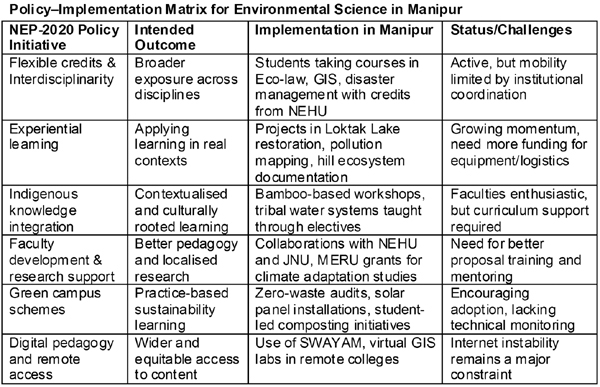
The Academic Bank of Credits, also known as ABC, allows students to carry their earned credits from one institution to another. This means that students studying Environmental Science can take up subjects like eco law, disaster management or geographic information systems at different colleges or universities. This kind of freedom helps them build a more personalised and meaningful academic journey that matches the urgent environmental issues of today.
Promoting Indigenous Knowledge and Local Contexts
NEP emphasises indigenous knowledge systems, regional languages and local contexts. For Environ- mental Science, this shift means teaching anchored in vernacular scholarship and community practices, from Manipuri wetland heritage to tribal conservation methods. Such grounding nurtures both academic insight and deeper cultural connection.
Faculty Development and Research Strengthening
The New Education Policy encourages teachers to keep learning and growing through regular training, refresher courses, and by joining international research networks. In Manipur, this support has opened up new opportunities for Environmental Science faculty. Many have started applying for grants under the Multidisciplinary Education and Research University scheme. They are also building partnerships with well-known institutes like North Eastern Hill University and Jawa-harlal Nehru University. With these collaborations, they are writing research papers that focus on local issues such as the vulnerability of hill ecosystems and ways to build climate resilience. This ongoing learning and research is helping teachers bring fresh knowledge into the classroom while also contributing to real-world environmental solutions.
Green Campuses as Living Laboratories
The green campus goal of the New Education Policy is changing the way students learn within their own college environments. It encourages practical, hands-on learning right on campus. Students are taking the lead through Eco-Clubs where they carry out sustainability checks, look after compost pits, and run creative activities that turn waste into useful items, often called trash to treasure projects. Many campuses now have solar-powered laboratories and vermicomposting units that not only help the environment but also act as live learning spaces. These setups give Environmental Science students the chance to see real solutions in action and to understand how theory connects with everyday environmental practices.
Digital Pedagogy and Accessibility
Even with internet and network challenges in some areas, colleges in Manipur are making good use of the digital learning tools offered under the New Education Policy. Platforms like SWAYAM, virtual labs, and e PG Pathshala are helping students access lessons on topics such as hydrology and geographic information systems. These online resources are making Environmental Science learning more reachable and flexible. They also support classroom teaching and have become especially important in helping students and teachers continue learning smoothly after the disruptions caused by the pandemic.
Appreciation from the Academic Community
The New Education Policy 2020 has been well received for promoting flexible, holistic, and locally relevant learning. In Manipur, academic leaders see it as a chance to make Environmental Science more rooted in local needs while meeting global standards. Educators value the support for interdisciplinary work and the inclusion of traditional knowledge. They also welcome the move away from Western models toward local case studies. Most importantly, NEP encourages a shared learning process where students and teachers work together to create meaningful environmental knowledge.
An Evolving Policy with Hope and Challenges
The New Education Policy has a strong vision, but its success depends on better infrastructure, collaboration and steady funding. In Manipur, many colleges still lack proper labs, GIS tools and reliable internet. Teachers also need more help to bring local knowledge into the classroom. Despite these challenges, the progress is promising. Colleges are becoming more active, students are engaged and early research linked to NEP is already coming from the State University. These are encouraging signs of change.
Conclusion
The New Education Policy 2020 brings a major shift in higher education, especially for Environmental Science. Its focus on flexible learning, hands-on experience, local knowledge and green campuses is helping shape an environmental mindset that is both global and locally rooted.
In Manipur, these changes are already making a real impact in classrooms, campuses, fieldwork and local actions. Students trained under this system will grow into scientists, leaders and changemakers who blend strong science with cultural understanding and both essential for tackling climate and biodiversity challenges.
The writer is Assistant Professor, Department of Environmental Science, SEMCO, Komlathabi and can be reached at [email protected]
A Transformative Policy in Motion
The National Education Policy 2020 marks a major change in India's education system after over thirty years. It aims to make learning more inclusive, rooted in Indian values and suited to today’s world. This policy is especially important for higher education. Environmental Science, which naturally brings together many different subjects, can benefit a lot from the policy’s flexible structure, focus on practical learning and encouragement of learning across disciplines.
Curriculum Flexibility and Environmental Relevance
One of the key features of NEP 2020 is its flexible curriculum, which allows students to mix and match subjects like ecology, policy, ethics, economics and technology. Environmental Science, which was earlier limited to specialised departments, can now be studied as a minor or elective by students from various fields such as chemistry, sociology or political science. This change helps more students understand environmental issues and supports the growth of a new generation that is more aware and responsible towards the environment.
Skill Driven and Practice Oriented Learning
Instead of focusing on memorising facts, NEP encourages hands-on learning through real-life experiences. Activities like field- work, community research, sustainability checks, pollution studies and climate risk assessments are given importance. Including intern- ships, research projects and community-based work in the syllabus helps students connect directly with environmental problems and understand how to find practical solutions.
How Environmental Learning is Growing in Manipur
In the green and naturally rich State of Manipur, the changes brought by the New Education Policy are already visible in daily life. College students in Imphal are teaming up to study the floating meadows of Loktak Lake by collecting useful data. In the hill regions, tribal communities are sharing their traditional knowledge such as bamboo-based water systems, which is now being taught through special courses linked to local culture.
Institutions Offering Full-Fledged Environmental Science Programs in Manipur
Several colleges in Manipur have embraced Environmental Science as a core academic discipline, offering dedicated undergraduate or postgraduate programs. Most of the colleges of Manipur serve as vital platforms for implementing NEP 2020 reforms and nurturing regionally grounded environmental professionals. All institutions reflect how NEP reforms are being operationalised through real curriculum diversification and experiential fieldwork in Manipur’s diverse ecological zones.
Credit Bank System and Interdisciplinarity
The Academic Bank of Credits, also known as ABC, allows students to carry their earned credits from one institution to another. This means that students studying Environmental Science can take up subjects like eco law, disaster management or geographic information systems at different colleges or universities. This kind of freedom helps them build a more personalised and meaningful academic journey that matches the urgent environmental issues of today.
Promoting Indigenous Knowledge and Local Contexts
NEP emphasises indigenous knowledge systems, regional languages and local contexts. For Environ- mental Science, this shift means teaching anchored in vernacular scholarship and community practices, from Manipuri wetland heritage to tribal conservation methods. Such grounding nurtures both academic insight and deeper cultural connection.
Faculty Development and Research Strengthening
The New Education Policy encourages teachers to keep learning and growing through regular training, refresher courses, and by joining international research networks. In Manipur, this support has opened up new opportunities for Environmental Science faculty. Many have started applying for grants under the Multidisciplinary Education and Research University scheme. They are also building partnerships with well-known institutes like North Eastern Hill University and Jawa-harlal Nehru University. With these collaborations, they are writing research papers that focus on local issues such as the vulnerability of hill ecosystems and ways to build climate resilience. This ongoing learning and research is helping teachers bring fresh knowledge into the classroom while also contributing to real-world environmental solutions.
Green Campuses as Living Laboratories
The green campus goal of the New Education Policy is changing the way students learn within their own college environments. It encourages practical, hands-on learning right on campus. Students are taking the lead through Eco-Clubs where they carry out sustainability checks, look after compost pits, and run creative activities that turn waste into useful items, often called trash to treasure projects. Many campuses now have solar-powered laboratories and vermicomposting units that not only help the environment but also act as live learning spaces. These setups give Environmental Science students the chance to see real solutions in action and to understand how theory connects with everyday environmental practices.
Digital Pedagogy and Accessibility
Even with internet and network challenges in some areas, colleges in Manipur are making good use of the digital learning tools offered under the New Education Policy. Platforms like SWAYAM, virtual labs, and e PG Pathshala are helping students access lessons on topics such as hydrology and geographic information systems. These online resources are making Environmental Science learning more reachable and flexible. They also support classroom teaching and have become especially important in helping students and teachers continue learning smoothly after the disruptions caused by the pandemic.
Appreciation from the Academic Community
The New Education Policy 2020 has been well received for promoting flexible, holistic, and locally relevant learning. In Manipur, academic leaders see it as a chance to make Environmental Science more rooted in local needs while meeting global standards. Educators value the support for interdisciplinary work and the inclusion of traditional knowledge. They also welcome the move away from Western models toward local case studies. Most importantly, NEP encourages a shared learning process where students and teachers work together to create meaningful environmental knowledge.
An Evolving Policy with Hope and Challenges
The New Education Policy has a strong vision, but its success depends on better infrastructure, collaboration and steady funding. In Manipur, many colleges still lack proper labs, GIS tools and reliable internet. Teachers also need more help to bring local knowledge into the classroom. Despite these challenges, the progress is promising. Colleges are becoming more active, students are engaged and early research linked to NEP is already coming from the State University. These are encouraging signs of change.
Conclusion
The New Education Policy 2020 brings a major shift in higher education, especially for Environmental Science. Its focus on flexible learning, hands-on experience, local knowledge and green campuses is helping shape an environmental mindset that is both global and locally rooted.
In Manipur, these changes are already making a real impact in classrooms, campuses, fieldwork and local actions. Students trained under this system will grow into scientists, leaders and changemakers who blend strong science with cultural understanding and both essential for tackling climate and biodiversity challenges.
The writer is Assistant Professor, Department of Environmental Science, SEMCO, Komlathabi and can be reached at [email protected]