Govt's inaction on unauthorised constructions breeds conflicts
31 Jul 2025 07:09:45
Birendra Laishram
The Government's involvement in the Naga-Kuki road disputes stems from a complex interplay of security imperatives and humanitarian concerns. These interventions are often reactive, addressing immediate crises rather than proactively preventing them.
Navigating Security and Stability Challenges : The Foothills Naga Coordination Committee (FNCC) initiated an indefinite bandh, restricting Kuki movement through Naga-dominated areas. This action was predicated on perceived threats to ancestral lands and cultural identity arising from the allegedly unauthorized con- struction of the German-Tiger Road. The FNCC viewed the road construction as an encroachment and a potential catalyst for demographic shifts, leading to the imposition of the bandh.
The resulting disruption of civilian movement exacerbated existing ethnic tensions in the region. Recognizing the potential for further escalation and widespread unrest, the Government engaged in negotiations with Naga groups. The primary objective was to de-escalate the situation, restore a semblance of normalcy, and prevent further clashes between the communities. This intervention highlights the Government's role in maintaining a fragile peace in a volatile environment.
Addressing Humanitarian Access Needs : The Kuki-Zo Council (KZC) has consistently maintained that the contested road serves as a vital “humanitarian lifeline.” This assertion gained greater significance in the aftermath of the 2023 violence, which rendered previously accessible routes, particularly those dominated by the Meitei community, unsafe for the Kuki-Zo population.
Consequently, the German-Tiger Road became an essential artery for the movement of goods, services, and people.
Government intervention is partly driven by the pressing need to ensure unimpeded access to essential services, including healthcare, food supplies, and other necessities, for displaced communities. Preventing the isolation of vulnerable populations is a key consideration, particularly in areas where access is limited due to security concerns or logistical challenges. The Government's role is therefore framed, in part, by its responsibility to protect the welfare of its citizens, especially those most at risk.
Examining the Silence on Drug Money and Unauthorized Construction - A Deeper Dive
The Government's apparent silence in addressing the issues of drug money and unauthorized construction surrounding the German-Tiger Road raises critical questions about governance and accountability in Mani-pur. The lack of decisive action invites scrutiny and fuels speculation about the underlying reasons for this inaction.
The Absence of Formal Oversight Mechanisms: A significant factor contributing to the controversy is the fact that the German-Tiger Road was constructed without the requisite Govern- ment approval. This lack of adherence to established procedures raises concerns about transparency and the rule of law. The road's construction often involved traversing through Reserved Forests and disputed territories, further complicating the legal and environmental implications.
Moreover, these routes remain unregistered, lack formal checkposts, and are effectively controlled by militia-linked Road Opening Parties (ROPs) up to the Kangpokpi region. This absence of official oversight creates a vacuum that can be exploited by illicit actors and undermines the authority of the State. The informal nature of the road network also poses challenges for law enforcement and security agencies.
Weighing Complicity Against Strategic Ambiguity : Credible reports suggest that Kuki militant groups, including factions such as the KNF-MC and KNF-P, are actively involved in funding road construction through the illicit proceeds of drug profits and poppy taxation. This alleged nexus between illegal activities and infrastructure development raises serious concerns about the integrity of governance and the potential for the State to be compromised by criminal elements. The law-and-order vacuum in certain areas further facilitates these illicit activities and the negative consequences bounce back to the Government.
The Government’s perceived silence on these matters could be interpreted in several ways. It may reflect a deliberate avoidance of direct confrontation with armed groups operating under the Suspension of Operations (SoO) agreement, a precarious balan- cing act aimed at maintaining a fragile peace.
Alternatively, it could represent a form of strategic ambiguity, employed to navigate the complex political landscape during periods of President’s Rule. The underlying rationale could also involve political sensitivities, including allega- tions linking the drug trade to governance failures, as exemplified by the Biren Tape scandal. These allegations, whether substantiated or not, contribute to a climate of mistrust and suspicion.
Navigating the Evidence Threshold and Denial: Despite documented seizures of narcotics, such as the Rs 18 crore worth of brown sugar intercepted at Tupul Bridge, and numerous arrests that point to drug-linked activities, Kuki civil society organizations and other bodies consistently deny any criminal intent. They often dismiss such claims as “malicious and unfounded,” further complicating efforts to address the underlying issues.
The apparent lack of official acknowledgment or thorough investigation into the funding sources of the German- Tiger Road allows the Government to evade accountability. This inaction perpetuates a cycle of impunity and undermines public confidence in the fairness and impartiality of the state. Without a transparent and credible investigation, allegations of complicity will continue to linger, casting a shadow over the Government's actions.
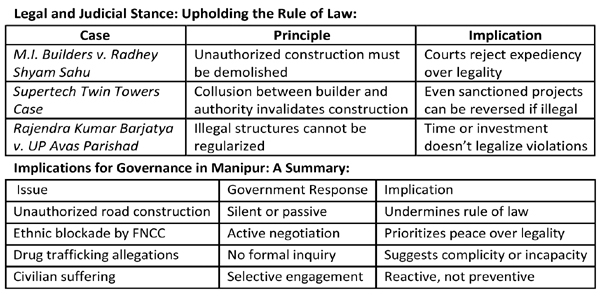
Implications for Governance in Manipur: A Summary
Strategic Questions for Further Examination: Why hasn’t the Government initiated a comprehensive judicial or Parliamentary inquiry into the funding sources and ultimate purpose of the German-Tiger Road project ?
What specific safeguards are in place to prevent SoO camps from inadvertently becoming conduits for drug trafficking and other illicit activities ?
Can the Government adequately justify negotiating with the FNCC regarding the ethnic blockade while simultaneously turning a blind eye to the illegal construction and associated en- vironmental degradation ?
Governance Impacts of Illegal Road Construction in India: Broader Implications : The Erosion of the Rule of Law and Institutional Integrity Roads constructed without the necessary environmental clearances, proper land acquisition procedures, or adherence to established planning approvals constitute blatant violations of multiple statutes, including the Forest Conservation Act and the Land Acquisition Act. These actions undermine the legal framework that governs infrastructure development.
Tolerating such projects sends a detrimental signal, suggesting either State complicity or a profound incapacity to enforce its own laws. This erosion of the rule of law undermines public trust in the integrity and effectiveness of lawful governance. It creates a perception that certain individuals or groups are above the law, further exacerbating societal divisions.
Undermining Democratic Planning and Sustainable Development: India’s infrastructure development is guided by meticulously crafted Master Plans and Development Control Regulations (DCRs), which are designed to ensure sustainable and equitable growth. Unauthorized roads circumvent these established frameworks, disrupting carefully planned zoning regulations, land use patterns, and the delicate ecological balance.
In tribal and forested areas, this often leads to encroachment on protected lands, threatening the rights of indigenous Naga communities and endangering biodiver-sity. The lack of proper planning and environmental safeguards can have long-term consequences for the environ- ment and the well-being of local populations.
Facilitating Illicit Economies and Criminal Activities: Roads funded by drug money or controlled by militia groups, as alleged in parts of Manipur, inevitably become conduits for a range of illicit activities, including: Narcotics trafficking and the movement of illegal substances; The clandestine movement of arms and ammunition; Tax evasion and the establishment of parallel governance structures.
This undermines formal institutions and empowers non-state actors, particularly those operating under the umbrella of Suspension of Operations (SoO) agreement. The presence of these illicit economies weakens the state's ability to maintain law and order and provide essential services.
Exacerbating Inter-Community Conflict and Societal Fragmentation: Unauthorized roads that traverse contested or ancestral lands, such as those belonging to Naga villages, often provoke heightened ethnic tensions. These tensions can escalate into blockades, acts of violence, and retaliatory governance actions, further destabilizing the region.
Selective State intervention—negotiating the movement of people and goods while simultaneously ignoring the illegal construction and its associated environmental damage—creates asymmetric legitimacy, fuelling resentment and deepening existing societal divisions. This inconsistent application of the law undermines the government's credibility and its ability to act as a neutral arbiter.
Collusion between builder and authority invalidates construction
The passage of time or the investment of resources does not legitimize violations of the law.
These landmark rulings reinforce the fundamental principle that unauthorized infrastructure cannot be legitimized, regardless of its perceived utility or the political pressures involved. The courts have consistently upheld the importance of adhering to the rule of law and protecting the environment.
Environmental and Fiscal Consequences: A Tangible Impact : Deforestation and hill levelling undertaken for road construction in Manipur constitute clear violations of established ecological norms, significantly increasing the risks of landslides, devastating floods, and widespread erosion. These environmental consequences have both immediate and long-term impacts on the region's sustainability.
The loss of potential tax revenue and the need for unplanned service extension (such as electricity and water) place a significant burden on already strained state finances. Furthermore, demolition costs and protracted legal disputes further deplete public resources, diverting funds away from essential services and development initiatives.
Key Legal Frameworks Addressing Illegal Road Construction in India: Several laws address illegal road construction, though enforcement is inconsistent, especially in remote areas.
Forest Conservation Act, 1980: Requires central government approval for non-forest use of forest land, preventing unauthorized deforestation for roads.
Environment Protection Act, 1986: Mandates Environmental Impact Assessments (EIAs) for construction in ecologically sensitive zones; violations incur fines and imprisonment.
Right to Fair Compensation and Transparency in Land Acquisition Act, 2013: Requires landowner consent and fair compensation for private or tribal land acquired for public infrastructure, upholding Article 300-A (Right to Property).
Indian Penal Code (IPC) & Bharatiya Nyaya Sanhita, 2023: Addresses illegal activities through sections on Criminal Trespass (forcible construction), Public Nuisance (obstruction/danger), and Conspiracy/Abetment (if linked to illicit activities).
Public Premises (Eviction of Unauthorized Occupants) Act, 1971: Enables eviction from government land encroached upon by unauthorized roads.
National Building Code (NBC), 2016: Sets standards for planning and construction, violated by unauthorized roads that disregard zoning and safety norms.
Scheduled Tribes and Other Traditional Forest Dwellers (Recognition of Forest Rights) Act, 2006: Protects tribal land and forest rights, requiring consent for construction affecting Naga villages.
Article 226 of the Constitution: Empowers High Courts to enforce legal rights via writs, allowing citizens to challenge illegal construction through PILs.
Practical Enforcement Mechanisms
Demolition Orders: Municipal or Forest Departments remove unauthorized structures.
Stop Work Notices: District Magistrates halt illegal construction.
RTI Requests: Used to obtain sanctioned plans and approvals.
PILs: Seek judicial intervention.
NGT Complaints: Challenge ecological violations.
Strategic Use in Manipur Context (e.g., Churachandpur–Kangpokpi road): The Forest Conservation Act applies to hill levelling. The Land Acquisition Act applies if tribal land was used without consent. The Environment Protection Act addresses ecological damage. The IPC/BNS may apply if linked to illicit activities.
Enforcement Challenges : While legally robust, enforcement faces challenges such as political interference which delays or blocks action.
Militant Control: Hinders enforcement in regions like Manipur.
Corruption: Officials ignore violations.
Lack of Awareness: Citizens lack knowledge to report.
Judicial Delays: Cases take years.
Practical Steps to Curb Illegal Road Construction:
Administrative Measures: GIS/drone surveillance, mandatory tribal consent, audits.
Legal Tools: RTI requests, PILs/NGT complaints, eviction under the Public Premises Act.
Civic Engagement: Community monitoring, RWAs/tribal councils, public awareness.
Relevance to Manipur
Enforcement is complicated by militant control, drug-linked funding, and ethnic tensions. Selective government engagement undermines legal integrity, necessitating a multi-pronged strategy involving legal action, environmental oversight, and tribal advocacy.
Strategic Implications: A Look Ahead
The strategic implications of the issues surrounding the Naga-Kuki road disputes are far-reaching and require careful consideration.
Addressing the underlying causes of the conflict and ensuring that infrastructure development is carried out in a sustainable and equitable manner are crucial for fostering long-term peace and stability in the region.
A comprehensive and multi-faceted approach is needed to address the challenges and create a more just and prosperous future for all communities.