Is Manipur prepared for the Great Himalayan Earthquake
21 Aug 2025 08:08:53

Brigadier (Retired) L Ibotombi Singh
(The next big quake is inevitable, but mass death and destruction are not. We still have time to prepare, only if we choose to use it. The threat of a major Himalayan earthquake is real, and the clock is ticking. While we can’t stop it, we can reduce its impact by preparing today and save countless lives.)
For years, scientists have been warning about a ticking time bomb buried deep beneath the Himalayas, in the form of a massive earthquake that could rip through Northern and North Eastern India and will have catastrophic consequences. Scientists call it the ‘Great Himalayan Earthquake’ and it is expected to reach a magnitude of 8 or higher and is not a speculation but a certainty. Historically, earthquakes of this scale have occurred every few hundred years. But it’s now been over 70 years since a big one has happened that is enough to release the immense tectonic pressure that has hit the Himalayan arc. It is not a matter of ‘possibly’ but an unfortunate likely disaster which is ticking, inevitable terror for millions living near or on the top of major fault lines to which North East Region is part of it.
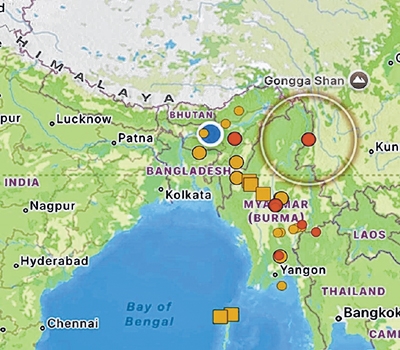
The North Eastern Region (NER) of India lies in seismic zone V in the country, which is considered one of the most seismically active zones in the world. The Assam–Nagaland–Manipur belt lies in a complex tectonic zone where the Indian Plate interacts with the Indo–Burma ranges, making it one of the most seismically sensitive zones in Asia. The pattern suggests localized stress release along regional fault lines, possibly linked to the Kopili Fault system and adjoining active zones. The tectonic heartbeat of NE Region and its adjoining regions has been pulsing faster in recent months—with multiple earthquakes striking across Assam, Manipur, Nagaland, Myanmar, and the Bay of Bengal. According to the National Centre for Seismology under the Central Ministry of Earth Sciences, a total of 428 earthquakes were recorded in the year 2024 in the NER. Assam had the highest number of earthquake occurrences, with a total of 78 triggers, followed by Manipur with 59 triggers, Meghalaya with 39 triggers, and Arunachal Pradesh with 31 triggers. The remaining States – Nagaland, Sikkim, Tripura and Mizoram, experienced 10, 9, 3, and 2 triggers, respectively, in the same period. Additionally, the adjoining areas of NER had 199 earthquake triggers. During 1897 to 2019, the Region was hit by more than 20 earthquakes with magnitudes greater than 7.0. One of the most devastating earthquakes in Indian history with magnitudes 8.7 took place on August 15th, 1950 at the North-East of Lohit Thrust. The epicentre was at Mishami Hills, in Notheastern tip of Aruna-chal Pradesh near Tibet border, causing devastation in both Assam and Tibet.
Earlier there was great Assam Earthquake of 1897 with magnitude 8.2-8.3, affecting 4,00,000 km 2 areas and was felt over 6,50,000 km 2 areas from Burma (now Myanmar) to Delhi. It raised the Northern edge of Shillong plateau by more than 11 m, resulting in the huge destruction of structures over much of the plateau and surrounding areas, which causes flooding in the Brahmaputra and Sylhet floodplains.
As per recent report NER is vulnerable for an earthquake of magnitude 8.2, which would release three times the energy of the 2015 Nepal earthquake that stood at a magnitude of 7.8. Some segments can even generate a magnitude 8.7 quake, releasing energy more than Nepal’s disaster. There’s also a low-probability but possible scenario of a magnitude 9 earthquake, similar to one that may have struck medieval India 800–900 years ago. While the overall shaking intensity might not surpass what was felt during the Nepal earthquake, the duration of shaking could last up to five minutes, posing a severe threat to the region’s weak buildings/structures.
Coming specific to Manipur, in the past 10 years a total of 614 earthquakes, including 54 in the current year, with a magnitude of four or above have struck within 300 km of Manipur which works out to yearly average of 61 earthquakes or 5 per month. On average an earthquake will hit near Manipur roughly every 5 days. In the month of January 2025, Manipur recorded the highest of 8 quakes out of 11 quakes in the NE Region. Again, on May 28th, 2025, a series of earthquakes struck Manipur, two at Churachandpur with 5.2 and 3.9 magnitude and one at Noney with 2.5 magnitude. One of the strongest earthquake in Manipur, in recent years, occurred on January 4th, 2016 having a magnitude of 6.7, with epicentre near Noney village of Tamenlong district. Apropos above, to avoid catastrophic losses, we must act ‘before’ the quake strikes and not after that.
Are we prepared ? The answer is a big No. Majority of the private residential houses in Manipur are constructed or being con- structed without any norms with most of the concrete buildings hugging each other without maintaining inter house gaps. Of major concern is construction of high rise multi storeyed buildings in small plinth areas by defying the laid down rules and regulations which will have colossal impact during high intensity earthquakes. The Bureau of Indian Standards (BIS) has laid out earthquake-resilient construction codes, but they’re often disregarded/ flouted. With narrow inter village/lekai roads because of constant encroachment and unauthorised ramps jutting out on the road, illegal haphazard vehicle parking on permanent basis and dumping of construction mate- rials on such roads, if there is a major earthquake, which is inevitable, it will have a disastrous consequential effect as relief forces will not be able to reach in time for rescue operations.
Urgent need for changes. Unlike NER, Japan and Chile Regions are also prone to large quakes but they have learned how to live with seismic risk. They have brought into force strict construction norms, train communities, and run regular drill. Their cities aren’t immune, but they’re far better prepared. We not only suffer from a lack of knowledge, but also suffer from a lack of implementation. Builders and Construction Supervisors (Boro Mistris) who ignore earthquake resilient regulations must face strict legal consequences to ensure accountability. Conducting regular structural audits is necessary. To bridge this gap, universities, technical institutes, NGOs, CSOs, local clubs and women organisations need to step in. By launching certification programmes and mentorships, we can create a new generation of seismic safety professionals. That means retrofitting old buildings training safety auditors, and holding builders accountable. Since NER is one of the intense zone for earthquakes, which cannot be prevented from occurring, we have to learn to live with the earthquake hazard looming and try to minimize its adverse impact on human civilization. Earthquake hazard is one the deadliest natural disasters which claims the lives of large number of person without any warning. These deadliest destructions were mainly caused due to the collapse of structures and buildings. Hence, to mitigate this natural disaster following are the some pre-preventive measures we can follow-
a) Know well about seismic zone areas of own locality and ensure experts to help in making our houses earthquake resistant.
b) Schools, colleges and other organisations should make some awareness programs.
c) Prepare an emergency kit and place it in safe place so you can use it in needy hours.
d) Create emergency evacuation zones in cities, conducting school drills, and making earthquake safety part of everyday life.
e) Create safe lanes for evacuation and rescue operations. Width of the IVR and inter district roads should be as per specifications.
f) Address on priority encroachment towards the IVR, State Highways and District Roads by the concerned SDCs, SDOs, IMC, Town Planning, MUDA, MAHUD and other authorities; by imposing heavy penalties and eviction of such encroachments.
g) There is a need for enacting anti dumping laws on the roads, nitty-gritty can be worked out by imposing penalty on dumping of constructions materials on the road. Where it is inescapable, requisite permission must be obtained from concerned authorities by paying taxes.
h) The CSOs. NGOs, local clubs, women organi- sations and village authorities need to be pro-active towards controlling illegal parking and dumping of construction materials wherein they may introduce parking charges on monthly basis at designated spots, as well as charges for dumping of construction materials.
i) State Disaster Management authority, in coordination with SDRF, CSOs. NGOs, local clubs and village authorities must spread awareness and educate the citizens both for preventive measures to minimise effect of major earthquake. Organise preventive drills for earth- quakes, during as well as post occurrence, periodically for all citizens in parti- cular Schools and Colleges.
j) As prediction of earthquake is not possible till date, so don’t listen to or spread rumours.
The next big quake is inevitable, but mass death and destruction are not. We still have time to prepare, only if we choose to use it. The threat of a major Himalayan earthquake is real, and the clock is ticking. While we can’t stop it, we can reduce its impact by preparing today. Stronger buildings, better awareness, and timely action can save countless lives. The time to act is now—before it’s too late.