Few moments with a legend : Shri Thuingaleng Muivah
|


Hareshwar Goshwami
It has now been more than two decades since that fateful period when Manipur found itself enveloped in a cloud of uncertainty and unease. The extension of the ceasefire agreement, rather than soothing tensions, had sown fresh seeds of restlessness and anxiety among the people. At that time, I was serving as the Deputy Resident Commissioner of Manipur Bhavan in Guwahati. I still remember vividly the heavy atmosphere that seemed to weigh upon every conversation, every gathering, and every thought of those days. It disheartened me deeply to witness my fellow citizens—men and women from the hills and the valley alike—gripped by suspicion, fear, and the gnawing sense of division. It was out of this profound sense of concern that I, along with a few like-minded friends, resolved to do something—however modest—that might serve the cause of peace. Together we founded the Manipur Peace and Integrity Council, an initiative born not of political ambition but of a heartfelt desire to heal the growing fissures among communities.
Alongside this collective effort, a personal thought began to take root in me: perhaps I could try to write a book, one that would illuminate the shared foundations of our people, and remind us that the bonds of history and culture run deeper than the currents of discord.
Though I had always harbored a love for writing, I had never before undertaken the formidable task of authoring a book. Yet the urgency of the moment compelled me. I felt that the stories of our people—their folk tales, myths, legends, and historical narratives—contained within them the seeds of reconciliation. The Meitei, Naga, and the Thadou/Kuki, (excluding non-indigenous and illegal migrants) and other communities who together make up the mosaic of Manipur were, I believed, linked by an organic unity of origin, culture, and even early forms of governance. Despite this truth, political aspirations of exclusiveness and the rhetoric of separation seemed to grow louder with every passing year. It was to counter this narrative, and to offer another way of seeing ourselves, that I embarked upon the writing of my book, History of the People of Manipur (2004).
The work was not easy for me. It stretched over three years, during which I labored through nights of doubt and moments of clarity, always with the encouragement and support of some of my younger colleagues who offered me guidance and assistance. I tried to weave together the diverse strands of memory and history into a fabric that could remind us of our common heritage. Whether or not I succeeded, I still cannot say. When at last the book was published, I did not seek to sell it widely or promote it for personal gain. Instead, most of the copies were carried to the hill areas and distributed as gifts. It was my hope that in gifting these pages, I might also gift an idea—a reminder that our people are bound together not merely by geography, but by shared stories, by intertwined destinies, and by the organic unity of our origin which is rooted in us. Whether the book was ever embraced as a “book” in the conventional sense hardly mattered to me. What mattered was the intention behind it: that we might learn to understand one another better, and that in that understanding, the seeds of peace and integrity might find fertile ground.
At that juncture, another thought struck me with a quiet insistence: why should I not present a copy of my book to Shri Thuingaleng Muivah, the Ato Kilonser of the NSCN (IM) ? The book was, after all, conceived with the idea of fostering understanding, exploring the organic roots of Manipur’s communities, and presenting a narrative that might bridge divides. It seemed only natural that such a work should reach the hands of those who were themselves engaged in shaping the destiny of their people amidst a tumultuous political landscape. Yet, as is often the case in the North East, access to the higher echelons of one of the leading armed insurgent organizations is not a matter of casual approach. I had no direct acquaintance among the top brass of the NSCN (IM).
Undeterred, I sought the help of friends who, in their own way, had connections that extended across communities. Through their goodwill and mediation, I was able to establish contact with one of the Kilonsers of the organization. The arrangement was made with quiet efficiency, and soon the plan was set in motion. Two of my close companions accompanied me on this journey—one from the Poumai community and another from the Tangkhul. We set out from Imphal by road, squeezed into a Maruti 800, that small but sturdy vehicle which, in those days, had become a symbol of aspiration and mobility for the Indian middle class. The drive itself was long but filled with anticipation, each mile carrying us closer to a meeting that was both sensitive and momentous.
By the time we reached Dimapur in Nagaland, arrangements had already-been made for our stay. We were welcomed with courtesy and respect, not as mere visitors but as honored guests. That evening, the air was charged with the gravity of the times: the ceasefire between the Government of India and the NSCN (IM). Yet, despite the tense political backdrop, what followed was an evening of warmth, candor, and informal interaction with people who had gathered there, each for their own reasons. I soon found myself among friends mostly from the outfit. Our conversations did not dwell on the broader objectives of the organization, which were beyond our scope and level. Instead, I being from Manipur, our exchanges turned to local concerns that weighed heavily on our lives in Manipur. They spoke of long-standing grievances: the neglect of hill areas under a valley-centric administration, the sense of chauvinism they perceived in certain prevailing attitudes; the imbalance of representation in policies and institutions; and the unresolved question of the Sixth Schedule etc. Being the only Meitei present in that informal gathering, I could easily have felt outnumbered, even defensive. But what I encountered instead was a spirit of trust and generosity. I was given the space to speak freely, to voice my thoughts without suspicion or restraint. For a brief moment, the walls of mistrust that had long divided communities seemed to soften, giving way to curiosity, respect, and dialogue. I listened carefully, clarified what I could, and shared my own reflections—not as a politician or as representative from any community but just as a brother. I touched upon the need for a fair land law system, the flaws of reservation policies that sometimes-deepened divides, and the unsettling possibility of an unseen hand pursuing a subtle strategy of divide and rule in the North East, exploiting inter-community distrust to maintain its hold. My words were modest, but they were spoken with the hope that even small ideas, sincerely shared, might contribute to a larger understanding. It was one of those rare evenings when dialogue softened divides, and trust, however fragile, pointed toward peace and integrity.
The tone of the evening remained informal throughout, and that perhaps was its greatest strength. We were, in that moment, simply individuals from different communities, sharing thoughts, doubts, and aspirations, acknowledging the limits of our knowledge and positions but united in our willingness to speak openly. The meeting concluded not with formality but with warmth. A heartiest dinner awaited us, prepared with care and flavored with the distinct touch of Naga hospitality. The centerpiece of the meal was Naga Manu—a dish that, for them, carried both cultural pride and everyday familiarity. As we sat together, eating, laughing, and continuing our conversation in lighter tones, I could not help but feel that this gathering, however small and private, carried within it the seeds of something greater: the possibility of understanding across divides, the recognition that dialogue, however modest, is always better than silence. That night in Dimapur remains etched in my memory—not merely as a personal encounter with an important political movement of our times, but as a moment when human warmth triumphed over suspicion, when frank dialogue prevailed over hardened narratives, and when a simple dinner table became the stage for reflections that transcended boundaries.
That morning, a wave of excitement swept over us as we received the message that our long- awaited appointment had been granted. For me, it was more than just a formal meeting—it was the culmination of an inner urge to connect through my work, to present a book born of conviction and reflection to someone whose name was woven into the contemporary history of our region.
My two companions, both close Naga friends—one a Poumai and the other a Tangkhul—were equally overwhelmed, though they carried within them the same sense of novelty and anticipation. For even they, despite belonging to the community mostly associated with the NSCN (IM), had never before met the Honourable Ato Kilonser, Shri Thuingaleng Muivah. From the heart of the town we began our journey, taking the road towards the side of Chümoukedima, a place steeped in history and memories. Just before reaching the historic town, our vehicle swerved to the right— if my memory serves me correctly—onto a road that carried us deeper into unfamiliar but expectant terrain- the Hebron. Along the way, we passed under an attractively designed gate that bore the bold and striking words: “Welcome Home, The NSCN Collective Leadership.” The message on that gateway was not merely an inscription—it was a declaration of belonging, a proclamation of identity and cause, and a reminder that for many, this was more than an organization: it was a home.
Soon, we ascended a small hillock where the vehicles could no longer carry us closer. We parked at some distance and proceeded on foot towards the gate that marked the entrance to our destination. Security was tight, as one would naturally expect in such a place, yet the atmosphere was not forbidding. Instead, there was a curious mixture of alertness and warmth. The presence of a Meitei among the visitors did not go unnoticed. A few voices rang out with cheerful familiarity: “Chak charabo!” and “Kamdourige!”—phrases in Manipuri that carried the playful cadence of brotherly teasing. It was heartening, almost disarming, to be greeted in such a friendly tone amidst all the seriousness that the setting implied. Our guide, with a quiet smile, informed us that the houses around us were mostly occupied by members of the Naga Army. After crossing through the gate, we were directed to a resting place. It was an open structure, airy and simple—a waiting space touched by the breeze of the hill and the murmurs of expectation. We sat there for some time, our hearts steadying themselves after the journey, until at last, after about ten minutes, the word came: we could enter. We rose and made our way to the residence where the respected leader awaited us. The house itself was modest, almost austere in appearance, seemingly comprising just three rooms. It bore none of the airs of grandeur that one might associate with a man of his stature.
And yet, simplicity often speaks louder than ornament. As we reached the doorway, the moment came that remains etched in my memory to this day—Muivah himself stepped out to greet us. He came forward in person, and in that gesture was revealed a glimpse of the man beyond the leader: accessible, grounded, and sincere.
I introduced myself, and for a fleeting moment he seemed to search his memory, perhaps to place me. Then, in a tone of curiosity, he asked whether I was Assamese. I smiled and replied with clarity and conviction that I was a Meitei, a pucca Meitei, though my forefathers had once, long ago, journeyed from Bengal and made Manipur their home. At this, his face lit up and he responded warmly in Manipuri: “Oh, changlak-o, changlak-o!”—an exclamation of happy surprise. What struck me then was not only his recognition but the fluency with which he spoke Manipuri.
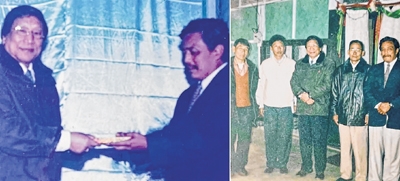
It was not labored or hesitant; it flowed naturally, carrying the cadence of someone who had long nurtured familiarity with the language. We were soon invited inside and took our seats. In the gentle unfolding of the conversation, I offered the gifts I had brought with me—a Leiroom shawl, symbol of shared tradition, respect and warmth from my home, and my book, The History of the People of Manipur. He accepted them with a gracious smile, holding the book with interest. As he looked at it, he asked me what the work was about. I explained that it was more than a chronicle of events—it was about the Idea of Manipur, an idea that transcended mere geography, rooted instead in organic origin, in the threads of shared culture, history, and administration that bound together the diverse peoples of the land. His interest was genuine. He listened attentively, and though our exchange was not long enough to cover every detail, the warmth in his eyes conveyed acknowledgment. Whether my idea was accepted or not, it was enough for me that he understood the spirit with which the book was written.
The forty-five minutes we spent together passed swiftly, carried by the flow of greetings, discussions, and the inevitable pause for photographs to commemorate the occasion. For me, those moments were not merely a formal interaction but an affirmation that respect and sincerity and honesty could still find their place in the complex landscape of our times. As we rose to take our leave, gratitude filled my heart. I bowed inwardly to the generosity with which he had welcomed us, despite the burdens that must have weighed upon his shoulders. We bid him adieu with thankful hearts, walking away with the comfort of having been received not only as guests but as brothers who had shared a little time together. That day remains vivid in my memory, not just as a personal milestone but as a testament to the enduring power of human connection, even in the midst of histories marked by conflict and division. In that simple dwelling, on that quiet hillock, amidst the presence of armed sentinels and vigilant eyes, what prevailed in those moments was neither fear nor suspicion, but recognition, respect, and the quiet grace of shared humanity.
Lastly, I have come to learn from various media reports that respected brother, Shri Thuingaleng Muivah has not been keeping well of late. I sincerely pray for his speedy and complete recovery.
May he be blessed with renewed strength, enduring health, and a spirit ever resilient, so that he may continue to stand firm at the helm of leadership. In these crucial times, when the region yearns for stability, harmony, and a shared sense of destiny, his wisdom and steadfastness are of immense significance. It is my heartfelt wish that he continues to inspire the people of the North East with courage and clarity, guiding them towards an era of inclusive peace, reconciliation, and lasting prosperity.
Hareshwar Goshwami is a writer and political activist