Save the Pony, save our identity
23 Aug 2025 08:12:52
Nongthombam Bishwajit Singh
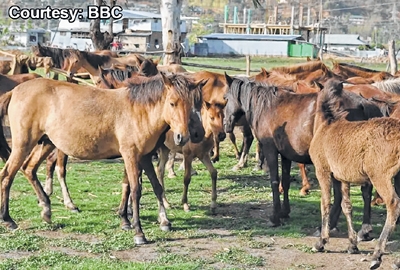
Every morning, after dropping my son at his tuition centre located about four kilometers from our home, I take a morning walk around the city while waiting for his tuition to get over. During these walks through the heart of Imphal, I often see a distressing sight — Manipuri ponies, a rare and endangered horse breed found only in Manipur, grazing on garbage dumps along the roads and market areas.
These ponies — once a proud symbol of our culture, history, and the very identity of Manipur — are now forced to feed on plastic waste and litter discarded by careless passers-by and nearby residents. Seeing these majestic animals scavenging in hazardous areas shook me deeply. Questions kept flooding my mind:
Why are these animals, central to our identity and known worldwide as the origin of polo, left to fend for themselves like this ?
Where are the authorities responsible for their welfare ?
What happened to the animal lovers and organizations who once vowed to protect them ?
Just a month ago, I witnessed a heartbreaking scene. The lifeless body of a grown pony lay near a newly constructed culvert at Khoyathong, while police and apparently Imphal Municipal staff prepared to dispose of it. A second pony, possibly its companion, stood some 50 meters away, staring at the dead body — a sight that left me completely shattered. It’s likely the pony was struck by a speeding vehicle.
We must ask : Who is accountable for this neglect ? Ponies, along with stray cattle, are left to wander the congested, traffic-heavy streets of Imphal, risking accidents and death. Owners and authorities alike have failed them.
Several organizations in Manipur are dedicated to pony preservation, but many are likely hindered by financial and infrastructure limitations. The Government, too, has shown limited initiative despite introducing the “Manipur Pony Conservation and Development Policy, 2016”. The current condition of the ponies makes it painfully clear that this policy is not being fully implemented.
It’s not just about the ponies. It’s about our identity. Polo, the world-renowned game, originated in Manipur, played first by riders on these very ponies. Losing them would mean erasing a part of our legacy that we can never reclaim.
We must raise awareness, especially among the youth, to cultivate compassion for animals. Look at how animal lovers in Delhi protested the Supreme Court’s directive on stray dogs. Their strong public outcry led the apex Court to revisit its decision. That’s the power of collective empathy and civic action.
Sadly, in Manipur, we haven’t shown the same concern — not even for an animal so deeply embedded in our cultural fabric.
The protection of the Manipuri pony is not solely the job of the Government. It calls for a united effort — from Government departments, civil society organizations, NGOs, and individual citizens. We must work together to:
· Provide safe grazing areas and shelter for the ponies.
· Enforce strict regulations to prevent ponies and cattle from roaming busy streets.
· Implement the 2016 Pony Policy with full transparency and accountability.
· Improve waste disposal habits, especially in Imphal city.
In this digital era, we should abandon the primitive practice of randomly dumping waste along roadsides and riverbanks. Shockingly, many well-to-do families with the means to hire services are the ones littering public spaces — often in the wee hours to avoid being seen. Instead, they should subscribe to the door-to-door waste collection services provided by NGOs under the Imphal Municipal Corporation with a monthly subscription fee of Rs 200/-
The pony is not just an animal — it is a living symbol of Manipur’s history, pride, and global recognition. Let’s not wait until it vanishes completely from our streets, fields, and memories.
The writer, a journalist, works with Doordarshan News, Imphal