What NIRF 2025 reveals about higher education in Manipur ?
|


Sorokhaibam Aguraj Singh and Dr Anuradha Oinam
On 4th September 2025, when the Honourable Minister of Education, Shri Dharmendra Pradhan, released the National Institu- tional Ranking Framework (NIRF) 2025, it reflects the ladder of India’s Higher Education listing from the top institutes, universities, colleges and other categories to those who misses out from the list. The NIRF relatively ranks institutions based on parameters such as Teaching, Learning, and Resources (TLR), Research and Professional Practice (RP), Graduation Outcomes (GO), Outreach, and Inclusivity (O&I), and Perception (PR).
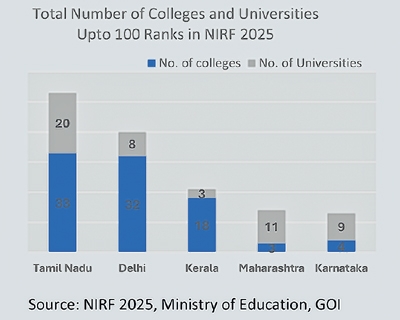
Actually, the NIRF is not just a simple list of India’s best institutes but also reflects a yearly assessment of the strengths and weaknesses of the country’s higher education institutions and their subsequent prospects and pitfalls. The Indian Institute of Science, Bangalore, bagged the 1st rank without breaking its fashion of being at the top position since 2016, when the ranking data got its first publication. The Hindu College of Delhi University topped the list among colleges. Amongst institutions that offer engineering courses, IIT Madras secured the 1st rank. Further, the ranking highlights the disparities in the concentration of educational institutions, with most of them confined to Tamil Nadu, followed by Delhi (as shown in the graph).
This could be a plausible reason why many students choose these States to pursue their higher education. Nevertheless, most of the top ranking institutes belong to metropolitan or big cities, institutes from the North East region of India such as Gauhati University (33), Tezpur University (79), Mizoram University (82), and Assam University–Silchar (97) could manage to place in the top 100 ranks. Besides, there are many others like Central Agricultural University, Manipur, Nagaland University, and North Eastern Hill University that could find a place in the 151–200 rank-band, along with private institutions such as Sikkim Manipal University and the University of Science and Technology, Meghalaya. When it comes to colleges, only Pachhunga University College from Mizoram is able to secure the 49th among the top 100 colleges.
Where could one situate Manipur in NIRF 2025 ? In 2025 ranking data, prominent institutions like Manipur University (MU), and Manipur Institute of Technology (MIT) have failed to reserve its place even though the former which has 126 affiliated colleges (including Government, aided, constituent, and private institutions as on 04.02.2025, see https://www.manipuruniv.ac.in/p/list-of-affiliated colleges) could manage to obtain the 151–200 rank-bands in 2019. Since then, it has failed to secure a place in the top 100 of the NIRF ranking. When it comes to colleges of Manipur, nearly 30 colleges from across the State entered the NIRF process in this year, 2025. However, not a single college secured a place in the rankings. There are many causal factors and a series of events that could explain these outcomes.
One factor could be the lack of infrastructural development in the State though things are improving incrementally in various tiers/levels in current times; another was the COVID-19 pandemic, which disrupted educational campuses Nationwide including Manipur, stalling both teaching and research scholars in their research related activities. Fortunately, classes were then shifted to online mode, and the new normal thus began.
However, digital connectivity which is again a recent development in the North Eastern States including Manipur was not that upto the standards then to have an efficient and effective teaching-learning research for teachers, students and researchers. Further, the problem was compounded since 3rd May 2023 due to the ongoing ethnic conflict in Manipur. Since then, things remain haphazard due to shutdown of university campuses, colleges and schools; displacement of students and staffs; and Manipur thus witnessed the country’s longest internet shutdown in the same year. Some of these factors attribute to make it impossible for institutions to meet the data driven demands of NIRF reporting. Thus, it is crystal clear that the State’s fragile law and order situation has its spill over effects in the classrooms, impacting the eco-system of the State’s educational institutions in myriad ways. Most importantly, the 2025 NIRF added a new category of Sustainable Development Goals (SDG), assessing institutions on criteria like energy use and waste management. IIT Madras tops the list, while many institutes from the North East participated.
In this regard, there is a huge question mark for those institutions that are still struggling with basic amenities; to fulfil the requirement of the newly added category based on sustainability, makes it an additional burden. Meeting such National benchmarks requires not just financial resources but also administrative continuity and efficiency. For a State which is already stretched by conflict and crisis, sustainability reporting seems like a distant priority.
Having said that, one cannot ignore the story and achievement of Jammu and Kashmir when it comes to NIRF list. In 2019, the State not only witnessed its most profound political upheaval in decades with the abrogation of Article 370, universities over there had also faced curfews, communication blackouts, and academic disruptions. The internet access was limited from August 2019 until February 2021. By all measures, conditions were just as challenging—if not more severe—than as in Manipur. Despite this, institutions like the University of Kashmir and the University of Jammu could manage to hold a place in rankings. They appeared in NIRF rankings year after year — with the University of Kashmir at 34 and the University of Jammu at 51 in 2025 respectively. On the top of that, IIT Jammu, NIT Srinagar, and IIM Jammu secured a place each in the top 50 of their respective categories.
This exemplifies that even under extreme political instability, educational and technical institutions in J&K again showed resilience, unlike other States like Manipur.
However, the absence of colleges of Manipur and, in particular, MU and MIT in the NIRF 2025 does not imply the end of the story rather, it is taking a step behind to assess and improve its educational policy and related arenas. For instance, new schemes/grants and funding are being introduced in the State’s colleges and universities for faculties, researchers/students to enhance and excel their skills/knowledge, multiplying the number of faculties through recruitment channels, and expanding scopes by introducing new valuable courses under New Education Policy (NEP) 2022. Besides, many colleges are now having their own websites and NAAC accreditation. Additionally, the Government needs to focus on implementation of infrastructural developments, come up with new policies aligning with NEP 2022 to bring quality education in the State in consultation with the respective institutions, and encourage improving the campus overall by going beyond the classroom milieu. These are small steps but significant shifts.
If sustained, these could provide the foundation for colleges and universities of Manipur to finally break into the NIRF rankings in the years ahead. Rankings matter as they are not just about prestige. It shapes student choices, determines funding flows, and influences partnerships. In fact, it also signals healthy academic ambience. Neverthe- less, one really needs to have a reality check on why some institutions are able to maintain National standard under duress, while others fall behind. Unless one questions such a policy conundrum in the days to come, the vision of the higher education sector in Manipur will appear exactly like what Thomas Alva Edison once warned against — “Vision without execution is hallucination.”
Aguraj Singh is in the Economics Dept, Anura-dha Oinam in the Political Science Dept and both are Assistant Profesors at Imphal College