Nepal crisis : Another ‘Arab Spring’ in South Asian region
12 Sep 2025 08:07:24
Brigadier (Retired) L Ibotombi Singh
The last four years have witnessed tectonic shifts in India's neighbourhood, in particular ‘Change of Regime’ in pearl of string countries around India. It started in Myanmar in the form of 2021 coup d'état, when democratically elected members of the country's ruling party, the National League for Democracy (NLD), were deposed by the Tatmadaw, Myanmar's military, which then vested power in a military junta. This was followed by the Sri Lankan economic crisis, the ouster of Imran Khan in Pakistan, both happened in 2022, change of pro-China Regime in Maldives in 2023 and ouster of Awami League Government in Bangladesh in 2024, each development saw a familiar script unfold – mass protests leading to the collapse of Governments. Nepal finds itself on the list after the Himalayan country witnessed massive protests over the Govt's move to ban social media platforms.
The protests in Nepal followed a similar script that happened in Sri Lanka and Bangladesh. What started as an agitation in Nepal against a social media ban, quickly spiralled into protests against corruption, forcing Prime Minister KP Sharma Oli and the President to resign. The recent horrific episode in Nepal in which 28 protesting youths have been killed and some 400 injured has raised questions whether Nepal’s Prime Minister KP Sharma Oli (a known Beijing puppet) is sanguine that he can act as ruthlessly as the Chinese regime. On September 4, 2025, Nepal banned 26 social media sites, including Meta (Facebook, Instagram, WhatsApp), Alphabet (YouTube), X (formerly Twitter), Reddit, and LinkedIn which had reportedly not submitted applications for registering with the Government by the deadline of August 28. In 2024, Nepal’s Supreme Court reportedly gave directions that social media platforms establish a point of contact and name a resident grievance handling officer and compliance officer. Notably, Chinese apps were not banned albeit the Oli Government claim that they follow Nepal’s regulations. What is actually seen as problematic is Oli’s inability to face criticism. In the ongoing Gen Z protests, the youth are accusing the Government of corruption, which has been rampant in recent years. Because social media empowers anyone to express their unhappiness with the Government freely, these attacks are often taken personally by the leadership, which then wishes to curtail them. This has been a classic trait of Communist leadership globally, and it’s no surprise that Oli employed the same. While Nepal is no stranger to protests and demonstrations against the Government, never before have they been led by a certain age group like Gen Z.
The ban on social media is not all why Nepal is burning. Tensions have been simmering in Nepal for months. Since Nepal became a Republic in 2008, it has seen power rotating between Oli, widely seen as pro-China, Pushpa Kamal Dahal 'Prachanda' of the Maoist Centre, and five-time PM Sher Bahadur Deuba. All the three leaders face corruption allegations, and the Nepalese youth have become increasingly frustrated with the political system. Economic stagnation and unemployment have only added fuel to the fire. In fact, weeks before the ban on apps, a "nepo kid" campaign, spotlighting the lavish lifestyles of the children of Nepalese politicians and allegations of corruption, flooded social media. Since the first democratic elections in 2008, no Government has been able to complete a five-year term in office. In the last 17 years, Nepal has seen over a dozen Prime Ministers, thus making political instability prominent since the dawn of democracy in the country. While elections are held every five years, almost all new Governments are formed in a coalition with other parties. All these years, Prachanda, Oli, and Nepali Congress leader Sher Bahadur Deuba have continued to form convenient alliances that suit their needs but often do not represent the original electoral mandate. In the last three years, there have been three Govts. An ageing leadership has barely allowed youth to come and take up key roles in the Govt. Meanwhile, political instability has paralysed the country’s institu- tions, policy framing, and development.
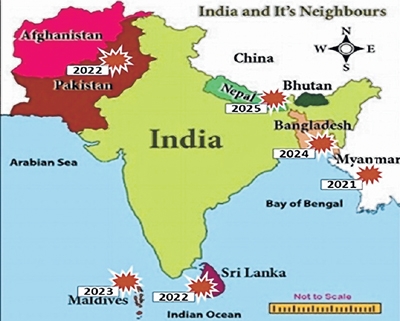
It was among the string of agitations that has plagued KP Sharma Oli since he became the Prime Minister in July 2024. In the past one year, he has worked to build relations with China while alienating traditional ally India. In fact, in a departure from the norm, Oli chose China for his first foreign trip after being sworn in for his fourth term in July. Traditionally, Nepalese leaders have chosen to visit India first. During his China visit, Oli signed the framework for the Belt and Road Initiative (BRI), Xi Jinping's pet project. It secured debt-burdened Nepal a USD 41 million in financial assistance. It is part of China's long game to establish its hegemony in the South Asia region. Sri Lanka, a key recipient of Belt and Road loans, had defaulted on foreign debt in May 2022. It was among the reasons behind the economic crisis that saw the overthrow of the Rajapaksa Government.
In 2020, a report by the ‘Global Watch’. calling Oli corrupt, stated that Nepal is a “classic example” of how China uses corrupt leaders to make inroads into weaker countries. The charges against Oli were serious. During his first stint as Prime Minister, Oli tried to invest in the telecom sector of Cambodia. Reports said the then Chinese Ambassador to Nepal Wu Chuntai had extended assistance to Oli for the deal. In his second term, Oli used his powers to award contracts to Chinese companies; several deals struck under Oli were under scanner like the agreement to set up a digital action room with video conferencing facilities in the Prime Minister’s office. The contract reportedly went to China communication service, a subsidiary of Huawei without any competitive bid.
Another deal under scrutiny was a contract to build Nepal’s largest hydropower project which went to a Chinese State-owned company, again without a competitive bid. Oli overturned a decision by his predecessor Sher Bahadur Deuba while in office, when Deuba had decided to not award the contract to the Chinese. Oli’s rapid rise in personal wealth also added to the suspicion. According to the Global Watch, more than USD 5 million dollars in the Geneva branch of the Mirabaud bank belonged to KP Sharma Oli. The money had been invested in long term deposits and shares and that these investments gave Oli and his wife half a million dollars every year. Oli’s inner circle (Health Minister, several Government members and several senior advisers of Oli) also faced serious corruption charges with several members of his Government accused of taking kickbacks; including over the purchase of Chinese equipment like personal protection kits and testing machines. Oli tried to downplay these reports but young Nepalese even then had taken to the streets against Oli and his Government, but the protests were suppressed.
US-China Dominance
The US has always been wary of increasing Chinese influence in the South Asia region. Earlier this year, the Donald Trump administration brought back from the brink the Millennium Challenge Nepal Compact, a package of energy and road upgrade projects that will see the US pump in USD 500 million in aid. The revival of the project has put it in direct clash with China's Belt and Road Initia- tive. Moreover, Oli's participation in China's Victory Day parade was viewed as Nepal being firmly in the anti-US camp. It has led some analysts and experts to theorise that the US Deep State, like in the case of Bangladesh, might be behind the unrest in Nepal. Some say as a "100% US-engineered" revolution in Nepal. One of the theories is that a US-friendly 'monarchy' may soon be established in Nepal, removing the China-friendly Govt now. Just like what happened in Sri Lanka, and Bangladesh. Those following the situation closely are left with two questions: Is this Nepal’s Arab Spring moment, and will it mark the rise of a new generation of leadership ? The answers will likely unfold in the time to come.