Attack in Doha-A brute hegemony by Israel in the Middle East
19 Sep 2025 08:48:10
Brigadier (Retired) L Ibotombi Singh
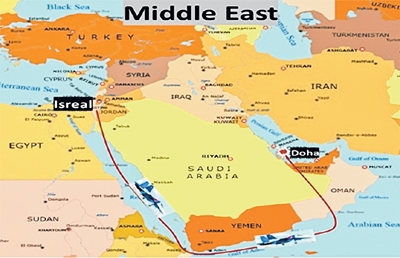
On September 9th 2025, during the Gaza war, the Israel Defense Forces (IDF) conducted an airstrike in the Leqtaifiya district of Qatar's capital Doha. Since Ha-mas’s Oct. 7th, 2023 incur- sion, this was the sixth country in the Middle East where Israel has targeted senior Hamas leaders, the other countries being Palestine, Lebanon, Syria, Tuni- sia and Yemen, beside Iran. The airstrike was on the villa of a senior Hamas leader, located in an upscale neighbourhood filled with embassies and schools, in the Qatari capital, Doha, that drew broad international condemnation. For the operations, eight F-15s and four F-35s flew to the Red Sea, far from Qatar, and fired missiles into space over Saudi Arabia before they descended on Doha. The flight path though long, using Boeing 707 for mid-air refuelling, allowed Israel to avoid flying through Arab States’ airspace, but the move left the US with only minutes of notice, as alleged, before impact. The ones Israel actually wanted to target, the main Hamas negotiators, survived, but the ones who weren't the target and not even involved, like the son of Khalil al-Hayya, a central Hamas figure and a negotiator in the group, were killed.
Post strike on Qatari soil, the leadership in Doha is furious. Qatar's Prime Minister openly declared that Israel's actions were nothing short of terrorism and that Doha has every right to strike back. Amid escalating tensions in the region, Qatar’s Prime Minister has called for international accountability on Israel at preparatory Ministerial meeting for the emergency Arab-Islamic Summit. Reportedly, the Emir of Qatar spoke to Donald Trump over phone, the same Trump who always claims to be the big boss of world politics, and asked him one simple but explosive question as why Washington didn't stop Israel's attack. And Trump's reply shocked the world, that the US was informed too late and couldn't intercept the strike in time. When Iran attacked Israel, American defense systems intercepted many missiles within minutes. When Russia bombs targeted Ukraine, American systems at NATO bases detected and responded instantly. But in Qatar, where the US has one of its biggest military bases, they suddenly couldn't stop Israeli jets.
Even a schoolboy will understand that America and Israel are clearly hand in glove. This is proven by the fact that on September 12th, a Bill was introduced in US Congress that would allow Marco Rubio to revoke the passports of US citizens if they criticize Israel. The truth is simple, Washington will never shoot down the F35 jets it proudly sold to Tel Aviv. Everyone knows without US backing, Israel can't survive. So now the world is asking can America be ever trusted ? Doha is humiliated as Qatar hosts the massive Al Udid Air Base for the US Military, trusting that America would guarantee their security, besides investing one trillion dollar in US defense deals in the recent past for American protection, and what did they get in return, a direct Israeli strike on their soil. This is exactly why the Qatari leadership now believes they must strike back, possibly a shift in alliances and new security partners, otherwise Israel will attack again with even more confidence. The harsh truth is that Isreal has declared to the world “we will redraw the map of the Middle East, we will go after whoever we want, wherever we want, No one can stop us,” and unfortunately the 57 Muslim countries are silent, nobody came forward. Israeli media has already added fuel to the fire by claiming they informed Qatar, Egypt and even Turkey before the attack. But Qatar strongly denied it, saying Israel and America are lying. Israeli officials are now openly warning that they will strike again, not just in Qatar, but wherever Hamas leaders are hiding and Washington will always cover for them. Be it in Istanbul, in Moscow, anywhere else. If Israel dares to hit in Turkish soil, Erdogan will not take that lightly. Imagine if they even think about striking Beijing or Moscow, that would be game over, because Russia or China will retaliate strongly. Anywhere else, Israel believes they can act freely and no one will stop them. Only Iran responded after the operation. No other country dared.
Israel wanted to eliminate the Hamas leadership inside Qatar. But guess what ? Netanyahu and his intelligence agencies, Shin Bet, Mossad, everyone failed. But failed only about 0.1%. Why ? Netanyahu went against the advice of Army Chief and Shin Bet Chief for not launching the operation, as there was room for talks. However, Netanyahu does not want any more talks and deals, instead he wanted Gaza even at the cost of Israeli hostages, all of Palestine, completely; as America was fully on board. Accordingly. he ordered full scale military action. Leaflets were dropped. He addressed the Nation and even addressed the people of Gaza directly, saying people to leave or face the consequences. Through surveillance, mobile phone interceptions, monitoring devices, maybe even human informants, about Hamas leadership would be meeting at a villa in Doha, the operations were carried out, but Hamas leaders survived, others didn't. As per Doha, they were not sheltering Hamas leaders, instead were only facilitating negotiations. In Gaza, Israel has pushed to dismantle Hamas, unleashing a campaign of strikes that have reduced the territory to rubble and killed more than 60,000 Palestinians—prompting accusa- tions of genocide. Throughout the conflict, militants in Gaza have also launched rockets toward Israel and engaged in firefights with Israeli troops in the enclave. Israel has also carried out fierce military operations in the occupied West Bank, destroying entire city blocks, bulldozing roads and using drones to fire on cars and buildings it claims sheltered militants.
India’s Reaction
India’s Prime Minister has rightly condemned the attack in Doha without mentioning Israel; in ‘X’, Narendra Modi posted “Spoke with Amir of Qatar Sheikh Tamim Bin Hamad Al-Thani” and expressed deep concern at the attacks in Doha. “India condemns the violation of the sovereignty of the brotherly State of Qatar. We support resolution of issues through dialogue and diplomacy, and avoiding escalation. India stands firmly in support of peace and stability in the region, and against terrorism in all its forms and manifestations”. Again, on September 12th, 2025; India voted in favour of a resolution in the UN General Assembly that endorses the ‘New York Declaration' on peaceful settlement of the Palestine issue and implementation of the two-State solution. The resolution, introduced by France, was adopted with an overwhel-ming 142 Nations voting in favour, 10 against and 12 abstentions. Those voting against included Argentina, Hungary, Israel and the US.
Plausible New Alliances and Security Partners
Post humiliation by Israel, Qatar is now evalua- ting its alliances and considering new security partners. The historic military and strategic partnership is under scrutiny, with top officials hinting that Qatar might restrict American operations on its soil. Such a move would shake the entire Middle East's security framework, limiting Israel's ability to conduct strikes without interruption. The US Military base in Qatar is a strategic hub for American operations. If withdrawn, Israel's operational capabilities in the Middle east would face severe disruption, affecting everything from refueling to executing strategic strikes. China and Russia are now on Qatar's radar as potential new allies, offering security guarantees and advanced military technology to counterbalance Israel's F35 advantage.
With Qatar among the wealthiest Nations in the world, their decisions carry immense financial and strategic weight. This shift could trigger a domino effect, with other Gulf nations reassessing their alliances and possibly turning to Beijing or Moscow. Meanwhile, US attempts to stabilize the situation, including calls from Donald Trump to Netanyahu, have done little to regain trust. Netanyahu's comments hinting at unilateral actions similar to the Osama operation in Pakistan have intensified Qatar's concerns. This signals a broader shift, with Middle Eastern geopolitics potentially pivoting towards China and Russia as trusted partners for security and technology. Qatar's growing dissatisfaction underscores a critical moment in global diplomacy, with billions at stake and military strategy hanging in the balance.
The next steps could reshape alliances, challenge US Influence, and redefine po-wer dynamics in the Gulf. The world watches as Qatar explores new security partnerships, potentially signal- ling the end of an era where American guarantees dictated Middle east opera- tions. Revealing the middle East at the cross roads of loyalty, betrayaland strategic realignment.