Interaction programme on ‘Manipur after merger with India’ held ‘Understanding Manipur's history before merger crucial’
|


By Our Staff Reporter
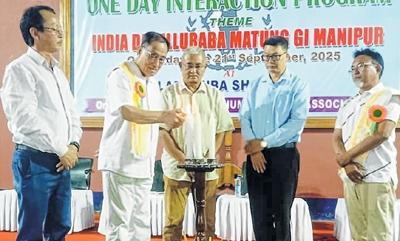
IMPHAL, Sep 21 : A one day interaction programme on the topic "Manipur after merger with India" was held at Lamyanba Shanglen, Konung Lampak, Imphal today.
The interaction programme was organised by the South East Asia Human Rights Association remembering the merger of Manipur with India.
On this day in 1949, the Manipur Merger Agreement was signed between Maharaja Bodhchandra and VP Menon, Advisor to the Government of India.
Former rebel leader Ningthemcha Sanayaima, popularly known as RK Meghen, retired IAS officer Dr RK Nimai, Indira Gandhi National Tribal University Associate Professor Dr Homen Thangjam, MU Law Department's Head Dr Y Premananda attended the event as resource persons.
To understand the present state of Manipur, understanding its history before merger with India is a must, Dr RK Nimai said, speaking as a resource person.
The Ningthouja clan, in the process of building a Meiteileipak, didn't try to assimilate other clans--Luwang, Khuman, Moi- rang etc.
Instead, the King protected and promoted the distinct culture, traditions of all communities, he said.
Dr Nimai explained, for governance in the hills, the King established "Haomacha Loishang". When Pangals began to settle, King Khagemba established "Kaji Loishang".
While the Meitei Nationhood was built during the 11th-16th century based on the foundation where the respective culture and traditions of every community are respected and protected, the British conquest of Manipur in 1891 however brought many changes. The British implemented the divide and rule policy with the objective to create division among communities, Dr Nimai said.
After Manipur won independence in 1947, an elected Government was formed with the king as the Constitutional head. However, the "controversial" Merger Agreement was signed in 1949 and Manipur was merged with India, he said.
The then ADC Mayengbam Anandamohon wrote a book "Shillong 1949" which contains details of the agreement signed in Shillong, Dr Nimai said.
After the signing of the agreement, on October 15, 1949, Manipur was officially declared a part of India bringing changes in the State's governance and economy. Opposing the merger, many took up arms, Nimai said
The State which was once an independent Nation was then governed by a Chief Commissioner. This angered the public, he added.
Cut to the present day, Nimai said that the State which once exported rice has now become an importer, with the people worrying over shortage of PDS rice.
Ignored and left unchecked, increasing illegal immigration and influx of outsiders has Manipur now facing serious issues. When electing their own Government, people have developed a general notion that the State will not do well if they elect leaders other than those of the party ruling at the Centre, Dr Nimai said.
He further accused India of implementing policies that align with the then British's colonial policy of divide and rule. In addition, the Manipur Land Revenue and Land Reforms Act, 1960 and Article 371-C have helped pitched the people of the hills and the valley against one another, he added.
Speaking at the event, RK Meghen said Manipur was an independent State which had its own Constitution.
After the merger with India, the country's Constitution which had no reflection of Manipur's history and culture was implemented in the State. For this reason, Manipur still has not shed its image as a colony, and communities are still unable to unite, Meghen said.
Now, there have emerged outsiders who want to undermine and break Manipur's integrity and create their own State. The people of the present generation should clearly study and understand the issues facing Manipur today and take firm resolutions, Meghen added.