Dirgheswari Temple, where Mahishasura’s head is lying
22 Sep 2025 09:07:01
S Balakrishnan
If you want to see the head of Mahishasura that was severed by Goddess Durga, then you have to head to Dirgheswari Temple near Guwahati in Assam.
Durga Puja, as we all know, marks the victory of Goddess Durga over Mahishasura, the half-man and half- buffalo demon. He was so powerful and arrogant that he thought that he could not be killed by anyone, the least by a woman. So he got a boon that he could be killed only by a woman. The Gods created Durga combining their power and weapons. The mighty Goddess Durga waged a long and tireless battle against Mahishasura that ended at last by severing his head. Hence Durga is praised as Mahishasu-ramardhini and worshipped in a grand manner during the nine-day long ‘Navratri’ festival or the ten-day long ‘Dasayan’ festival, symbolically marking the victory of good over evil.
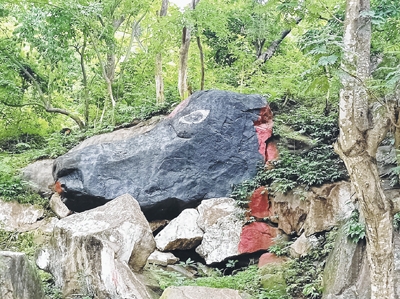
If you want proof of this battle, you need to go to Dirgheswari Temple in North Guwahati where the chopped off head of the buffalo demon is still lying, eyes wide open. The small temple is situated away from the hustle-bustle of Guwahati City in a peaceful and green surrounding. It lies just across Guwahati on the northern bank of the mighty River Brahmaputra. It can be reached either by the long-winding road (30 kms) or by ferry or rope car across Brahmaputra and then by road (5 kms). The second option (ferry or rope car) is not only shorter but also highly enjoyable and cheaper. Taxies/auto rickshaws for the package trip (to & fro + waiting) to Drigheswari temple are available on the northern side. With a tributary river running on one side, the short road trip is a pleasant one.
On landing the first sight that attracts the visitor is a rock resembling the head of a buffalo. ‘Here is the proof in solid rock’, I say to myself. Two tigers guard the archway at the foothill; after leisurely climbing some 50 or so steps another archway welcomes you, leading one into the temple complex. The second archway has an inscribed tablet and two small images (all painted gold). While climbing the steps one comes across a few statues on the rock face, created as bass relief/embossed sculptures; of these, the Ganesh statue is said to be the biggest statue of its kind in Assam (datable to Circa 100 to 1100 CE); a Hanuman statue is also seen besides Shiva&Shakthi, and a figure seated on an animal and holding a weapon.
As we enter through the second archway the small brick-built temple appears, painted saffron. The brick temple was built by the Ahom dynasty king Swargadeo Rajeswara Singha who ruled between Circa 1751 and 1769 CE. The Ahom Viceroy of Guwahati and Lower Assam, Tarun Duwarah Barphukan, supervised the construction work of this temple atop the Sitachal Hill that is made of solid rocks. These details are found in a stone inscription in the temple premises. If any temple of Goddess Durga already existed here during ancient and early medieval periods, it is not clear. The sanctum sanctorum (garbhagraha) is located underground, resembling a mini cave, as is the custom in many Assam temples. Our visit to the Dirgheswari temple coincided with the ‘Ambubachi Mela’ festival at Kamakya Temple in Guwahati. During Ambubachi Mela (which comes in June-July) it is the religious custom to close the sanctum sanctorum of most of the temples in Assam for three days and open only on the fourth day. So we could not darshan Goddess Dirghewari and seek her boon to kill all the present-day Mahishasuras; the priests were taking rest and chit chatting in the nearby mandap. The puja items like lamps, etc., were kept ready to be cleaned for the grand reopening of the garbagraha on the fourth day. We could, however, darshan a pair of footprints engraved on the rock floor near the temple, believed to be that of Goddess Dirgheswari.
Dirgheswari temple is locally considered as a Shaktapitha for worship of Goddess Shakti. But this temple is not listed among the primary 51 Shakti pithas located not only in various parts of India but also in Nepal, Tibet, Sri Lanka, Bangladesh, and Pakistan. Hence this temple on the Sitachal Hill could be a subsidiary Shakti peeth, with the Kamakhya Temple on the opposite Nilachal Hill regarded as a most venerated Shakti Pitha. Local devotees hail the Dirgheswari Mandir as the second-most holiest place only after Kamakhya Devalaya. It is believed that the great Hindu sage Markendaya performed a severe penance here towards Goddess Durga and was granted Her blessings. To obtain the full blessings of Devi Durga, one ought to necessarily visit Dirghe-swari Temple even after worshipping at Kamakhya Mandir. But not knowing this sacred rule we went the other way around – first Dirgheswari Temple and then Kamakya Mandir when it was reopened after Ambu-bachi Ceremony and the devotees’ crowd had considerably thinned. Yet it was so crowded that we could not enter the sanctum for a darshan. It was a double dhamaka disappointment for us.
The main attraction of Dirgheswari temple, naturally, is the annual Durga Puja celebrations (in September-October), when devotees throng to attend the puja celebrations. Hence one portion of the brick wall that was constructed during the Ahom reign had to be dismantled to accommodate the devotees. The highlight of Durga Puja here is the sacrifice of animals, befittingly the Buffaloes (mahish). I witnessed such a sacrifice in Darjeeling during the 1984 Durga Puja festivities which the Nepalis call as Dasain (as they celebrate it for ten days); the animal sacrifice is called ’maar’ (the killing). I being a pious vegetarian, the mass ‘maar’ was a revolting sight and I was forced to retreat from the battlefield of Maa Durga vs Mahishasura.
Though we could not have a darshan of Goddess Dirgheswari (unlike Sage Markendaya), we felt happy having just visited this green and serene spot; the rope car trip was a first of its kind unique experience for us. As a memento of our visit I thought of carrying off the head of buffalo demon Mahishasura but the pair of tigers guarding the archway put me off with its fierce eyes and sharp claws and teeth. So if you head to North Guwahati you can still see the head of Mahishasura lying at the foot of Dirgheswari Temple.
The writer can be reached at krishnanbala2004@yahoo.co.in