Japan’s surrender in Andaman Islands
07 Sep 2025 08:03:37
S Balakrishnan
2nd September 2025 marked a historical remembrance event in world history; 80 years ago it was on this day the 2nd September 1945 that Japan formally surrendered, thereby officially ending World War-II. A phase of this Japanese surrender happened on Indian soil also, thereby ending 3 ½ years of Japanese occupation of that territory. That part of India, for that matter the only part of India which was under Japanese rule was the Andaman & Nicobar Island Territory.
The Japanese forces captured Port Blair, the capital of A&N Islands that was part of the British colonial India, in the early hours of 23rd March 1942 without firing a single shot. The British administration had earlier deserted the islands knowing well that it was simply impossible to defend the remote island territory, because many South East Asian countries had already fallen to the Japanese forces. For the next 3 ½ years the abandoned people of the A&N Islands suffered untold miseries under the Japanese rule. Even though Netaji visited the Islands and even set up the Provisional Government of India (PGI), it was only an eye-wash by the Japanese. But that is a different and long story.
Coming to the surrender and end of Japanese occupation of the Islands, the news of Japan’s surrender reached the islands the very same day of 15th August 1945 itself. The British re-occupation forces, however, arrived only on 7th October 1945 and the islands changed hands once again without firing a single bullet. The British continued to rule the islands as before while negotiations were on for an independent India. In February 1946, the British appointed Mr Inamul Majid as Chief Commissioner of the Islands, the first Indian to hold such a post. He continued to be the Chief Commissioner for some years even after Indian independence on August 15, 1947.
Baldheads & Popcorn
The British operation to reoccupy the Islands was codenamed ‘Popcorn’ and the pre-occupational counter-intelligence activities were codenamed Baldheads. Major Denis McCarthy (who had previously been Superintendent of Police in the Andamans and had widely toured the islands to deal with the hostile activities of the aborigine Jarawa people) was commissioned to do the “Baldhead” operations in Andamans. McCarthy, along with a party of five, whom all had also served in the Andamans, successfully carried out ‘Baldhead I to V’ by setting up their base in Colombo in Ceylon (now Sri Lanka).
As per the commands of Admiral Lord Louis Mountbatten, the Supreme Allied Commander of South-East Asia Command, who took over the administration of the Islands on September 23 1945, Brigadier AJ Solomon commanded the 116th Indian Infantry Brigade and landed in Port Blair on October 7, 1945 to disarm the Japanese units and reoccupy the Island Territory. The landing troops took position at strategic places. Brigadier Solomon accepted the surrender of Japanese in the Islands in an informal way on the very same day of landing itself. Well, it was high time the bloody red sun descended and the ‘Popcorn’ popped up!
Meerankutti (who worked then as Warden in Cellular Jail and whom I interviewed in 1979) recollected that one night as he was going towards Cellular Jail for his night shift duty of warden there, he saw bright lights and buzzing activities in the Japanese camp situated little ahead of the Jail. In the days to follow, he said, planes dropped notices announcing dropping of atomic bombs on Hiroshima and Nagasaki in Japan. The notices further read that Japan was sure to be defeated. “But I neither dared to retain the notice nor open my mouth about it to anybody”, said Meerankutti, submerged in the fear-struck memories of those times. Sometime in the end of September 1945 came a large ship that stood beside Ross Island, he continued. The Japanese drove a speedboat towards it and brought back two white men; one among them, he remembered, had served as Chief Conservator of Forests during British times.
The Japanese were asked to handover a list of population. Later, each civilian was handed over a sack with two tins - one of rice and the other of various food stuffs. Clothing was also provided. Some people suffered of dysentery because they drank a good quantity of milk (powder) that was distributed by the British, because they had not even seen milk all those 3 ½ years, added Meerankutti with a dry grin.
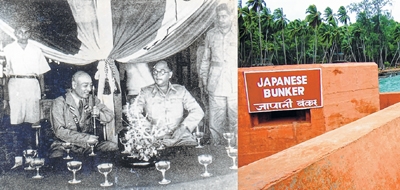
The formal ceremony of handing over of the A&N Islands by the Japanese to the British took place at about 10.45 am on October 09, 1945 at the tennis court of Andaman Club, beside Gymkhana Grounds in Port Blair. A big table was laid on the court and some chairs were also arranged. The Japanese were brought to the site in cars. “What a difference in the way of treating prisoners of war (POW) between the Japanese and the British!” exclaimed Meerankutti. “How meanly the Japanese had treated the British Chief Commissioner and other white men, and how gently they, in turn, were treated by the British!” he wondered. The Japanese were conducted to the table and Brig AJ Solomon, Commander of the 116th Indian Infantry Brigade, after inspecting the guard of honour, read out the Instrument of Surrender. It was signed on behalf of Japan by the Japanese Naval Commander stationed in the Islands, Vice-Admiral Toiso Hara, and the Army Commander, Major-General Tamenori Sato, and on behalf of the British Government by Brigadier AJ Solomon. The Japanese Commanders who had come there in full uniform surrendered their swords, stripped themselves of all their badges and decorations, saluted and marched off towards the vehicle with bowed heads. As the crowd that had gathered there to witness the momentous ceremony booed loudly, the car carrying the Japanese Commanders drove off. “The whole ceremony lasted hardly for three to five minutes”, said Meerankutti.
(To be contd)