In the face of modernization, charcoal trade hangs on
04 Jan 2026 23:51:27
Laishram Disinthui Singh
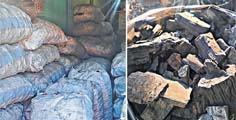
IMPHAL, Jan 4: In the narrow lanes of Imphal, among vegetable vendors and second-hand winter clothing stalls, is a trade that has quietly survived decades of change. There are no bright signboards or displays. Instead, there are blackened gunny sacks stacked by the roadside with dark dust sprayed on the ground, and sellers whose hands bear the marks of years spent handling fire for survival. This is the charcoal trade of Imphal. Traditional, demanding and slowly fading, but still holding on.
Locally known as “Meitan”, charcoal has long been an essential part of everyday life in Manipur, especially during the winter season. It warms homes during cold winters, cooks meals, and is used in many rituals.
Today, however, the trade stands at a crossroad, caught between modernization and environmental concerns.
In the charcoal market, the quality is clearly defined, not by branding or packaging, but by experience, weight, and colour. Sellers and buyers alike recognize two main types of charcoal-- Shahi Meitan and Ucham Meitan.
The Shahi Meitan is considered premium. It is superior in quality and often the preferred choice of many people.
It sells at Rs 1000 per bag. The charcoal is darker in colour, heavier in weight, and does not stain hands easily.
It burns more efficiently than the other charcoal, lasts long, and produces less residue (ashes).
It provides steady heat for a longer duration than other charcoal, and hence it is the preferred choice of many households that still rely on charcoal for heating and cooking during winter.
The Ucham Meitan, on the other hand, is considered to be slightly lower in quality. It is sold at Rs 850 per bag. This charcoal is light weight, greyish or dull black in colour, and easily stains the hands when touched.
It burns out quickly. Ucham charcoal is cheaper, and is often bought by customers who need charcoal only occasionally. It is also commonly used for small-scale purposes.
The quality of a charcoal is primarily decided by its weight and colour. Experienced sellers and buyers can easily identify quality with a single lift of the bag or by breaking a piece in their hand.
Contrary to popular belief, selling charcoal is not a high-profit business. Most charcoal products in Imphal are ordered in bulk by wholesalers and later distributed to small roadside stalls based on demand.
The wholesale price ranges between Rs 750 and Rs 800 per bag.
Retail selling price for Ucham is Rs 850 and that of Shahi is Rs 1000.
Retail sellers make a profit between Rs 50 and Rs 100 only per bag after deducting costs of transportation, storage and physical labour.
For many sellers, especially women, charcoal trade is not a choice made for profit but for survival.
The charcoal is brought to Imphal from the hills. Most of the charcoal comes from Churachandpur, Chandel, Ukhrul, Mao, Kamjong and other hill regions.
The charcoal-making process is labour intensive and time-consuming.
Trees are cut and chopped into chunks, and are stacked and buried under a thick pile of mud. The wood chunks are then burnt slowly under controlled conditions, with limited oxygen. After the burning, the pit is left to cool down.
After cooling down, the pit is dug out, and the pieces of charcoal are removed, dried, sorted, and packed into bags.
A woman charcoal seller in Imphal, with over 20 years of experience, reflects on the changing times, and said, “Due to the conflict in Manipur, some of the good suppliers from Churachandpur have stopped their supply. It has become very hard to get good quality charcoal."
She revealed how the conflict and instability in Manipur has directly affected small trades.
When supply routes are disrupted, quality drops, prices fluctuate, and sellers bear the burden.
Charcoal trading involves multiple middlemen. From the hills to Imphal, a product passes through several hands before reaching the final seller in Imphal.
Another seller explained that the presence of many middlemen increases costs.
The quality is found compromised often when the contact supplier isn't good or well established. Many sellers often receive bags with mixed charcoal inside (Shahi and Ucham). Such mixed charcoal doesn't sell well, added the seller.
Customer behaviour has also changed a lot, making the business hard to sustain, a woman seller said.
“Nowadays people don’t buy much charcoal. Even if they buy, they buy small bags of Rs 50 or Rs 100,” said the seller.
Large bags are increasingly seen as burdensome. It takes up space and people don't want to carry them, added the seller.
"Plus, most of the household nowadays are using electric heaters," the woman said.
While there is certainly a decline in the use of charcoal, many economically weaker households still use "Meiphu", a traditional charcoal furnace/heater, for heating and cooking during winter season.
The sale of charcoal saw a spike on the eve of Emoinu and New Year.
However, sadly for many small scale traders who depend on charcoal trade for survival, the spike in sales lasted only a few days.
The trade is without a doubt declining.
At a time when there is increasing concern about the impact of mass felling of trees on the environment, a reduced charcoal demand may ease pressure on forests. But, it also means loss of livelihood for communities that have depended on this trade for generations.
Meanwhile, there has emerged a new alternative to charcoal production-- using agricultural waste, ashes and organic materials.
This new alternative could reduce deforestation while preserving the utility of charcoal. However, such alternatives require policy support, training, and investment, which are currently limited.
Standing near a charcoal stall in Imphal, watching a seller carefully measuring and repacking charcoal into smaller bags, one would realize that this trade is not merely about fuel. It is about memory, endurance, and adaptation and survival.
Charcoal once symbolized warmth and sustenance. Today, it symbolizes resistance against disappearance.
Many who once worked in this trade have moved on to other trades, but there are also many who have remained in the trade quietly in absence of a sustainable alternative.
Whether charcoal has a future in Manipur depends on how the State balances environmental protection, cultural preservation, and economic justice.
For now, in the narrow streets of Imphal, the black sacks of “Meitan” remain a quiet witness to a trade slowly turning into history.