River currents dwindle to a trickle, water scarcity looms large
01 Feb 2026 00:24:49
By Our Staff Reporter
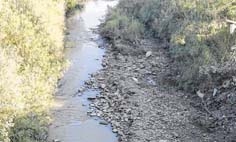
IMPHAL, Jan 31: The State is likely to face yet another spell of water scarcity as the flow of two major rivers in the valley, Imphal and Iril, have diminished significantly.
Climate change has greatly affected annual rainfall patterns in the State.
For the last many years, people of the State have consistently faced the issue of water shortage during the dry months from December to April/May.
A majority of the water supply schemes in the valley source raw water from rivers. When the river flow is reduced to a trickle, they are unable to supply tap water to the public. This problem has persisted for many years.
The same issue is rearing its head again.
The flow of the Imphal River and Iril River has tapered off in many places.
Under such circumstances, without any rainfall, some water supply schemes in the valley region may not be to provide water to the public in the coming days.
According to a report by the Directorate of Environment & Climate Change, 18 streams in the catchment area of the Imphal River merged to form the river, while 34 streams merged together to create the Iril.
When there is no water in these streams, it causes the rivers to dry up.
In the past, the streams had continuous water flow throughout the year. Thus, even with no rainfall, the rivers did not dry up as they were always fed by the streams.
Now, when these streams dry up there is a large decline in the flow of water in the rivers, especially without any precipitation.
Widespread deforestation and developmental works in catchment areas have affected springs, which are the primary source of streams, leading to drying up of rivers in the valley. Climate change also plays a big role in depletion of ground water which feeds the springs.
More than 52% of these springs in the State have dried up. In case of Nambul River, 36 springs out of around 96 in its catchment area have dried up.
In this connection, an official from the Directorate of Environment & Climate Change said that conservation of springs requires the cooperation of local residents.
In the past when the forests were lush with thick vegetation, the streams never dried up.
During rainfall, tree roots and soil prevent the water from running off and recharge the groundwater, which feeds the springs, the primary source of water for the streams, which then flow into the rivers. The water stored underground ensures that rivers do not dry up even during prolonged dry spells, said the official.
The drying up of rivers is due to aquifer (an underground layer of permeable rock, gravel, sand, or silt that stores and transmits groundwater) depletion.
The problem of water scarcity can be solved when the issue of aquifer depletion is adequately tackled.
This requires concrete efforts to rejuvenate springs such as rainwater harvesting, which increases groundwater recharge, he maintained.